














Le Verdict
DUMPLINGS. Une ancienne actrice de télévision, voyant apparaître les premières rides et pour reconquérir son mari infidèle, décide de demander de l'aide à tante Mei, célèbre pour ses "particuliers" raviolis au pouvoir rajeunissant.
DUMPLINGS. Une ancienne actrice de télévision, voyant apparaître les premières rides et pour reconquérir son mari infidèle, décide de demander de l'aide à tante Mei, célèbre pour ses "particuliers" raviolis au pouvoir rajeunissant.
COUPE. Un jeune réalisateur talentueux, à son retour chez lui, est séquestré par un fou qui avait travaillé comme figurant dans ses films. Le ravisseur a également enlevé et attaché la femme du réalisateur et une enfant, posant à l'homme un choix terrifiant : soit il tue l'enfant inconnue, soit le ravisseur couper un doigt toutes les cinq minutes à la femme du réalisateur.
BOÎTE. Une écrivaine est tourmentée par le sentiment de culpabilité d'avoir causé involontairement la mort de sa sœur jumelle il y a de nombreuses années.
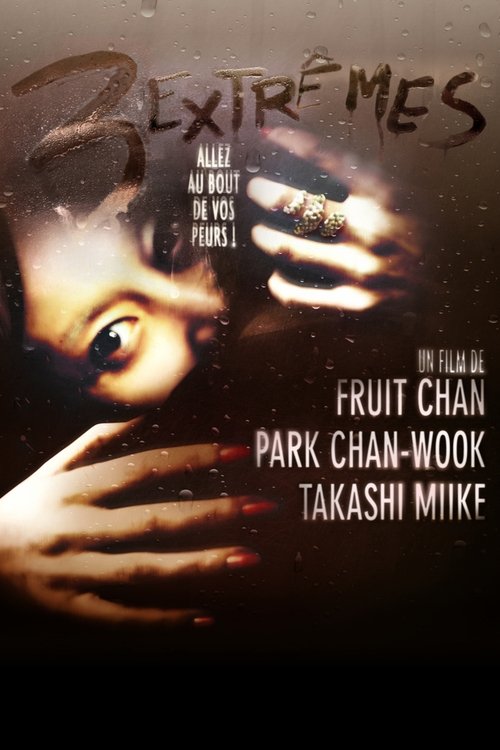
"Three…Extremes" se présente comme une tentative de réunir les traditions de trois pays d'Orient (Chine, Corée et Japon) à travers le langage commun du cinéma de genre en épisodes et tout cela est réalisé par trois réalisateurs de talent indéniable et une autorité remarquable dans le domaine cinématographique, deux d'entre eux ayant réussi à se faire connaître et apprécier dans notre pays ; il s'agit de Chan-wook Park ("Old Boy", "Lady Vengeance"), Takashi Miike ("The Call", "Audition") et le moins connu Fruit Chan.
Il faut immédiatement dire que "Three…Extremes" n'est pas une opération réussie car l'union de trois réalisateurs autorisés dans une opérette aux connotations commercialement marquées n'a pas donné de bons fruits : chaque épisode est complètement submergé par le désir des réalisateurs respectifs de se prouver auteurs et de montrer au public à quel point ils sont bons. Clarifions, ce n'est pas un défaut de vouloir mettre en avant des qualités artistiques indéniables de la part des réalisateurs impliqués, mais l'idéal serait de doser la technique et de ne pas la placer au-dessus de tout autre élément, car en faisant cela, le film manque de participation émotionnelle et se révèle d'une froideur et d'une hermeticité parfois déconcertante. Il est impossible pour le spectateur de s'identifier aux différents personnages et de se laisser emporter par les événements mis en scène car l'écart émotionnel entre la représentation et la représentation est trop évident et on ne parvient pas à créer cette empathie particulière qui devrait obligatoirement être à la base de tout processus de feedback émotionnel.
Mais venons aux histoires. "Dumplings" est réalisé par Fruit Chan, un réalisateur étranger au genre horreur qui nous fournit pourtant l'histoire la plus horrifique, cruelle et politiquement incorrecte du triptyque. Il s'agit d'une histoire hautement pessimiste qui montre jusqu'où l'individu contemporain est prêt à aller pour se conformer et être accepté par une société fondée sur l'apparence ; le tout est agrémenté de thèmes cannibales et incestueux. L'histoire en elle-même semble particulièrement originale et les acteurs se montrent tout à fait à la hauteur, mais en plusieurs points, on peut noter une précipitation excessive, dictée naturellement par les temps restreints pour un film en épisodes, et une fin coupée exempte d'une réelle conclusion, qui laisse un léger goût amer dans la bouche du spectateur. "Dumplings" aurait certainement mérité une plus grande attention et aurait peut-être pu faire tranquillement l'objet d'un long métrage.
"Cut", de Chan-wook Park, est l'histoire la plus classique (et probablement la meilleure) parfaitement en phase avec le temps que le moyen métrage exige ; le réalisateur se divertit avec une série de mouvements de caméra suggestifs et de cadrages recherchés et ne nous épargne pas non plus une certaine dose d'atrocité et de parenthèse splatter. Pourtant, l'ensemble de l'épisode s'éclipse sur lui-même dans une conclusion grotesque et caractérisée par un hermétisme excessif.
"Box", bien que réalisé par un excellent réalisateur comme Miike, s'avère être l'épisode le plus mauvais ; très éloigné des canons de l'horreur et rempli d'une série d'éléments d'une présomption parfois ennuyeuse, il se distingue par une lenteur exaspérante, un manque de climax final et une pauvreté narrative plutôt inhabituelle si on la compare aux épisodes précédents. Tout repose sur la bonne photographie et les excellentes qualités de réalisation de Miike, aux prises avec une petite histoire prévisible et exempte d'une réelle idée de base.
Par le passé, on avait tenté de réunir plusieurs auteurs sous le toit du film à épisodes, on se souvient de la collaboration entre Carpenter et Hooper dans "Body Bags", Vadim, Malle et Fellini dans "Trois Pas dans le Délire" ou Romero et Argento dans "Deux Yeux Diaboliques", mais dans tous ces cas, on a eu un résultat bien loin de celui atteint avec "Three…Extremes", grâce à une plus grande capacité à conjuguer technique et spectacle ; dans "Three…Extremes", on a simplement une petite œuvre sur commande, exemple académique de maîtrise cinématographique indéniable, mais incapable d'impliquer le spectateur ou de laisser en lui une quelconque émotion qui se prolonge au-delà de la vision.
Commentaires
Commentaires (0)




Commentaires