


The Verdict
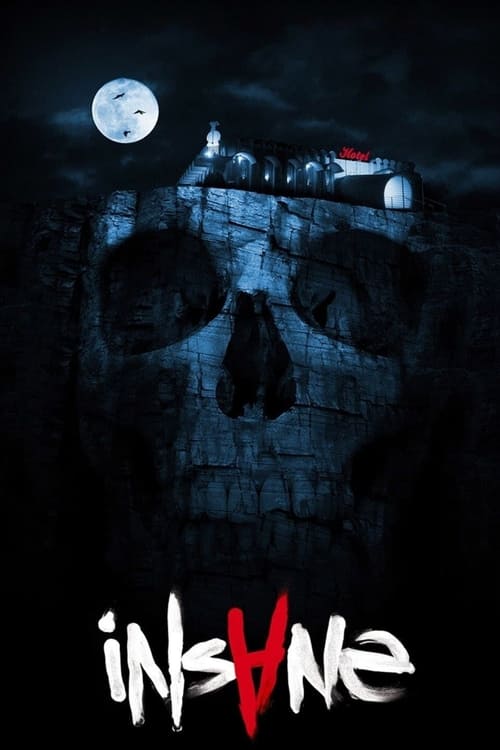
Sarah is looking for her sister Jenny, who disappeared without a trace during a trip. Following the girl's footsteps, Sarah arrives at a motel, the last place visited by Jenny before she vanished, and decides to stay there.
Sarah is looking for her sister Jenny, who disappeared without a trace during a trip. Following the girl's footsteps, Sarah arrives at a motel, the last place visited by Jenny before she vanished, and decides to stay there. But a mysterious individual with a raincoat and a gas mask on his face roams the building's rooms, reaping victims.
In these latest years, the Scandinavian peninsula has been spoiling us with a series of absolutely high-quality genre films that seem to breathe new life into a landscape often monopolized by remakes and recycled ideas. But not everything that comes from Northern Europe is called "Let Me In" or "Sauna," but there is also the "Insane" of the moment that comes to balance the parts, between the good and the bad that naturally alternate in every sector.
Fourteen years after his first film, the metacinematographic splatter "Evil Ed," director Anders Jacobsson returns behind the camera accompanied by the debutant Tomas Sandquist to bring to life this low-value film titled "Insane."
We are faced with a low-budget work that shows it a bit from all points of view, but the fundamental problem lies rather in the scarcity of ideas that underpins this work. Dear Jacobsson, if you return to direct a film after almost three decades and, surely, not without production difficulties, one would expect that you at least have in your hands a story that is really worth telling! And instead, what do we find? A clone of "Psycho" structured as an American slasher, with a masked killer and voluptuous, half-naked victims who flee screaming through the hallways. Is that all? Yes, that's all, with good peace of the long wait.
And what is most surprising is that to write the screenplay for "Insane" it took five people. Not two or three, which are already many, but five, a bit like they do for our Christmas comedies... and from national experience, we know that all this crowd to sign a script is not a synonym for qualitative success. Practitioner Jacobsson and Sandquist do nothing but follow in a rather meticulous way the narrative structure of the aforementioned Hitchcock masterpiece: it begins with a protagonist who arrives at an empty and isolated motel and that after about twenty minutes we discover is not the true protagonist because someone, whose identity is well concealed but whom we have all immediately recognized, kills her. Then the true protagonist enters the scene, the sister of the first, accompanied/reached by the boyfriend (who here is a colored bully with the expressiveness of a medlar), who, investigating, stays precisely in the motel where the victim disappeared. But it does not end here, because there is also an investigator on the trail of the disappearance. Déjà-vu?
However, the reinterpretation of "Psycho" follows this time the rhythm and the simplistic development of the slasher movie, with all the hallmarks of the genre, from the killer's look to his weapons (white), from the vocation for action to the concessions to extreme gore. The killer wears a gas mask to conceal his identity and a long black raincoat, uses knives and hooks, moves and acts like the killer of "Scream" and on one occasion also enjoys torturing a victim, just to wink at the fashion of the moment called torture porn.
Therefore, really nothing worth mentioning in a conceptually old and tired work like this, except for a certain merit that must be recognized to the direction, on more than one occasion enhanced by some pleasant camera movements that remind a bit of Kubrick.
Suitable only for nostalgics of Norman Bates and slasherophiles in the final stage.
Rounded down rating.
Comments
Comments (0)








Comments