
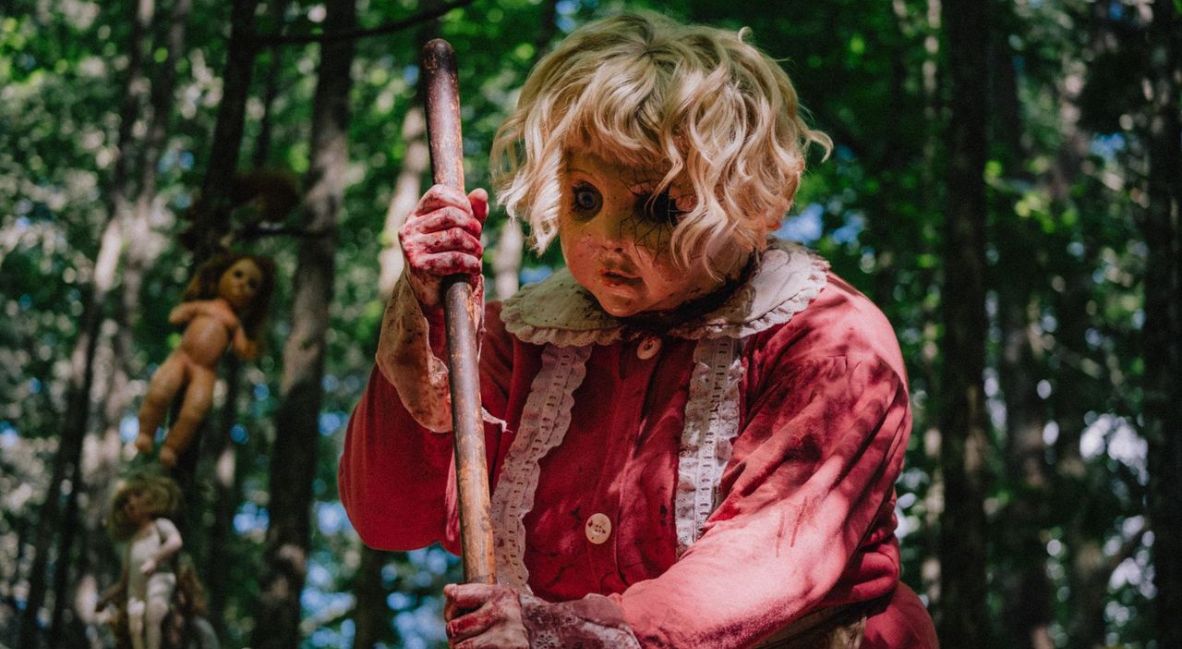

The new independent horror film "Dolly", directed by Rod Blackhurst, hit U.S. cinemas on March 6, 2026, and in just a few days has become one of the most talked-about titles among genre fans. The film follows the story of Macy, a young woman who, during a romantic getaway with her boyfriend, is kidnapped by a disturbing figure dressed as a doll. The creature wants to transform her into his "daughter," bringing to life a claustrophobic nightmare that blends slasher and psychological horror.
The plot begins with a seemingly simple premise: Macy and her boyfriend Chase are spending a few days in an isolated forest area, where he intends to propose to her. The romantic escape quickly turns into tragedy when they are attacked by a mysterious masked figure. Macy is kidnapped and taken to a decaying house full of toys and children's objects, where the creature known as Dolly wants to "play" with her as a child would with their favorite doll.
One of the most unsettling elements of the film is the design of the villain. Dolly appears as a giant human doll with a broken porcelain mask and childlike behavior that alternates between moments of apparent innocence and sudden bursts of violence. The character is played by the non-binary wrestler Max the Impaler, a choice the director made to give the character a physically imposing and almost surreal presence. In the film, the creature speaks very little and communicates mostly through gestures, sounds, and unsettling movements.
Stylistically, Blackhurst has stated that he drew inspiration from the dirtiest and most brutal horror films of the 1970s. The grainy photography, isolated locations, and sudden violence clearly recall classics like The Texas Chain Saw Massacre, while the limited use of digital effects helps give the film a rawer, more realistic look. The stated goal was to create a horror that is physically disturbing and viscerally uncomfortable for the viewer.
An interesting curiosity is that the project originated from a 2022 short film titled "Babygirl", made by the same director. The short film attracted attention at independent film festivals and led to the development of the feature-length film, expanding the story and delving deeper into the character of the creature. Despite the transition to the longer format, the production has remained deliberately low-budget, maintaining the artisanal approach and aesthetic typical of American indie horror.
Early reactions from American critics are quite mixed. Some reviewers have praised the film for its return to a cruel and uncompromising slasher, while others find it too derivative and tied to past models. Either way, "Dolly" seems to have achieved its main goal: making people talk and dividing the audience, which often becomes the best fuel for the success of an independent horror film.
What makes the film even more discussed are some audience reactions during early screenings. Several commentators have noted that particularly graphic sequences have caused strong discomfort among viewers, with some even referring to scenes as "hard to watch." Whether these are marketing exaggerations or a genuine shock for the audience, one thing is certain: "Dolly" is quickly becoming one of those small horror films destined to be remembered by genre fans.
Comments