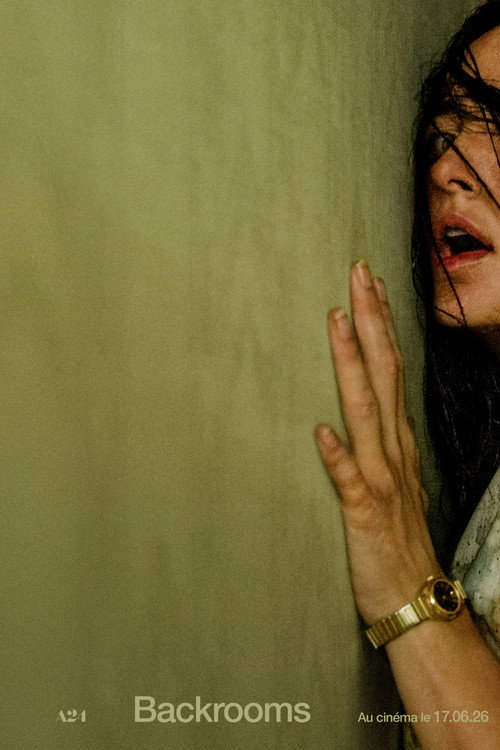















Backrooms poster

BACKROOMS

2026 • US HMDB
mai 27, 2026

Une étrange porte apparaît dans le sous-sol d'un magasin de meubles.

Réalisateurs

Distribution

👍 👎 🔥 🧻 👑

Commentaires

Commentaires (0)
Equipe

Production: Shawn Levy (Producer)Dan Cohen (Producer)Judson Scott (Executive Producer)Christopher White (Executive Producer)Dan Levine (Producer)James Wan (Producer)Michael Clear (Producer)Roberto Patino (Producer)Kori Adelson (Producer)Chris Ferguson (Producer)Osgood Perkins (Producer)Jesse Savath (Executive Producer)Jenno Topping (Producer)Peter Chernin (Producer)
Scenario: Will Soodik (Writer)
Musique: Edo van Breemen (Original Music Composer)Kane Parsons (Original Music Composer)
Photographie: Jeremy Cox (Director of Photography)

CRITIQUES (1)

Roberto Giacomelli •
Des salles impossibles aux murs anonymes, éclairées par des néons aseptisés, des objets partiels enchevêtrés et empilés selon une logique tordue, des entités qui sont la synthèse grotesque d'autre chose. Avec Backrooms, le jeune cinéaste Kane Parsons trouve une intuition brillante, réalisant peut-être la représentation cinématographique la plus troublante et concrète du concept d'Intelligence Artificielle jamais vue au cinéma. Mais pour vraiment comprendre Backrooms, il faut remonter à internet. Cet énorme inconscient collectif numérique qui a transformé une image apparemment innocente en l'une des creepypastas les plus célèbres du web. Le phénomène naît d'une photo postée en ligne en 2019 : un bureau vide, jaunâtre, infini, accompagné de l'idée terrifiante que, en « quittant la réalité de la mauvaise façon », on puisse se retrouver dans un espace liminaire sans issue. De là naît le mythe des « Backrooms », des environnements suspendus entre le familier et l'étrange, des lieux de transition vidés de toute humanité. Le jeune Parsons – connu en ligne sous le nom de Kane Pixels – transforme cette idée en une série de vidéos found footage postées sur YouTube à partir de 2022 (vous trouverez sa chaîne ici), devenues virales grâce à leur capacité à évoquer la peur avec très peu d'éléments. Le terme « creepypasta » désigne des récits d'horreur diffusés en ligne sous forme virale, des légendes urbaines numériques modernes. Les « Backrooms », en revanche, s'appuient sur le concept d'« espace liminaire » : des lieux conçus pour le passage – couloirs, bureaux, salles d'attente – qui, vidés de la présence humaine, deviennent soudainement troublants. Parsons a construit tout un univers visuel sur cette sensation de malaise abstrait, jusqu'à faire le saut au cinéma produit par A24 en collaboration avec Atomic Monster de James Wan. Le film raconte l'histoire de Clark, architecte raté et propriétaire d'un entrepôt de meubles, ruiné économiquement et revenant d'un mariage échoué. En thérapie avec la psychologue Mary, une femme marquée par le traumatisme de la maladie de sa mère, Clark découvre que sous-sol de son magasin existe un portail vers une dimension impossible : un labyrinthe infini de salles vides, de couloirs identiques et d'environnements apparemment dépourvus de logique. Obsédé par cette découverte, l'homme décide d'explorer toujours plus profondément cet espace, jusqu'à disparaître mystérieusement. C'est Mary qui se lancera à sa recherche, comprenant que ce que Clark racontait était réel et infiniment plus dangereux qu'elle ne pouvait l'imaginer. Dans les vidéos originales, Parsons utilisait le found footage situé dans les années 1990, parlant de fissures dimensionnelles et du mystérieux « Projet KV31 », laissant beaucoup à l'imagination. Le film, en revanche, tente une interprétation plus stratifiée et étonnamment contemporaine du phénomène. Les Backrooms deviennent en effet une extension du subconscient de celui qui les traverse : un espace qui assimile les souvenirs, les peurs, les détails personnels et les restitue sous une forme altérée. Et c'est là que le film devient vraiment fascinant. Parce que les Backrooms semblent fonctionner exactement comme une intelligence artificielle. Elles absorbent les informations, les stockent, les traitent et les restituent de manière synthétique et déformée. Comme une IA qui tente de recréer quelque chose qu'elle n'a jamais vraiment vécu. Les environnements semblent alors « presque justes », mais erronés dans les détails ; les créatures ressemblent à des imitations imparfaites de l'être humain et ont une apparence qui semble être une synthèse entre l'imaginaire de Clive Barker et celui de David Lynch ; les espaces rappellent des salles réelles mais fusionnées ensemble sans en comprendre le vrai sens. C'est le célèbre « dessin du chien fait par quelqu'un qui n'a jamais vu de chien ». Interprété sous cet angle, Backrooms devient un horror extrêmement puissant sur le traitement artificiel de l'expérience humaine. Et c'est peut-être précisément cela qui le rend si troublant. D'un point de vue visuel, Parsons démontre un talent extraordinaire. Il n'est pas surprenant qu'Hollywood se soit aperçu de lui alors qu'il était encore adolescent. Le film utilise continuellement le langage analogique des années 1990 des vidéos, créant un court-circuit fascinant avec le thème de l'IA : VHS, caméras usées, found footage, images dégradées. Tout contribue à donner la sensation de regarder quelque chose qui ne devrait pas exister. Et quand il s'agit de construire la tension, Parsons frappe fort. Le problème est que Backrooms porte en lui sa nature originelle de court-métrage viral. On sent que le concept naît de fragments narratifs et de l'accumulation de suggestions visuelles, et quand il doit tenir la durée d'un long-métrage, le film tend à se disperser. Toute la composante psychologique et psychiatrique liée aux personnages interprétés par Renate Reinsve et Chiwetel Ejiofor apparaît souvent redondante et n'est pas vraiment utile au développement narratif. Le vécu traumatique de Mary n'ajoute presque rien au cœur du récit, tandis que l'évolution de Clark s'avère trop abrupte pour être vraiment crédible. Parsons semble vouloir donner aux personnages une profondeur « adulte » et auctoriale, mais le vrai protagoniste du film reste le concept même des Backrooms. Ce sont ces couloirs infinis, ces salles silencieuses, ces vides géométriques qui fonctionnent vraiment. Quand le film se concentre sur cela, il devient hypnotique. Malgré quelques longueurs et une écriture encore inachevée, Backrooms reste une œuvre originale, troublante et étonnamment intelligente. Un horror qui naît d'internet presque comme un jeu mais réussit à parler parfaitement des peurs contemporaines, transformant l'angoisse numérique en expérience cinématographique. Et peut-être que c'est précisément cela la chose la plus troublante : l'idée que les Backrooms existent déjà. Sauf qu'aujourd'hui on les appelle des algorithmes.
👍 👎 🔥 🧻 👑

Commentaires

Commentaires (0)

Critiques d'Influenceurs

AVIS DE LA COMMUNAUTÉ (5)

James Berry

James Berry

Given how many endless, empty geometric hallways our main character had to wander through, having Justin Long’s character from Barbarian pop up with a tape measure to calculate the square footage would have genuinely made this a 5-star masterpiece.

Backrooms completely nails the atmosphere in the first half. The grainy, handheld "home video" style shots build an insane amount of tension, and making the entire environment harsh and well-lit instead of hiding in the dark is a brilliant way to capture that pure, unsettling liminal space dread. The sound design is heavy and unrelenting, but the editing kills the momentum in the second half. The audio masterfully amps up your anxiety to a 10, but the actual visual reveals completely flatten out and fail to deliver on the build-up. Still, it's a solid watch on a big screen.

Brent Marchant

4 /10

Anointing a young, first-time big screen director as the new filmmaking messiah of his or her particular genre is a risky undertaking, to be sure. Does the fledgling auteur have what it takes to live up to that auspicious title? Is this an ordination that’s truly warranted? It’s serious business, both for box office tallies and artistically speaking. But does the heir apparent truly possess the skills, talent and vision to achieve success on both fronts? That’s something worth considering in light of the debut feature from writer-director Kane Parsons, the force behind this aspiring smart horror release, which is quickly being praised to the hilt and drawing huge numbers in ticket sales. However, I believe that the coronation of this new voice in the genre is far from deserved and entirely premature. While it’s true that Parsons has a keen eye for the aesthetic, that’s only half the challenge when making a movie in virtually any genre. The other part – being an effective storyteller – needs work (and a lot of it). Based on a YouTube adaptation of his immensely popular internet TV series The Backrooms, the film follows a troubled (and largely unsuccessful) seller of cheap furniture, Clark (Chiwetel Ejiofor), who’s experiencing difficulties in his personal life and professional calling. His failed marriage and inability to make use of his training as an architect have led him to seek counseling from a high-profile therapist, Dr. Mary Kline (Renate Reinsve). His progress takes a drastic turn, though, when he finds a maze of what appears to be a collection of office suites adjacent to his store’s basement – a discovery he makes by somehow walking through one of its walls. The spaces are seemingly devoid of people but haphazardly strewn with various items from his life, including his past. Has he stepped into a corporeal manifestation of his psyche? An alternate reality? Or something else entirely? That’s what he hopes to learn with the unexpected help of his skeptical shrink. And what will that be? The film’s opening half capably sets the scene, creating a legitimately sinister sense of creepiness. However, about midway into the picture, it becomes repetitive and directionless, as if it’s searching for what to do next. That’s where this offering goes off the rails, turning inexplicable, underdeveloped and outright goofy at times. The alleged scariness of this would-be psychological thriller vanishes, turning tedious, silly and more laughable than frightening. And a last-ditch effort to take the narrative in a redemptive direction involving a mysterious scientific research organization only muddies the waters further, doing little to salvage what has already fallen apart. Many have likened this release to a video game with a protagonist trying to solve the puzzle of the story. Others have said that it’s full of nuanced references to the YouTube series, although that would require an intimate knowledge of the source material to fully appreciate it. And others still have postulated a host of other interpretations given the inherently vague nature of the finished product. For my money, even though it starts out well, it turns into an incoherent cinematic mess that fails to hold attention and left me sighing a big “So what?” What became most apparent to me while sitting through this is just how difficult it is to create an engaging smart horror film, a genre I enjoy immensely but has been plagued by more failures than successes, with this one being yet another entry on that list of disappointments. Indeed, don’t be too quick to reach for that crown just yet. If the filmmaker hopes to assume that title, he’s still got his work cut out for him, beginning with an urgent need to get out of his own “Backrooms.”

jamesstocks14

8 /10

New unofficial Christmas movie unlocked. Far more complex than I thought it was going to be, especially considering it was a combination of trauma based creatures and a touch of sci-fi uncertainty. Overall a good watch, and incredibly impressive from such a young creative mind.

JPV852

JPV852

7 /10

Well, that was interesting. This is a well made horror-drama released by A24 that, to my surprise, nabbed $81 million in its opening weekend. Both Chiwetel Ejiofor and Renate Reinsve give solid performances and while a few moments lost my attention, there are few great scenes particularly towards the end. Don't know where the hype came from but good for this (and Obsession) for capturing the mainstream audiences. 3.75/5

CinemaSerf

CinemaSerf

6 /10

Hmmm. Perhaps I just wasn't in the mood, but I really didn't get what the fuss was about with this. "Clark" (Chiwitel Ejiofor) is a recently divorced man who has big dreams but who is reduced to running (and sleeping in) his cheap and cheerful "Ottoman Empire" furniture emporium in small town America. The electrics in his store start playing up and upon investigation he is intrigued by a glimmer of light that appears to be emenating from beneath the basement wall! Investigating, he discovers that there is a mysterious portal into a construction that has something of an Escher drawing straight from the mind of Lewis Carroll to it. He tries to explain this discovery to his sceptical therapist (Renate Reinsve) but she thinks he's lost the plot so he engages the help of two of his employees "Kat" (Lukita Maxwell) and her boyfriend "Bobby" (Finn Bennett) to film his next exploration - and that's when they discover that all in this new dimension is not so very friendly. Meantime, his shrink "Mary" makes a visit to her patient's showroom only to discover the same portal. Is she going to be daft enough to walk through the wall into the unknown? There is some attempt made at the end to tie up the spurious threads but for the most part I found this to be really quite a dull and unmenacing affair that is hand-held filmed in a style of "Blair Witch" to try and immerse us in it's mystery but that more often than not relies on increasingly hysterical dialogue and a great deal of beige paint to create some sense of menace. Kane Parsons presided over a decent idea for about twenty minutes, but thereafter is all just fizzled out into a repetitious short-story of a film that I felt was overstretched.

Avis fournis par TMDB