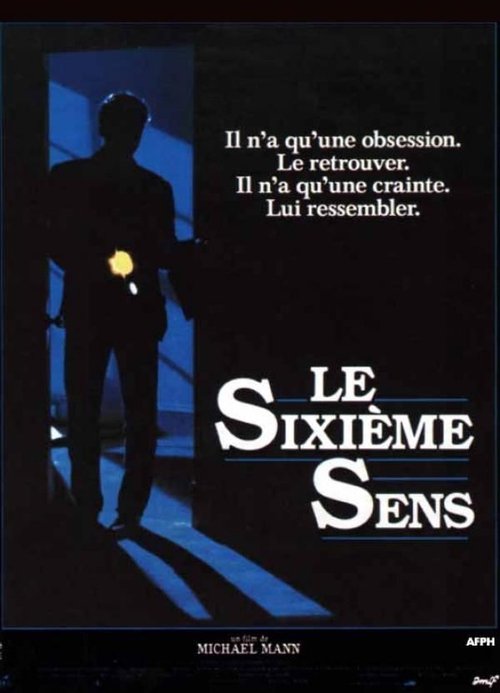




Le Sixième Sens backdrop
Le Sixième Sens poster

LE SIXIÈME SENS

Manhunter

1986 US HMDB
août 14, 1986

Will Graham est un des experts-légistes les plus habiles du F.B.I. Il excelle dans l'art de reconstituer à partir d'éléments quasiment inexistants le profil d'un assassin. Mais son "sixième sens" lui a valu de frôler plusieurs fois la mort. Alors qu'il est retiré depuis trois ans, un ancien collègue, Crawford, vient le relancer pour une affaire qui s'annonce complexe : deux paisibles familles de Birminghan et Atlanta ont été, à un mois d'intervalle, sauvagement massacrées par un "tueur de la pleine lune".

Réalisateurs

Distribution

👍 👎 🔥 🧻 👑

Commentaires

Commentaires (0)

Equipe

Production: Richard A. Roth (Producer)Dino De Laurentiis (Executive Producer)
Scenario: Michael Mann (Screenplay)
Musique: Michel Rubini (Original Music Composer)The Reds (Original Music Composer)
Photographie: Dante Spinotti (Director of Photography)

CRITIQUES (1)

Vanessa Reggiani
Pendant les nuits de pleine lune, des meurtres étranges sont commis. Un tueur en série, auquel la presse attribuera bientôt le nom de Dente di Fata (Tom Noonan), s'amuse à massacrer des familles heureuses. Pour ce cas difficile, l'agent Will Graham (William Petersen), qui s'était retiré après un désagréable affrontement avec le cannibale docteur Leckter (Brian Cox), sera également sollicité. C'est pourtant de ce dernier, enfermé dans un hôpital psychiatrique, que l'agent cherchera de l'aide pour résoudre l'affaire. Le réalisateur, également scénariste avec Walon Green, réalise un film peu cru, dans la mesure où l'on ne voit jamais la violence explicite sur les victimes, mais aux atmosphères indéniablement sombres et surréalistes. Intrigante, par exemple, l'insolite histoire d'amour entre le tueur et la fille aveugle interprétée par Joan Allen. L'une des scènes entre les amoureux nous montrera, par exemple, elle buvant un verre et lui à ses côtés regardant morbidement les films de ses futures victimes. En général, dans ce film, les personnages sont fortement caractérisés, à commencer par Dente di Fata, sombre et mystérieux, Will, impatient de prendre le tueur mais effrayé en même temps vu les antécédents, et le docteur Leckter, criminel d'intelligence inimaginable qui se fond avec la folie cannibale. Tout le film entremêle le bien et le mal, les faisant passer même entre le bien fou et le mal fou. Le bien absolu étaient les familles heureuses vivant dans de belles petites maisons blanches et bien ordonnées, le mal absolu est Dente di Fata au visage sombre et avec une maison tout aussi sombre. Les deux personnages qui se trouvent au milieu sont l'agent Will Graham qui est du côté du bien mais qui n'est pas sans faute puisqu'il a tué un homme dans le passé, et le docteur Leckter, du côté du mal mais qui aide, si l'on peut dire, en partie à la résolution de l'affaire. Manhunter, réalisé avant le célèbre "Le Silence des Agneaux", nous offre la première apparition du docteur Leckter. Vraiment dommage que cette figure ait eu un si petit rôle dans toute l'histoire. Ce petit rôle restera pourtant dans l'esprit, en effet dans le film suivant qui le verra en scène, son personnage sera nettement élevé en importance et en style, donnant à "Le Silence des Agneaux" une touche de beauté et de folie en plus par rapport à Manhunter. De plus, le rôle interprété par Cox sera repris par Hopkins qui le revêt élégamment et de manière sûrement plus appropriée, au point que Hopkins deviendra le visage par excellence du docteur. Il est obligatoire de comparer avec "Red Dragon", préquel de "Le Silence des Agneaux" et "Hannibal", et également remake de Manhunter. Les deux se ressemblent beaucoup en ce qui concerne l'intrigue, à l'exception de quelques séquences dans certaines scènes et de la fin, que j'ai personnellement trouvée plus belle dans Manhunter. En effet, les dernières séquences, même si un peu prévisibles, sont plus impressionnantes grâce à l'atmosphère qu'elles créent, par rapport à celles de "Red Dragon" centrées surtout sur l'action. Il faut toutefois souligner que le film de 1986 est nettement plus lent que "Red Dragon", donc pour certains, il pourrait perdre un peu de valeur vu les habitudes cinématographiques américaines des dernières années. Tiré de "I delitti della luna rossa" de Thomas Harris et accompagné magnifiquement par les musiques de The Reds, ce thriller a donné le coup d'envoi à une saga fantastique et pour cela seulement, il mérite d'être noté. Recommandé.
👍 👎 🔥 🧻 👑

Commentaires

Commentaires (0)

Où Regarder

Louer

Amazon Video Amazon Video
CG tv CG tv

Acheter

Amazon Video Amazon Video

AVIS DE LA COMMUNAUTÉ (2)

John Chard

John Chard

10 /10

Recover the mindset.

Retired FBI specialist Will Graham is lured back into action to track a serial killer who is killing families, seemingly linked into the lunar cycle. In the process it opens up some old mental wounds that were born out during his last action out in the field...

Before the gargantuan success of Silence of the Lambs, where the name Hannibal the Cannibal moved into pop culture, and before director Michael Mann became a named auteur often referenced with relish by hungry film students; there was Manhunter, Michael Mann's brilliant adaptation of Thomas Harris' equally brilliant psychological thriller, Red Dragon. It feels a bit redundant now, years later, writing about Mann's use of styles to bear out mood and psychological states, his framing devices, his commitment to his craft, but after revisiting the film on Blu-ray, I find myself once again simultaneously invigorated and unnerved by the magnificence of Manhunter. Visually, thematically and narratively it remains a clinical piece of cinema, a probing study of madness that dares to put a serial killer and the man hunting him in the same psychological body, asking us, as well as William Petersen's FBI agent Will Graham, to empathise with Tom Noonan's troubled Tooth Fairy killer. Here's a thing, too, Francis Dolarhyde (The Tooth Fairy) is a functioning member of society, he is quite frankly a man who could be working in a shop near you! This is no reclusive psychopath such as, well, Buffalo Bill, Dolarhyde is presented to us in such a way as we are given insight into this damaged mind, he is fleshed out as a person, we get to know him and his motivational problems.

Dream much, Will?

Mann and his team are not about over the top or camp performances, gore is kept to a premium, the real horror is shown in aftermath sequences, conversations and harmless photographs, but still it's a nightmarish world. Suspense is wrung out slowly by way of the characterisations. Will has to become the killer, and it's dangerous, he knows so because he has done it before, when capturing Dr. Hannibal Lecktor. Needing to pick up the scent again, to recover the mindset, Will has to go see the good doctor who has a penchant for fine wines and human offal. These scenes showcase Mann at his deadliest, a bright white cell filmed off kilter, each frame switch showing either Lecktor or Graham behind bars, they are one. When Lecktor taunts Will about them being alike, Mann understands this and visually brings it out. Dolarhyde's living abode is murky in colour tones and furnished garishly, and with mirrors, paintings and a lunar landscape, yet when Dolarhyde is accompanied by Joan Allen's blind Reba, where he feels he is finally finding acceptance, this house is seen at ease because of the characterisations. Switch to the finale and it's a walled monstrosity matching that of a killer tipped back over the edge. Brilliant stuff.

If one does what God does enough times, one will become as God is.

Lecktor, soon to be back as the source material Lecter in the film versions that follow, is actually not in the film that much. Brian Cox (chilling, calculating, frightening and intelligent) as Lecktor gets under ten minutes of screen time, but that's enough, the character's presence is felt throughout the picture in a number of ways. The Lecktor angle is very relative to film's success, but very much it's one strand of a compelling whole, I realise now that Mann has deliberately kept us wanting more of him visually. Noonan is truly scary, he lived away from the rest of the cast during filming, with Mann's joyous encouragement, the end result is one of the best and most complex serial killer characterisations ever. Lang scores high as weasel paparazzi, Allen is heart achingly effective without patronising blind people and Farina is a huge presence as Jack Crawford, Will's friend and boss who coaxes Will back into the fray knowing full well that Will's mind might not make it back with him. But it's Petersen's movie all the way. His subsequent non film career has given ammunition to his knockers that he is no great actor. Rubbish, with this and To Live and Die in L.A. he gave two of the best crime film portrayals of the 80s. He immerses himself in Will Graham, so much so he wasn't able to shake the character off long after filming had wrapped. There's a scene in a supermarket where Will is explaining to his son about his dark place, where "the ugliest thoughts in the world" live, a stunning sequence of acting and a showcase for Petersen's undoubted talents.

Newcomers to the film and Mann's work in general, could do no worse than spend the ten minutes it takes to watch the Dante Spinotti feature on the disc. Apart from saving me the time to write about Mann's visual flourishes, it gives one an idea of just how key a director and cinematographer partnership is in a film such as this. The audio is crisp, which keeps alive the perfect in tone soundtrack and eerie scoring strains of Rubini and The Reds. Some say that the music of Manhunter is dated? I say that if it sits at one with the tonal shifts and thematics of a story then that surely can never be viewed as dated. And that's the case here in Manhunter. The director's cut is included as part of the package but the transfer is appalling, and for the sake of one cut scene that happens post the Dolarhyde/Graham face off, there's really not much to the DC version anyway. The theatrical cut is perfect, brilliantly realised on Blu-ray to birth a true visual neo-noir masterpiece. 10/10

CinemaSerf

CinemaSerf

7 /10

With "Hannibal Lecktor" (Brian Cox) now safely behind bars, the traumatised profiler "Graham" (William Petersen) might be looking forward to a well earned-retirement. Thing is, the "Tooth Fairy" has other plans as he embarks on a killing spree that causes his erstwhile FBI boss "Crawford" (Dennis Farina) to seek his help. These murders are truly gruesome with entire families killed, inside their own homes, on nights with a full moon. With the next one of those due very soon, "Graham" has to enlist the help of his former tormentor - whose help is never as straightforward as he might like - to see if they can establish some patterns and preempt more slaughter. Meantime, we are introduced to "Dollarhyde" (Tom Noonan) who's about eight foot tall and maybe not the most stable of photographers we are ever going to meet. It's possible that he might succumb to the more calming influence of the lovingly blind "Reba" (Joan Allen) but with the pressures mounting you wouldn't want to bet on that. Is there a connection? As with Thomas Harris's "Red Dragon" book, the audience is aware of far more than the pursuers and that works well here as we see "Graham" try to work from a blank canvas, and with an insane convict, to track down a man who has left virtually nothing for them to go on. Petersen holds this together quite well and the cleverly cast Cox, well he always comes across as an actor who'd be quite prepared to eat the competition. I found the ending just a little rushed, but the jigsaw is well presented and the jeopardy effectively increased throughout this quite chilling adaptation. Honestly - I didn't much care for the intrusively synthesised score - just a little too much "Miami Vice" for me - but this is a solid and at times quite gripping story of imbalance and mania that I did quite enjoy.

Avis fournis par TMDB