






The Verdict
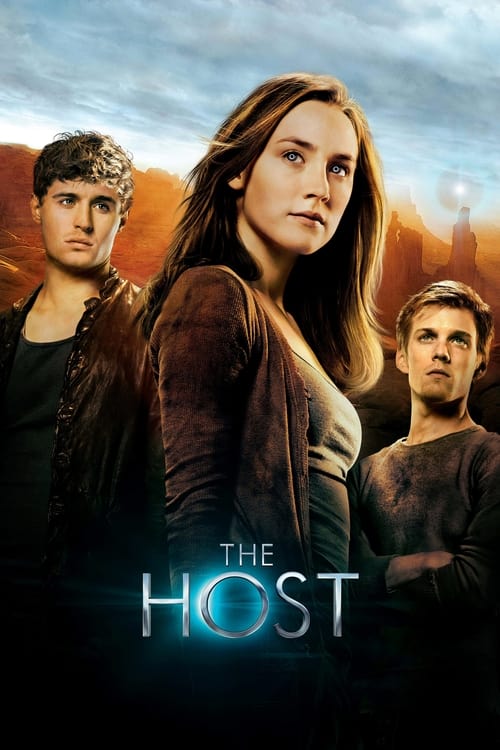
The Earth has been invaded by an alien race that uses human bodies as shells and controls their will. Most humans have already been "possessed" by the "guests," but there are small communities of resistors scattered around the world, including Melanie, who is eventually captured by the aliens and possessed by a guest.
The Earth has been invaded by an alien race that uses human bodies as shells and controls their will. Most humans have already been "possessed" by the "guests," but there are small communities of resistors scattered around the world, including Melanie, who is eventually captured by the aliens and possessed by a guest. However, something strange happens: Melanie's will remains strong and intact, and she manages to communicate with her guest, transmitting her sensations and feelings to it. Melanie's greatest concern is knowing whether her brother Jamie and her boyfriend Jarod are safe, so she sets out on a journey to their hideout, supported by the guest inside her. Obviously, the alien Seekers set out on her trail, intending to use Melanie as bait to flush out a new group of dissidents.
The influence that "Twilight" has had on young adult literature and cinema has been so strong that it has created a real genre: the fanta-romance that in recent years has literally invaded bookstore shelves, TV schedules, and movie theaters. While this genre has not taken off in cinema beyond the strict circle of pure Twilight fans, with resounding flops ("Beautiful Creatures") and relatively modest successes ("Warm Bodies"), Stephenie Meyer is back with the hope of another commercial success that can match that of the saga with Edward and Bella. "The Host," in fact, is the adaptation of another Meyer novel ("The Host"), which she finances personally. This time, no vampires or werewolves, but aliens, shifting from horror to science fiction, while keeping the romantic flavor of a love story seen from a female perspective.
"The Host" is even less successful than "Twilight," and despite attempts to distinguish it from its predecessor, the author's signature is unmistakable. She has an incredibly banal and dangerously bigoted view of the feeling that moves the world. Everything is beautiful and painted in pink when you're in love, the good are good, and the bad are good too; the very bad ones, however, have a guaranteed moment of redemption. And then there are moral lectures that travel on the double track of wanting (to have sex) but it's not right, with sighs, languid looks, and continuous moments in which—quote Freddy Krueger—"the protagonist's mouth says no, but her body says (indeed screams) yes." Obviously, contextualizing everything and knowing that Meyer had a strict religious education of Mormon origin, everything is explained and almost fascinating to the outside eye to notice how this author's religious beliefs affect her characters, with results that tend to the continuous repression of instinct and passion until the explosion, with plenty of erotic fantasies under the persistent suspicion of "threesome."
Setting aside the moral content of Meyer's films, which ultimately concerns the subjective sphere of the viewer, "The Host" presents itself as a film with interesting but poorly exploited ideas. The story is nothing new, old-school science fiction that screams "Invasion of the Body Snatchers" from miles away, finding in the scenario of the alien entity that possesses and controls human bodies a fertile number of films ranging from "The Invaders" to "I Married a Monster from Outer Space" to the remakes/sequels of "Invasion of the Body Snatchers" itself ("The Faculty," "The Astronaut's Wife"). The ground is therefore well-trodden, but "The Host" has the merit of finding an unprecedented point of view: that of the alien, or rather of the possessed human who enters into a partnership with the parasite that possesses it. The device in "The Host" is immediately clear, and this "duet of souls" that inhabit the same body is an original way to show the inner conflict of the protagonist, torn between her attraction to two men and, above all, focused on the conflict between sexual desire and its repression. Wanda (as humans call the alien parasite) is the more libertine half, Melanie the more timid and moderate one, the classic conflict between the Id and the Super Ego in Freudian style. The problem is that, if this inner conflict can work on paper, it is very difficult to render it credibly on screen, and the usually skilled Andrew Niccol—who writes and directs—has not succeeded, showing the protagonist as almost schizophrenic, talking incessantly to herself for two hours. Melanie's inner voice is omnipresent and invasive, used as a hybrid between a narrator's voice and a participatory stream of consciousness, with a result that is annoying and difficult to get used to.
Furthermore, the film is terribly static, both narratively and in terms of action. Most of the interesting parts of the story are in the prologue, then—once Melanie/Wanda has escaped—everything is reduced to her participating in the social life of the group of humans and her love story with four people. The search for a solution, the drama, the chase of the Seekers... everything is overlooked and minimized in rare and ineffective moments of action and tension. The rhythm is completely missing, and incredibly, a final climax is also missing, so that we arrive at the showdown without even realizing it. There is no real moment of confrontation/redemption, and the open ending arrives with a bad and squalid scene that leaves us with a huge "mah!"
It's a shame for Andrew Niccol, who is an attentive and very personal author, director of films like "Gattaca," "S1mOne," "Lord of War," and "In Time," as well as screenwriter of "The Truman Show," here also as a screenwriter but evidently constrained by a vice that limited his freedom of adaptation, given that "The Host" with its poetry of dystopian society has little or nothing to do with it. A great waste of actors as well, given that the excellent Saoirse Ronan ("Amabili resti," "Hannah") could definitely aspire to better, and the bad Diane Kruger ("Troy," "Unknow") is suitable for the role but has too little space. Better to keep silent about Max Irons, son of the famous Jeremy, inexpressive to the core and here engaged in the role of the handsome one loved by the protagonist, in short for the series "new Pattinson wanted."
Better to stay away from "The Host," then, a science fiction film that does not go beyond an attractive starting point; otherwise, it is a boring flow of words without rhythm and without real bite that once again tells us how much "Twilight" has done harm to the landscape of fantastic cinema.
Comments
Comments (0)







Comments