
















The Verdict
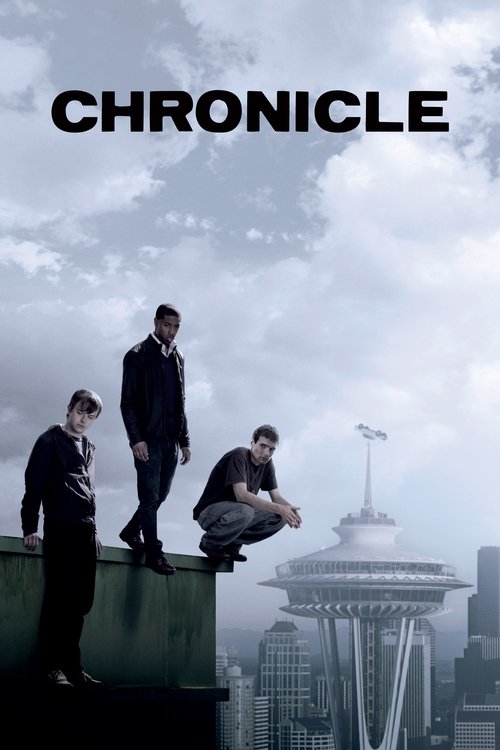
Andrew is an introverted teenager, very unpopular at school and with a disastrous family situation due to his mother's serious illness and a violent, perpetually drunk father. One day, Andrew decides to record with his video camera everything that happens to him and soon after, during a party, he discovers with his cousin Mat and schoolmate Steve a hole in the ground from which strange noises come.
Andrew is an introverted teenager, very unpopular at school and with a disastrous family situation due to his mother's serious illness and a violent, perpetually drunk father. One day, Andrew decides to record with his video camera everything that happens to him and soon after, during a party, he discovers with his cousin Mat and schoolmate Steve a hole in the ground from which strange noises come. The three enter the crevice and find a mysterious, luminous object. The next day, Andrew, Mat, and Steve realize they can move objects with the power of thought and do many other incredible things, such as fly and have superhuman physical resistance. The initial euphoria devoted to entertainment and harmless pranks turns for Andrew into an opportunity for revenge against those who had mistreated him until then. But the situation quickly gets out of hand. That mockumentary was already a popularized language on a large scale in contemporary cinema (and not only in horror) was understood since Brian De Palma used this technique to tell the war in the Middle East in his beautiful "Redacted" and today comes confirmation from the myriad of films, of any genre, filmed using, precisely, the expedient of found footage and P.O.V. (point of view). Even youth comedy took advantage with "Project X", so why not try it with one of those genres that are notoriously among the most costly and today particularly in vogue? And here comes "Chronicle", a film about superpowers on "ordinary" boys who become superheroes by accident. But "Chronicle" is an ambiguous and cross-genre film, not a "Spider-Man" or a "The Avengers" and not even a "Super" or a "Kick-Ass", rather a teen sci-fi movie, mature and ultra-dark, that does not disdain peaks of tension worthy of the best horror. Surely the propulsive thrust to make a film like "Chronicle" is the low cost that such operations require. The mockumentary expedient pushes the use of digital recording equipment, famous actors are not required, thus increasing the sense of realism, and the hypothetical special effects are often and willingly used within blurry/moving shots and quick editing cuts, so as to mask any imperfections. In short, "Chronicle" costs 12 million dollars and in the American opening weekend alone it takes in 22, reaching today, in the United States alone, almost 70 million dollars in box office revenue. "Chronicle", the phenomenon, therefore, the film that every producer would like to have in their stable. But "Chronicle" is not just a clever and remunerative product born to ride the wave of mockumentary and superhero films, Josh Trank's debut is indeed one of those gems of American indie cinema that manage to leave a mark on the viewer and the cinematic landscape, a genre work aimed at a wide audience and at the same time a mature product. Max Landis (son of John) writes the screenplay populating the story with well-recognizable character types: there's the boy with family and character problems, mocked by his peers, then there's the nice boy who quotes Jung and Plato and then the successful one, athletic and with the dream of making it in politics. Not stereotypes, mind you, because one thing is having marionettes, another is taking distinctive character traits and building credible and unique characters on top of them. "Chronicle", obviously, belongs to this second category. Characters of a certain depth, therefore, among whom, however, Andrew stands out in a barely veiled manner, the weak link in the group, the problematic and losing boy who, at the moment he acquires the powers, becomes the number one in everything. The curious detail is that Andrew excels even among his peers, he is the first of the three to discover how to use the powers and the only one to be able to use them to their maximum potential. You will understand that a character thus "spoiled" by life and suddenly invested with such incredible abilities cannot react indifferently. It is precisely in this particular that the development of the entire film lies, the reflection and the taking of position in the face of such a great responsibility, from which the life and death of people may depend. Very good Dane DeHaan ("True Blood") who plays Andrew, physically perfect for the role and particularly inspired in the performance. But Josh Trank is also good, who manages to handle the mockumentary style even in high-risk situations, never forgetting the technique used (unlike many of his colleagues who seem to be in obvious difficulty with these films). And to do this, they renounce to found videos and unique points of view, choosing instead to multiply the views on the narrated events extending them to all imaginable recording equipment. If at the beginning the eye of the spectator coincides with that of Andrew, who films everything with his video camera, halfway through the film the point of view quadruples and Andrew's video camera is passed from hand to hand among the three friends, to which is added from time to time the fourth eye of Casey's video camera, classmate and blogger, also a documenter of daily reality. In the long "apocalyptic" finale, for obvious reasons, Andrew's video camera exits the scene and the point of view splits into 50, 100, 1000 different shots that are testimony to the pervasiveness of amateur, institutional or journalistic recording. Surveillance cameras, passers-by's video phones, police car shots, journalists: at a certain point "Chronicle" becomes a sum of the stolen, recorded image. Trank thus realizes a different film, a work that follows the waves of the moment to differentiate itself considerably. A good fantasy thriller that makes virtues of its limitations. Warmly recommended.
Comments
Comments (0)






Comments