






The Verdict
Five episodes, all set in the same neighborhood. A girl, returning from school, finds her father playing with a remote control, but every time the man presses a button, the girl finds herself in the same situation but in different realities and her body suffers considerably.
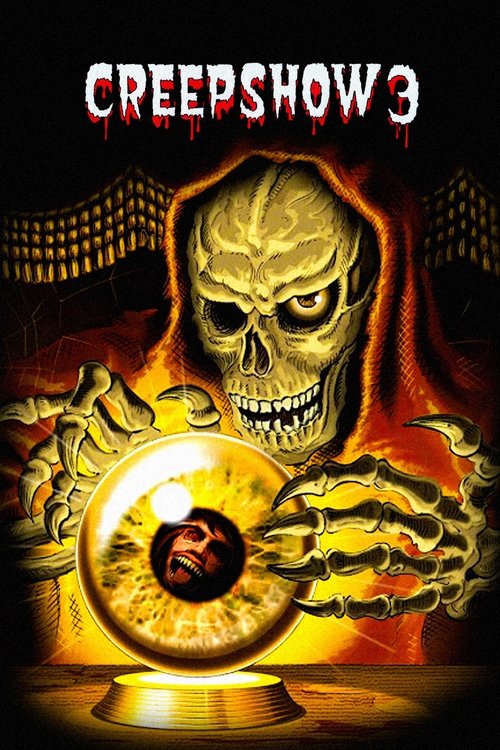
Five episodes, all set in the same neighborhood. A girl, returning from school, finds her father playing with a remote control, but every time the man presses a button, the girl finds herself in the same situation but in different realities and her body suffers considerably. A man buys a radio that starts giving him advice until it pushes him to murder. A serial killer prostitute goes to a work appointment, but her client hides a terrible secret. Two boys are invited by their former teacher to meet his fiancée, with whom he is about to get married, but the two are convinced that the woman is a robot and the consequences will be bloody. An odious doctor causes the death of a homeless man and is haunted by his ghost. Do you remember "Day of the Dead 2: Contagium"? If you've seen it, it's hard to forget for the sense of lethargy and at the same time indignation that it managed to convey to the viewer. "Creepshow 3" is a similar operation to the fake sequel of the "Day" romerian, a film that presents the same technical cast and has the same fraudulent intentions. At the helm are Ana Clavell and James Glenn Dudelson, and at production/distribution, the Taurus Enterteinment Company; their collaboration is now aimed at the plundering of romerian cinema, based on the simple strategy of buying the exploitation rights of Romero's classics (I assume for a few thousand dollars) and creating sequels that have nothing to do with the originals... perhaps out of spite towards the numerous horror cinema enthusiasts. This time again, we are not faced with a real sequel, so the number 3 that follows the title is a simple decoy to sell a bad episode film that has nothing to do with the beautiful diptych of the 1980s. The five stories that make up the feature film were probably thought of separately (also considering the large number of screenwriters: one per episode!) and in circumstances that did not foresee the amalgamation into a single film. The only sense of uniformity is given by the introduction in each episode of some elements that recall the others, thus giving an idea of overall uniformity, a characteristic that, moreover, distances this film even more from the previous two. In the end, this choral film construction is probably the most interesting thing and if it weren't noticed that the various stories are connected in a very superficial way, it could have also been a strong point for this little film. As is creepshow tradition, the film opens with an animated short that this time, instead of serving as a frame for everything, is placed there without any sense and is of very poor quality: the flash-like animation serves to tell a ugly and predictable story. They could have easily avoided it, as well as the image that opens and closes the film in which the drawn image of a fortune teller reading a crystal ball (the same one on the poster) is absolutely useless for the film. The technical poverty that permeates the entire film, characterized by a television-like photography and squalid sets, is accompanied by a very low quality of the stories. Among the five, the most elaborate and perhaps interesting one is the second, the one in which a somewhat repressed boy gives vent to his fantasies thanks to the persuasive female voice that advises him from a broken radio. Unfortunately, the actors involved are absolutely forgettable and the development of the characters is less than mediocre. Without a doubt, the one saved by the irony and the splatter is the episode in which two boys dismember the strange fiancée of their teacher believing she is a robot, and some interesting ideas, but poorly used, can also be found in the episode of the killer prostitute, in which the beautiful Camille Lacey (to whom you cannot forgive the prudish interpretation) becomes the protagonist of the most genuinely violent scene of the entire film. Absolutely bad is the first episode, distinguished by an annoyingly unsuccessful irony and characterized by an embarrassing void of ideas that wants to wink at "The Twilight Zone" and "Alice in Wonderland", without succeeding in the first attempt and being only forced in the second. The last episode, the one of the doctor and the ghost, is undoubtedly thought with the idea of recycling the episode of the hitchhiker from the second film, but this time the story is too drawn out and completely lacks the macabre that characterized the inspiring episode; the only thing salvageable is the performance of the protagonist, the unknown Kris Allen, although insisting too much on his cynical skits in the long run tires. In short, "Creepshow 3" is the usual bad home video product that also has the aggravating circumstance of exploiting a cult title. We hope that the two directors and Taurus stop producing fake sequels of Romero's films (but also leave other "Great" ones alone) because in addition to being harmful to the time and wallet of the viewer, it is also for their already irrelevant career.
Comments
Comments (0)










Comments