
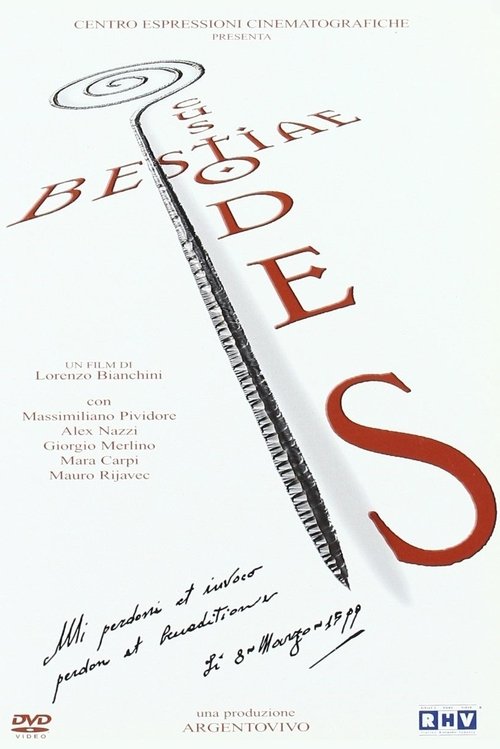


The Verdict
Professor Giorgio Dal Colle, after discovering an old and mysterious fresco in a church, learns of a disturbing truth dating back to the time when the church practiced the Inquisition. He decides to give an interview to a young journalist to make his terrible discovery known; but just before the interview, the professor mysteriously disappears without a trace.
Professor Giorgio Dal Colle, after discovering an old and mysterious fresco in a church, learns of a disturbing truth dating back to the time when the church practiced the Inquisition. He decides to give an interview to a young journalist to make his terrible discovery known; but just before the interview, the professor mysteriously disappears without a trace. The journalist, therefore, eager to complete his article and taken by curiosity about what the professor wanted to tell him, begins to investigate the mysterious disappearance of the man and what he wanted to reveal. He will thus learn of a disturbing reality concerning the inhabitants of a tiny village in Friuli. Released in 2004 but distributed only for the home video market in 2006, this "Custodes Bestiae" is a small Italian film that definitely went too unnoticed and that, despite the very low budget, offers results of great level. In the direction appears an excellent Lorenzo Bianchini, independent director, author of very few other films like the horror "Radice quadrata di tre", who, in addition to having directed the film, took the trouble to write it, edit it and produce it, demonstrating his competence in the genre and his great abilities. The film, which starts from a very interesting and well-thought-out basic idea in all details, takes advantage of an excellent screenplay that manages to involve the viewer more and more, minute by minute and manages to create dark and even unsettling scenes (like the excellent ending set in the sinister village of Friuli); the direction also seems particularly valid, demonstrating security and managing to give a touch of originality in the shots. Beautiful and fascinating are also the sets used, which, although extremely simple, are perfectly suited to the film and the story and manage to make unsettling what at first glance may seem extremely banal; of great impact are also the music, which tend to underline in an effective way the moments of greater tension. But the effects due to the low budget do not take long to be felt; in fact, the biggest problems of the film can be found at a technical level, especially in the photography and the sound: the photography appears annoyingly satin-finished (it seems almost to watch an episode of some TV soap opera), due to the use of digital, which makes the film lose much of its charm and manages to greatly smooth out the level of unease that the story offers; while the sound, which most of the time creates an annoying echo effect, is very poor and makes some dialogues barely understandable. The actors also represent a weak link in the entire work, in fact they are all quite incompetent and unconvincing, and therefore leave much to be desired, starting with the journalist protagonist who, although superior to the average of the actors who usually appear in films with a very low budget and released only for the home video market, appears rather inexpressive and little involved in the project. It is inevitable not to notice that Bianchini, to make this film, took as a model the various genre films of the famous director Pupi Avati, so much so that several characteristics that appeared precisely in his films can be found, one of them being the place where to set the plot. The film, in fact, chooses as a setting a small and remote village in northern Italy populated almost exclusively by illiterate people used to living far from the progress offered by large cities like Milan, Rome or Turin. And it is precisely here the charm of the film, managing magnificently to make terrifying what in reality is not, demonstrating that true horror does not lie in the most complex and technological things, but in the extremely simple things with which we live every day unaware of the danger they can cause. It is worth noting that in "Custodes Beastiae", as in Bianchini's previous film, in many scenes the characters speak in Friulian dialect (but there is no need to worry, the dialogues are equally understandable thanks to additional subtitles). In short, "Custodes Bestiae" is a fascinating and mysterious horror, well thought out, well scripted and well directed, but which unfortunately is let down by several problems due to the extremely low budget. Let's hope that next time this Lorenzo Bianchini will receive some additional funding to make a film since he has all the winning cards to become a new icon of Italian horror cinema.
Comments
Comments (0)


Comments