



The Verdict
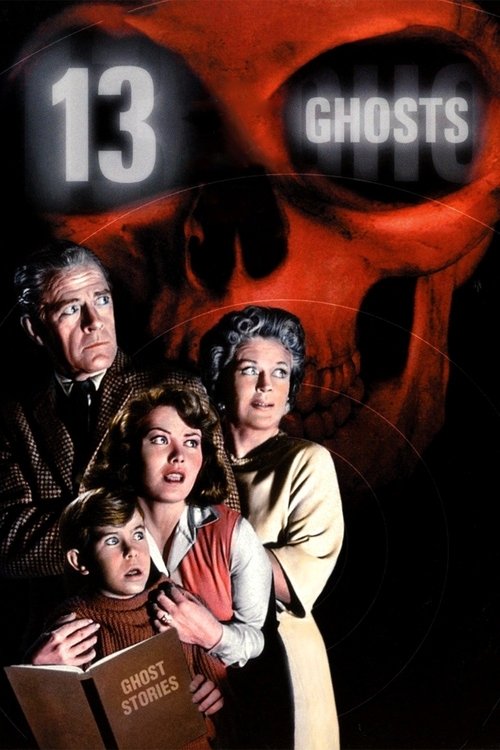
A man inherits a beautiful house from his uncle, a scientist. After moving into the new home with his entire family, he discovers that his uncle was passionate about the occult and had conducted studies on ghosts trapped on Earth, spirits that he had found a way to locate, through special glasses, and even to collect.
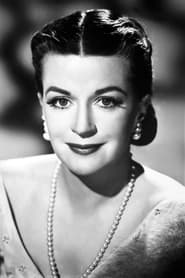
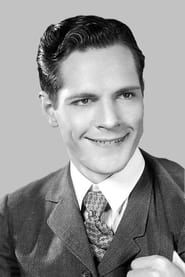
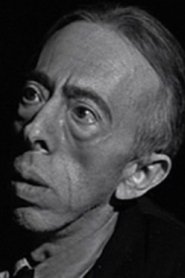
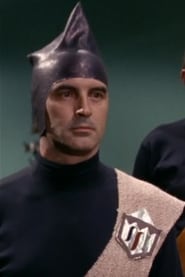
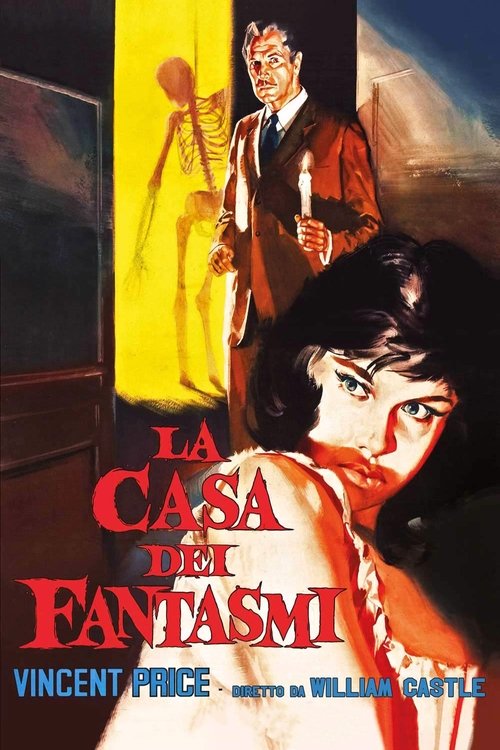
A man inherits a beautiful house from his uncle, a scientist. After moving into the new home with his entire family, he discovers that his uncle was passionate about the occult and had conducted studies on ghosts trapped on Earth, spirits that he had found a way to locate, through special glasses, and even to collect. The inherited house is indeed haunted by 12 ghosts, but the worst is yet to come: the spirits are searching for the thirteenth... "13 Ghosts" is a 1960 film unfortunately unreleased in Italy. Of this title, we were able to see, in 2001, a pleasant remake produced by Dark Castle, a horror-themed production company founded by Silver and Zemeckis. Remake, it must be said, quite different from the original, for which reason, as well as the enormous time difference between the two, it is impossible (if not also useless) for us to make comparisons. But let's return to the original film. The film is directed, as well as produced, by William Castle, master of Horror (often low-budget), a brilliant individual father of countless cinematic and promotional innovations. It is enough to think of some anecdotes to better understand the character: the audience attending the screening of the film in question were provided with special glasses, called ghost-viewers, that would allow them to see the ghosts on the screen since the film had been shot in a particular technique called "Illusion-O"; spectators were trained upon entering the theaters to wear the glasses when a particular shimmer of the image appeared on the side of the screen. The blue lenses showed no special effects, while the red lenses revealed to the audience a mysterious world of ghosts allowing them to visualize the terrifying protagonists of the film. At the end of the film, the image of the mephistophelian Castle appeared, who suggested keeping the ghost-viewers that could be extremely useful for revealing unexpected roommates. Or, to cite another of the director's ingenious devices, when during the viewing of the film "The Tingler" ("Il Mostro di Sangue") of 1959, he had a hidden mechanism placed under the spectators' seats in order to make them vibrate at the key moments. Incidentally, the aforementioned remake was, for Dark Castle, the second remake of a Castle film, whose name is clearly inspired by that of the production company. Before "13 Ghosts" (in Italy "I 13 Spettri"), in fact, there had been the remake of "House on Haunted Hill" (in our country "La Casa dei Fantasmi" for the original and "Il Mistero della Casa sulla Collina" for the remake). "13 Ghosts" is what can be defined as the classic film about the haunted house, with all its traditional characteristics and its typical details artfully realized. A brilliant array of presences, noises, voices, objects that move on their own, appearances of spirits, strange contraptions, ouija boards, and séances. The special effects of the time are rather good, and it should be noted that the film did not enjoy what can be considered a substantial budget, on the contrary, an additional merit, therefore, of such realization. The spirits have an intriguing look and are shown to us through techniques of fading and superimposition of images, perfect, moreover, the realization of all the mechanical effects. Scenography, attractive music, and ingenious lighting complete the picture of a perfectly sinister and quite suggestive atmosphere. Atmosphere to whose creation the black and white film contributes its seductive contribution. Good the characterization of the characters among whom the most picturesque is without a doubt that of the unsettling Elaine Zacharides, the housekeeper and also the trusted medium of the deceased scientist. Not to mention the various spirits that make their appearance throughout the film in the key scenes: from the cook equipped with a razor-sharp cleaver, to the headless tamer with a lion, from a bizarre skeleton to the ghost of Dr. Zorba, whose appearance will be the most particular: the ghost of the eccentric relative, in fact, will appear following a memorable séance with possession to the detriment of the unfortunate nephew. Positive the performance of the cast, a "bravo" without a doubt goes to the very young (at the time naturally) Charles Herbert in the role of the little Buck. The ending reserves a good plot twist, perhaps at some point foreseeable but nevertheless interesting. The last frames make the ending sympathetically unsettling. In conclusion, we can define Castle's film as a beautiful classic, a fascinating film, a well-made "old-school" Horror, whose viewing is pleasant and fluid. It's a shame it was never imported in Italy, if not recently by a satellite TV and in any case in the original version with Italian subtitles, in the face of so many ignoble films that, over the years, have made their useless landing on our peninsula.
Comments
Comments (0)










Comments