



















The Verdict
2018. A lunar module with two American astronauts on board lands on the Earth's satellite, marking the second time humans have set foot on the Moon.
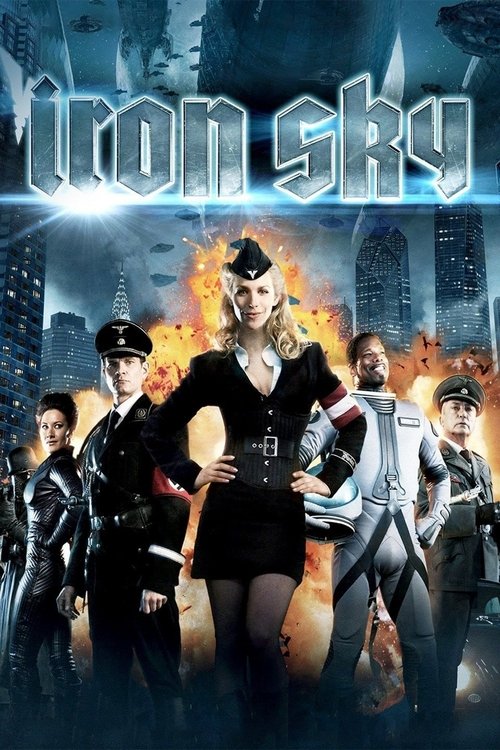
2018. A lunar module with two American astronauts on board lands on the Earth's satellite, marking the second time humans have set foot on the Moon. Upon reaching the dark side of the Moon, the astronauts discover with great surprise an Earth colony: they are Nazis, refugees on the satellite after fleeing Earth following their defeat at the end of World War II. The Nazi colony, which has meanwhile established the Fourth Reich, kills one of the two astronauts and captures the other, the black James Washinghton. Convinced that this is only a prelude to an imminent American/Earth invasion, the Nazis want to strike first and for this purpose prepare an invasion of Earth. They want to use the giant warship called Götterdämmerung, which however still does not work adequately. The Nazis then decide to go on a secret mission to Earth to steal more advanced technologies capable of making their spaceship work. They send the ruthless Klaus Adler and the idealist Renate Richter on a mission, accompanied by the prisoner James Washinghton, who has meanwhile undergone an Aryanization process.
"The Dark Side of the Moon" is not only the title of one of the most famous albums by Pink Floyd, but a concept that symbolizes mystery, the unknown, what we cannot see with the naked eye. After all, man has always wondered what was on the hidden face of the Moon, a portion of our satellite that is never visible to us due to the synchronous rotation between the Earth and its natural satellite. Yet, since the late 1950s, we have had the opportunity to map the entire lunar surface, including the mysterious dark side. Craters, many craters, distributed more densely due to greater exposure to space debris that can hit the lunar surface. Yet, human imagination has fantasized and translated into science fiction, populating that hidden side with any mystery and curious threat, including the alien robots of "Transformers 3".
Among the most bizarre inhabitants of the dark side of the Moon are undoubtedly the Nazis, who, according to the imagination of director Timo Vuorensola and screenwriter Johanna Sinisalo, would have settled on the satellite after their 1945 defeat. This is what happens in "Iron Sky", a curious science fiction film mixed with comedy that comes from Finland, a country that certainly has not accustomed us to cinematic productions of this type.
"Iron Sky" has a very particular genesis because it was born from the direct contribution of fans via the Internet. The film was born from a story by science fiction writer Johanna Sinisalo and developed thanks to a co-production between Finland, Germany, and Australia. However, the curious detail is that 10% of the film's budget (which totals 7.5 million euros) was provided directly by Internet users who donated money in exchange for film merchandise through that mechanism called crowdfunding. Moreover, the participation of individual users was requested to give suggestions on characters and plot elements (crowdsourcing), making the future spectator entirely active in the creation of the product. A technique that ensured success for the film, making it a small "case" even before it was completed.
But beyond the post-production, cross-media, and marketing process (the operation is completed with video games and three graphic novels that serve as prequels to the story), how is "Iron Sky" qualitatively? Constant highs and lows, great ideas that alternate with avoidable clichés and stupidities from parody comedy. That said, the technical realization is of very high level, all the more so if we consider the meager budget that the film had at its disposal.
Basically, "Iron Sky" is a satire film, a film that attacks the world politics laughing. The parts perhaps most successful of Vuorensola's film are those set during the meetings of the heads of state who, in the face of the Nazi threat, reveal weaknesses and useless quarrels. Obviously, the spokesperson state of the Earth is the United States, represented by a president who has the unmistakable face of Sarah Palin (played by Stephanie Paul), a kind of living cartoon that embodies the worst qualities a head of state can have. The man returns to the Moon for a precise electoral strategy, moreover the astronaut is black and a model by profession, therefore perfect to gain the votes of ethnic minorities, women, homosexuals, and those who focus mainly on look and appearance. Not surprisingly, it seems to have too much voice in the chapter Vivian Wagner (played by the effective Peta Sergeant), the President's image consultant with a future as Minister of Defense. And the little theater holds up sufficiently, with well-placed jabs that tend to reveal the worst of contemporary politics ("A war is ideal! A President who starts a war is always re-elected for a second term!").
Then, unfortunately, one realizes that "Iron Sky" also wants to be a stupid disengagement and to reach this goal it seeks expedients from the worst American parody comedy, with the black who must be nice at all costs calling the others "brother" and performing in rowdy skits à la Eddie Murphy, or the Germans who speak with a "z" instead of an "s" or end words in "-en" as if they were in a Bonvi comic.
The dual soul of "Iron Sky" - intelligent satire/stupid parody - compromises the full success of the film, which, from a promising start and a spectacular ending almost worthy of a Hollywood blockbuster, alternates with a rather flat and redundant central part. However, it is pleasant to note a certain care in the delineation of the main characters (in particular the already mentioned Vivian Wagner, the teacher Renate played by Julia Dietze and the aspiring Führer Adler/Götz Otto) and secondary characters (the not very authoritative Führer played by Udo Kier), as well as the undeniable success of some gags ("The Great Dictator" reduced to a short film).
With more precautions and perhaps a different approach to the subject, "Iron Sky" could have been a gem... so it is only a fanta-comedy of alternate entertainment.
Add half a pumpkin.
Comments
Comments (0)




Comments