
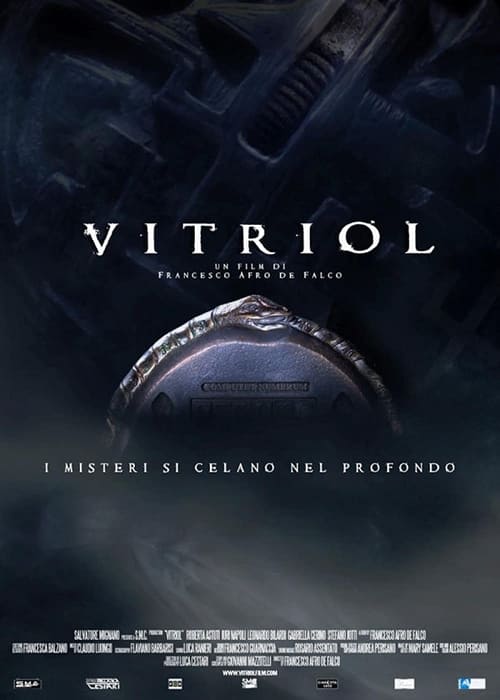

Le Verdict
Lola Verdis rédige une thèse de maîtrise en architecture sur les corrélations entre les constructions et la symbolique maçonnique dans les bâtiments de Naples sous les Bourbons. La découverte d'un objet mystérieux dans les sous-sols d'un bâtiment la mènera à la découverte d'un ancien ordre ésotérique, l'Ordre Osiridéen Égyptien.
Lola Verdis rédige une thèse de maîtrise en architecture sur les corrélations entre les constructions et la symbolique maçonnique dans les bâtiments de Naples sous les Bourbons. La découverte d'un objet mystérieux dans les sous-sols d'un bâtiment la mènera à la découverte d'un ancien ordre ésotérique, l'Ordre Osiridéen Égyptien. À partir de ce moment, Lola et son ami et collaborateur Davide se retrouveront en grand danger car ils ont touché un secret trop grand. Grâce à sa caméra, Lola documentera toutes les phases de la recherche. Quel projet singulier que ce "Vitriol", un mockumentaire anormal qui traite un sujet original et éloigné de ceux qui sont généralement abordés dans le cinéma italien, à savoir l'archéologie ésotérique et l'alchimie. "Vitriol" est un acronyme pour la phrase latine "Visita Interiora Terrae Rectificando Invenies Occultum Lapidem Veram Medicinam", qui signifie "Visite l'intérieur de la terre et en rectifiant tu trouveras la pierre cachée qui est le vrai remède", une expression alchimique qui invite à une recherche intérieure et, de manière ambiguë, fournit des coordonnées qui mènent à une vérité qui pourrait changer les destinées de la connaissance. Dérivé d'une véritable recherche documentaire jamais achevée, "Vitriol" utilise le langage du mockumentaire pour nous emmener dans cette aventure dans une Naples ésotérique et mystérieuse. Le film, qui marque le début du long métrage du Napolitain Francesco Afro De Falco, bénéficie cependant du langage du mockumentaire de manière différente de l'habitude. Tout d'abord, il y a une admission d'intentions que l'on ne trouve jamais dans ces opérations, car une didascalie au début du film nous informe que nous regardons justement un mockumentaire basé sur des recherches réelles, révélant ainsi le truc avant même le début du jeu. Ensuite, "Vitriol" se développe sur trois plans linguistiques : quelques (peu) scènes récupérées du véritable documentaire d'origine (avec des visages floutés et des voix modifiées), la recherche de la protagoniste filmée comme un mockumentaire en P.O.V. (qui occupe la plus grande partie du film) et des scènes de pure fiction avec les mêmes acteurs, tournées avec la technique cinématographique traditionnelle en troisième personne. C'est un usage étrange que De Falco fait du faux documentaire, peut-être aussi un peu impopulaire, qui à certains moments brise cette magie et cette identification que ce langage réussit souvent à créer. Appreciable, cependant, cette voie expérimentale dans une manière de faire du cinéma ces dernières années trop abusée. Le scénario, écrit par Giovanni Mazzitelli, trouve le juste compromis entre simplicité et approfondissement, vu qu'il traite des sujets plutôt arides pour ceux qui ne sont pas experts de la matière mais avec un langage compréhensible à tous. Il y a à dire cependant que certains mystères et certaines questions soulevées pendant le film ne trouvent pas toujours un accomplissement et à certaines occasions on a l'impression qu'il a fallu procéder avec trop de vitesse et de superficialité. Les dialogues ne convainquent pas toujours non plus, mais les deux jeunes acteurs protagonistes - Roberta Astuti et Yuri Napoli - sont bons et tiennent bien la scène. "Vitriol" est aussi un film cross-genre car il commence comme un horreur-mystère (la disparition d'une personne, une secte et des horreurs souterraines) pour se développer ensuite comme un film investigatif/archéologique du type "Le Code Da Vinci", jusqu'à se transformer dans la dernière partie en un aventureux qui rappelle les jeux vidéo de la série "Uncharted" plutôt que les divers "Indiana Jones". Dans le développement intéressant, Mazzitelli et De Falco réussissent à mettre beaucoup, peut-être même trop, avec des sociétés maçonniques, de l'alchimie, le mythe d'Arcadie et peut-être même des civilisations extraterrestres. À la fin, le mélange fonctionne pourtant et le film réussit à capturer. Produit et distribué par l'indépendant Salvatore Mignano Communication, "Vitriol" est une curiosité expérimentale qui vaut la peine d'être vue.
Commentaires
Commentaires (0)

Commentaires