







The Verdict
In a small town in Spain, the five hundredth anniversary of the execution of the Knights Templar is being celebrated. Centuries earlier, they had disturbed the town's peace with human sacrifices to the devil in exchange for eternal life.
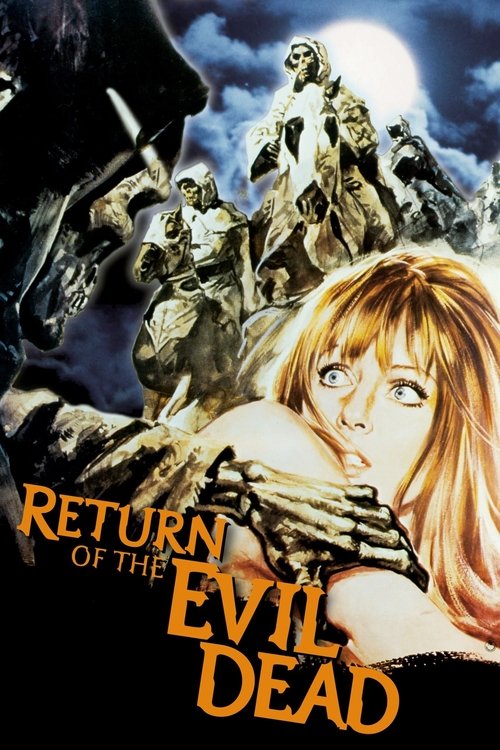
In a small town in Spain, the five hundredth anniversary of the execution of the Knights Templar is being celebrated. Centuries earlier, they had disturbed the town's peace with human sacrifices to the devil in exchange for eternal life. But before being burned alive, the knights swore that one day they would return and take revenge on the entire population. Now, during the town's celebrations for this anniversary, something terrifying is about to happen: the Knights Templar are preparing to leave their tombs and, mounted on their steeds, are heading to the heart of the town to carry out their revenge on all the descendants of those who, centuries ago, had blinded and burned them. The town is in panic, and among the crowd stands out a group of people who decide to lock themselves inside a church to wait, with anxiety, for the arrival of dawn as well as the moment when the dead Templars would return to their tombs. The wait will be very long and harrowing.
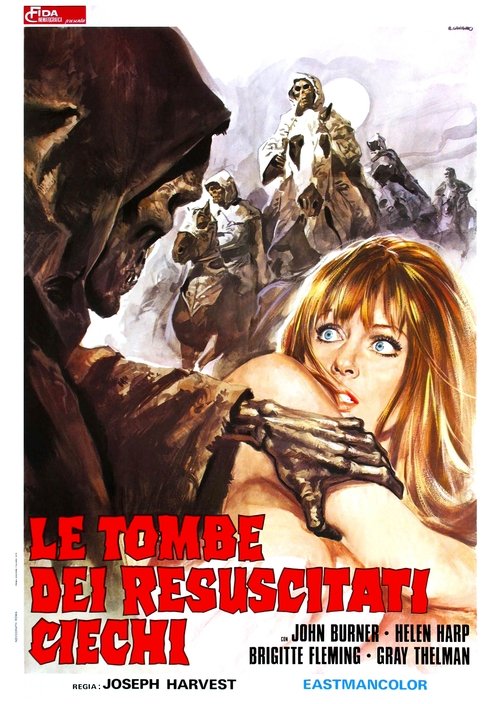
Amando De Ossorio directed in 1973 the second chapter of the saga dedicated to the zombie Templars that he had started in 1971 with the film "The Tombs of the Blind Resurrected" ("La noche del terror ciego"). The first film, which had more than sufficient success at the box office, encouraged the producers and Ossorio himself to make other chapters based on the legend of the zombie Templars who return from the world of the dead to carry out their revenge on all the inhabitants of the village. Thus, "The Ride of the Blind Resurrected" ("El ataque de los muertos sin ojos") was produced and realized, a false sequel to the 1971 film because it has no connecting link with the previous film (except for the central story of the zombie Templars) and, therefore, more than a true sequel, it could be considered a revision and variation on the theme.
This time, Ossorio seems to have understood more clearly what the formula for a good horror should be and thus tries to remedy, albeit not with dazzling results, most of the errors in which the first film fell.
The first film, "The Tombs of the Blind Resurrected," could easily seem quite shabby in the main story and seemed not to have very clear ideas about where it was going; this time, however, Ossorio creates a product lighter in content but far more compact and massive. The construction of the story and the development of the narrative are articulated in a more "professional" and classic way, moreover the story manages to begin and conclude always following a logical thread, without ever falling into frivolous digressions (which did happen in the first film).
Moreover, Ossorio decides to conform to the masses, in many aspects, with this sequel by resorting to some commonplace of the genre (but beware, this thing is not as negative as it might seem) and therefore will set part of his film in closed and cramped environments that certainly prove to be more effective for the horror genre and more capable of highlighting the state of danger and anxiety that resides in the protagonists; something that was not present in the previous film because it was always set in open and bright spaces and little capable of really instilling fear and concern.
To testify Ossorio's desire to better satisfy the lovers of the genre, there is not only the choice of the settings, but also a more fitting use of violence that, unlike the first film, this time manages to give us some healthy splatter sequences as well.
Excellent as always is the aesthetic representation of the zombie Templars who, although damned slow (and therefore not threatening), still manage to be very fascinating today (especially for the cultists of old-style horror).
A better job has also been done regarding the delineation of the characters who, although some tend to fall into easy stereotypes (there is always the jinx who foretells everyone's death; the bastard who would do anything to save his own skin, even endangering the lives of others; the family composed of husband, wife, and little girl without conscience that might remind Cooper's family from "Night of the Living Dead" by Romero, etc.), turn out to be much more convincing than all the characters shown in the first film.
In conclusion, "The Ride of the Blind Resurrected" presents itself as a sufficiently tasty film that, within its limits, manages to entertain and satisfy the viewer. It is not a particularly memorable film, but it certainly offers something more than its predecessor that passed into history, and for this reason, it surely deserves half a vote more.
The saga continues with "The Cursed Ship".
Comments
Comments (0)




Comments