

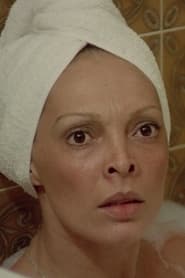
Le Verdict
Alice Gordon, employée dans un cabinet d'avocats, fait un rêve récurrent dans lequel une figure féminine (qu'elle ne parvient pas à identifier) l'attire irrésistiblement vers une étrange villa. Les images oniriques se répètent identiques à chaque fois : un scorpion, un papillon emprisonné dans un filet, un cerf-volant, une goutte de sang qui glisse sur une vitre.
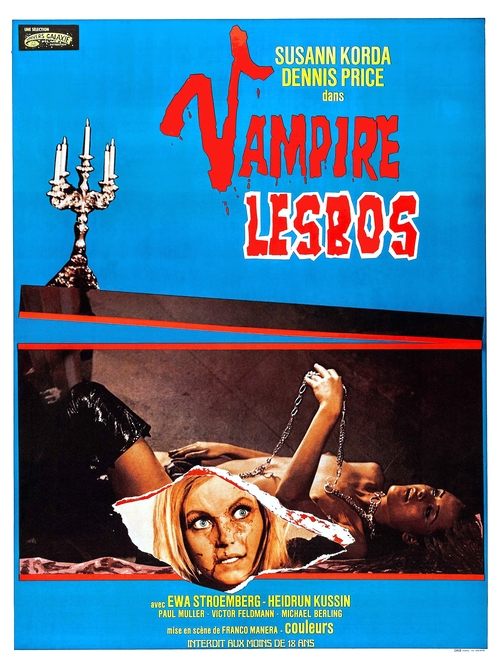
Alice Gordon, employée dans un cabinet d'avocats, fait un rêve récurrent dans lequel une figure féminine (qu'elle ne parvient pas à identifier) l'attire irrésistiblement vers une étrange villa. Les images oniriques se répètent identiques à chaque fois : un scorpion, un papillon emprisonné dans un filet, un cerf-volant, une goutte de sang qui glisse sur une vitre. Un jour, se rendant sur l'île d'Uskudar pour traiter une affaire légale, elle se retrouve face à face avec la villa et les images rêvées. Une légende raconte qu'à une époque, une princesse fut emprisonnée sur cette île, condamnée par son mari à mourir de faim. "Las Vampiras" représente l'une des meilleures pellicules de la prolifique production de Franco. Le film est connu sous une multitude de titres différents correspondant essentiellement à deux versions distinctes : celle allemande (surtout connue sous le nom de "Vampyros Lesbos") qui contient l'intrigue pour ainsi dire "originelle" et est caractérisée par un taux élevé d'érotisme ; et celle espagnole ("Las Vampiras" et autres titres) lourdement censurée, qui est celle arrivée en Italie sous-titrée. Dans la version espagnole examinée, la composante homosexuelle de la pellicule originale a été drastiquement réduite et certaines scènes inédites ont été ajoutées. La conséquence de ce processus d'addition-soustraction est que certaines séquences semblent irrationnelles ou peu claires, au point qu'on en arrive presque à parler de deux films différents plutôt que de différences entre les diverses versions. L'intrigue mélange une réinterprétation féminine du "Dracula de Bram Stoker" avec des éléments dérivés de la nouvelle "Carmilla" de Joseph Sheridan Le Fanu et d'autres éléments originaux sur fond d'un décor turc inhabituel (le film a été tourné entre Istanbul, Berlin et Alicante). La photographie correcte met en avant le sens de décadence et d'abandon des lieux où se déroule le film, principalement des stations balnéaires hors saison et des palais délabrés. Le même effet est obtenu par le choix singulier de situer l'intrigue presque toujours de jour (en pleine lumière) et l'utilisation fréquente de couleurs vives. La séquence du rêve d'Alice est particulièrement réussie : fascinante et chargée de symboles qui ne se clarifieront que partiellement à la fin. Le film, cependant, après un début prometteur, se perd progressivement, traînant un peu péniblement jusqu'à la conclusion cathartique. Heureusement, l'interprétation extraordinaire de Soledad Miranda dans le rôle de la comtesse vampire Diana d'Uskudar parvient à soutenir tout le poids du film, même dans les moments fréquents lents et moins réussis de celui-ci. L'actrice, morte peu de temps après à seulement 27 ans dans un tragique accident de voiture, domine entièrement la scène avec sa présence charismatique, magnétique et sa beauté mélancolique dès le générique de début. Franco lui-même a révélé que Soledad subissait presque une transformation physique pendant les tournages. Le film souffre malheureusement de quelques chutes trash typiques du réalisateur espagnol, mais dans l'ensemble, il parvient à maintenir intacte l'atmosphère onirique et décadente du début à la fin, se présentant comme un produit anticonventionnel et imprégné d'un érotisme délicat (au moins dans la version espagnole).
Commentaires
Commentaires (0)







Commentaires