
















The Verdict
In the sleepy town of Riverton, a terrible serial killer hides behind the mask of a loving father. One night, seized by a fit of schizophrenia, the man tries to kill his family but is stopped and injured by the police.
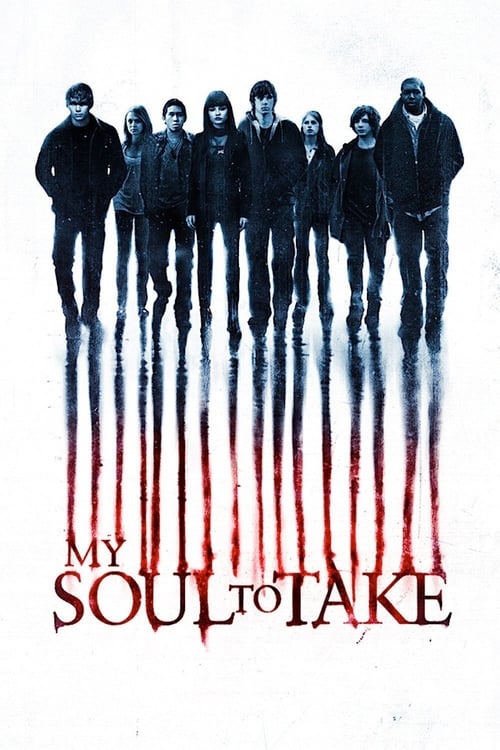
In the sleepy town of Riverton, a terrible serial killer hides behind the mask of a loving father. One night, seized by a fit of schizophrenia, the man tries to kill his family but is stopped and injured by the police. The killer, however, is not dead and during the transport to the hospital, he attempts to escape by making the ambulance go off the road and disappears into thin air after swearing he would return to kill anyone born that same night. Sixteen years later, Riverton is ready to celebrate the anniversary of the killer's disappearance, who has now become a local legend. But it is on this anniversary that a boy dies under mysterious circumstances, and it is precisely a sixteen-year-old born the night of the tragedy. From that moment on, the six remaining boys born that day fall into paranoia and begin to fall one after another under the blows of a mysterious assassin.
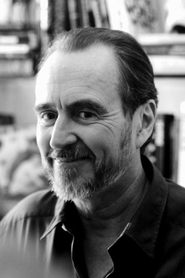
Distributed in American theaters (flopping) with a cheap 3D and arrived in Italy directly on video, "My soul to take – The Soul Collector" marks the return of Wes Craven to directing after a few years of activity only as a producer. "My soul to take", moreover, also marks the return of Craven as a screenwriter, who had not signed the script of a feature film since the times of "Nightmare – New Nightmare" (1994). An anticipated film, therefore, because from the subject one could intuit an eighties flavor very dear to the best cinema of the director of "Nightmare". In reality, faced with the facts, one can only be disappointed by "My soul to take", a teen-slasher that shows from the beginning its shortness of breath and although exuding experience and good craftsmanship in every frame, leaves mostly a bitter taste.
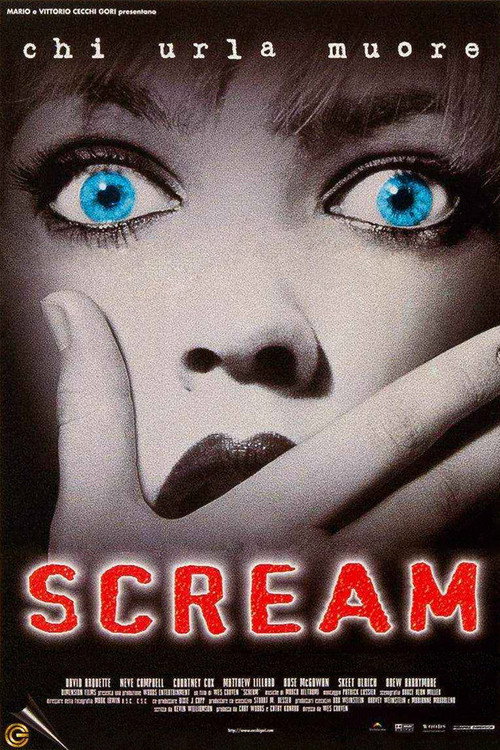
Wes Craven is someone who knows how to do it, there is little to discuss. Although periodically the loud wave of those who consider him overrated is heard, the director of masterpieces like "Nightmare – From the Deep" and "Scream" cannot be relegated among the mediocre who hit a film by "luck", because in addition to showing himself as a complete author in most of his works, he has always shown a great stylistic coherence that makes a Craven film well recognizable in the mass. "My soul to take", in the end, does not make an exception and in many aspects the Craven touch is well evident, only that one has the impression that this time it is at the service of a story with little bite that tends to repeat in a little convincing and convincing way things already said in the past. In this film we have the small provincial town shaken by dire events, the horror that comes from the past, the guilt of the parents that falls on the children, the adolescents and their problems, a serial killer wrapped in a legendary aura. In short, you will have understood that we are really in the territories of 80s teen-horror with notable qualitative potential. Some points, in fact, are not bad at all and findings like that of the schizophrenia of the serial killer and the multitude of souls trapped in a single body and then redistributed in many others appear new and winning. Then, we find ourselves in front of a film that alternates a somewhat too rushed introduction with a palpable difficulty in transporting the spectator to the heart of the story. Moreover, the 107 minutes of duration seem also quite long and are felt on some dead points distributed throughout the entire film.
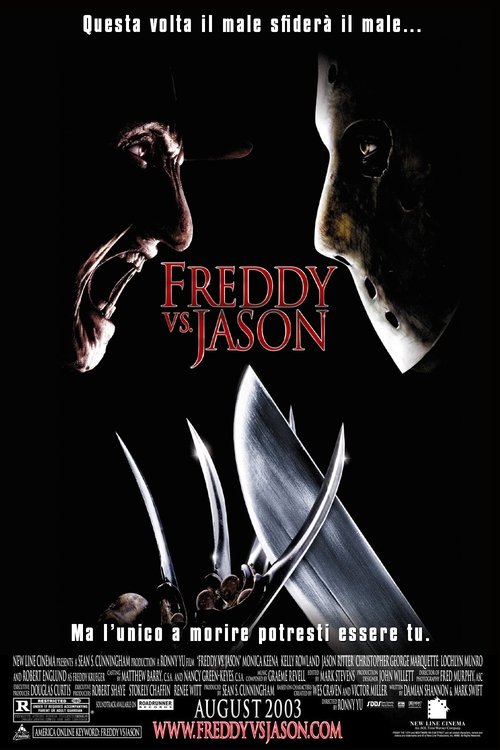
The figure of the serial killer, as often happened in slasher cinema from the mid-80s onwards, seeks to create an icon that can in some way settle in the heart of the spectator as did the Cravenian Freddy Krueger. The butcher of "My soul to take" theoretically could be on the right track precisely for those peculiarities related to science and the supernatural of which we spoke above (schizophrenia and soul), unfortunately, in practice it is not the same and one can notice a certain neglect in the staging of the monster even at the level of look, since it appears to us halfway between a metalhead and a representative of the Klingon race of Star Trek.
Interesting and unusual is the choice to considerably lower the age of the protagonists, teenagers facing eros and thanatos that, in addition to framing the story in the canons of individual growth linked to adolescent traumas, puts emphasis on a character development almost fairy-tale, echoing the times of "The Black House". Not all the cast is up to the task with an alternation between capable – Max Thieriot ("Jumper"; "Chloe"), John Magaro ("Before I Disappear"; "The Box") and Emily Meade – and less capable – Nick Lashaway ("The Last Song") and Denzel Whitaker ("Bad Lieutenant") above all.
In short, "My soul to take" is not very convincing, showing flaws especially in the weakness of the story and in the derivative development (the ending is too much copied from the model of "Scream"). We are certainly not facing that disaster that someone has waved, nor dealing with the worst Craven of all time, but the glories of "The Last House on the Left" and "The Serpent and the Rainbow" are far away.
Comments
Comments (0)









Comments