






The Verdict
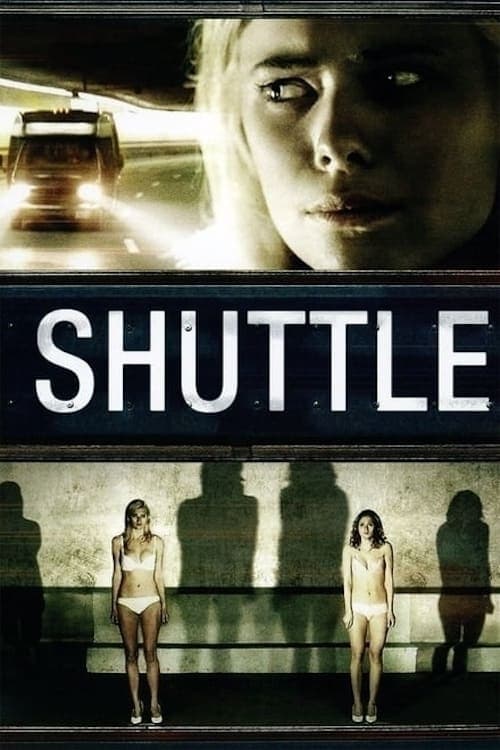
Mel and Jules are two girls returning from a vacation in Mexico. Arrived at Boston airport in the middle of the night and having had to wait to retrieve Mel's lost luggage, the two girls decide to go home with a shuttle, one of those private minibuses that connect the airport to the city center.
Mel and Jules are two girls returning from a vacation in Mexico. Arrived at Boston airport in the middle of the night and having had to wait to retrieve Mel's lost luggage, the two girls decide to go home with a shuttle, one of those private minibuses that connect the airport to the city center. With them in the vehicle, two boys who have been eyeing them since the airport and want to make a move, and a very anxious man who is in a hurry to get home. After driving around aimlessly through the deserted streets of the city and an accident that forces the shuttle to stop, the passengers discover that the driver of the vehicle has bad intentions. You know what the main problem is with a film that could have all the potential of a cult and instead turns out to be just a small movie? Starting with the wrong foot. Debutant Edward Anderson, who writes and directs "Shuttle – The Last Ride into Darkness", makes the mistake of making the story implausible from the beginning, messing up times and places in such a way that at the end of the viewing, with all the twists revealed, the viewer exclaims "But something like that would never be possible!" In short, if the foundations of the material used are not adequate, the building will collapse sooner or later. Anderson puts together a fascinating story that in some aspects approaches the torture porn genre, but the places where the story is set and the people involved, as well as some events brought to the scene, clash with overall credibility. Films like "The Monster of the Country Road", "Hostel", or "Turistas", to name three titles close to "Shuttle", were rightly set in "unsavory" locations and far from so-called civilization, or their inhabitants were somehow involved in the facts, in order not to leave any credible escape for the protagonists. In "Shuttle", everything happens in Boston, in public places like airports and gas stations, and if the unreal quietness of the night should create justifications, it is also true that in 90 minutes of film eyewitnesses to the events appear as if it were raining, the boys leave traces everywhere, and there is even a surveillance video in the gas station. Under similar conditions, how can we believe that the hoodlums always get away with it, even by bumping into, hitting people, and transporting hostages with the windows smeared with blood? Something inevitably doesn't add up. But let's do one thing, play the card of the providential suspension of disbelief, even if in this case forced, and imagine that the streets of Boston after midnight are really deserted like the Grand Canyon, that no one uses the night flights at the airport, that people do not notice the mess, the screams, and the shots. Let's pretend that all this is possible in an American metropolis – although the last point is not so improbable, after all – and then enjoy the intense thriller of the ingenuous Edward Anderson. The film starts with a slow, almost monotonous pace that frames a quintet of travelers who have ended up in the wrong place at the wrong time. The shuttle goes back and forth through the deserted streets, a movement almost hypnotic, anesthetized by the grayish photography and the chatter of the characters. Then a mysterious accident, the situation deteriorates, everything turns out to be a robbery, then a kidnapping, and the tension rises with twists, some very predictable, others less. The characters of the characters, in some cases, are cut with the axe, but overall they are more digestible than the average of productions of this type, with the joker of the two protagonists who are well matched with effectiveness (the one who is more cheerful and outgoing and the one who is more shy and reflective and who also has to get married) and well played by Peyton List ("Smallville"; "Flash Forward") and Cameron Goodman ("The Sect of Darkness"). The villain of the turn, played by the specialist Tony Curran ("The Legend of Extraordinary Men"; "Underworld: Evolution"), is a strange character, difficult to label as successful or not. On the one hand, one leans towards yes, appreciating his clumsiness and his transformation from lamb to wolf, on the other hand, one sees him fall into the usual clichés of the indestructible monster and in a character change perhaps too sudden. Of the two parts into which the film is ideally divided, one ends up appreciating more the second, although more conventional, than the first, too drawn out and dangerously static, where it seems that the script goes around in circles like the shuttle. The final, on the other hand, is one of those that strike, hard and almost surreal, a conclusion that allows a film that is mediocre all in all to remain in the viewer's mind for a few days, avoiding the oblivion to which everything seemed destined. If you can overlook the errors or carelessness made at the script level, there is a possibility that "Shuttle" may satisfy you, even because it improves with the passing of the minutes. However, there is this huge obstacle to overcome: the lack of credibility of the entire operation. Add half a pumpkin.
Comments
Comments (0)










Comments