











Le Verdict
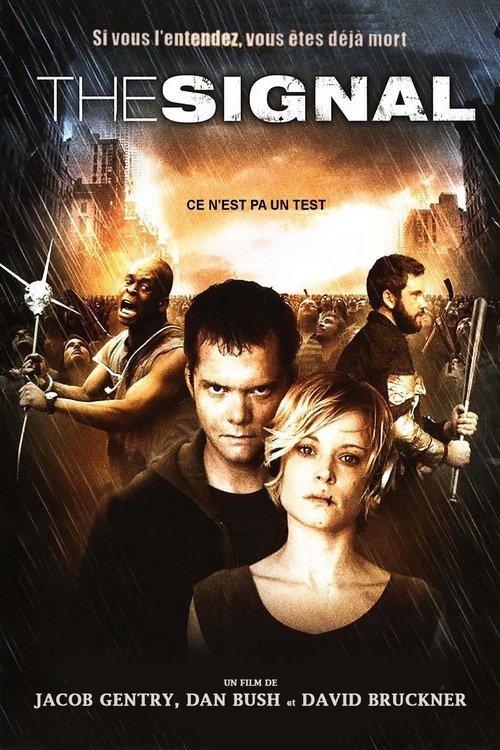
Dans la ville de Terminus, le chaos éclate soudainement. Un signal mystérieux s'insère sur toutes les fréquences audio et vidéo des moyens de communication, provoquant chez ceux qui en profitent un impuls inarrêtable de violence.
Dans la ville de Terminus, le chaos éclate soudainement. Un signal mystérieux s'insère sur toutes les fréquences audio et vidéo des moyens de communication, provoquant chez ceux qui en profitent un impuls inarrêtable de violence. Témoins de cette catastrophe, les amoureux Ben et Mya : elle est mariée mais entretient une relation avec Ben, avec qui elle voudrait fuir Terminus ; mais quand son mari Lewis découvrira l'infidélité de sa femme, déjà aveuglé par la colère que lui a insufflée le signal, il fera tout pour éliminer son concurrent et récupérer sa femme. "The Signal" est né comme une expérience : son titre de travail était "Exquisite Corpse" et c'était un défi que trois amis réalisateurs s'étaient imposé, à savoir que l'un d'eux commençait une histoire et les deux autres la menaient à terme en se passant tour à tour le relais au scénario et derrière la caméra. Le résultat final est, justement, "The Signal", un long-métrage insolite composé de trois parties (appelées thématiquement "Transmissions") qui racontent une seule histoire avec les mêmes personnages mais sous trois points de vue différents - un pour chacun des personnages principaux - et avec trois styles dissemblables. À bien y regarder, le film peut être considéré comme réussi même si toutes les parties qui le composent ne s'amalgament pas de manière impeccable. L'idée de départ n'a pas beaucoup d'originalité, dans la mesure où la folie qui enveloppe les masses jusqu'à les pousser à la destruction a déjà été explorée plusieurs fois dans le monde du cinéma, depuis "La cité sera détruite à l'aube" de Romero, en passant par "Impulse" de Baker, jusqu'au plus récent "28 jours plus tard" et ses suites ; même la cause déclenchante de la folie possède certains prédécesseurs, cette fois-ci littéraires, dans le récent roman de Stephen King "Cell" et surtout dans l'album n°5 de Dylan Dog "Les Tueurs". L'originalité du scénario ne réside donc certainement pas dans ce film, mais c'est plutôt sur ce qui peut susciter un intérêt plus grand, à savoir la structure semi-épisodique déjà citée et certaines thématiques qui y sont intrinsèquement abordées. Si la critique de la pervasivité des moyens de communication et leur pouvoir "hypnotique" est assez évidente, et d'ailleurs ne semble pas être au centre de l'intérêt des auteurs, ce qui émerge avec plus de force est la réflexion sur la crise du couple et le rôle déterminant que joue dans celle-ci la paranoïa. Le mariage est le premier lien à s'effondrer, encore avant que la folie ne prenne le dessus, écrivant ainsi un épitaphe sur l'institution qui se trouve à la base de la famille ; un mariage apparemment heureux mais destiné à la rupture se trouve aussi au principe du deuxième segment et dans ce cas également, la mort, la trahison - voulue ou non - et la fragilité de la relation planent sur chaque sentiment d'amour. L'amour ne réside donc pas dans la vie quotidienne, dominée par la mauvaise humeur et la violence, et peut être atteint par les protagonistes seulement en fuyant physiquement les liens qui les cimentent à une vie grise qui tend à les poursuivre. À ce stade, c'est la paranoïa qui joue un rôle déterminant car c'est le moteur principal qui pousse le méchant du moment à entreprendre une croisade contre les deux amants et c'est aussi le frein inhibiteur qui est abattu par le "signal". Comme nous l'est-il expliqué, en effet, le signal ne fait rien d'autre qu'accentuer l'indole paranoïaque inhérente à chacun de nous, déclenchant des cauchemars et des hallucinations qui poussent les "contaminés" à altérer l'état des événements en fonction de leurs peurs/obsessions internes, réagissant ensuite en défense. Il est ensuite intéressant de structurer l'ensemble de l'histoire en trois transmissions, même si les trois segments ne parviennent pas toujours à se lier avec naturel et efficacité. L'histoire est introduite par un mini-film à la réalisation très "indie" et aux caractéristiques évocatrices de certains films des années 1970 ("The Hap Hapgood Story" réalisé par Jacob Gentry, l'un des trois), qui anticipe de manière très marquée la violence et la torture qui suivront, en accentuant, voire, leur gratuité. La première transmission ("Crazy in Love") est réalisée par David Bruckner et peut être indubitablement considérée comme la plus réussie. Ici, certains films apocalyptiques dont il a été question plus haut sont ouvertement cités, en insistant beaucoup sur la relation entre les personnages et en introduisant la dimension intime de l'histoire. Probablement, le travail de "commencer" l'histoire était le plus simple, mais Bruckner, sans rien inventer, parvient à s'approprier les stéréotypes et à les réélaborer avec une certaine efficacité. Ce qui manque, en revanche, à la deuxième transmission ("The Monster of Jealousy") de Jacob Gentry qui plonge immédiatement dans les tons buffonesques de la comédie semi-démentielle. Le virage soudain des tons est cependant si brusque qu'il en devient intrusif dans l'histoire et ne s'amalgame absolument pas au ton apocalyptique général ; si quelques gags parviennent néanmoins à être réussis et l'usage de la violence est atténué par les situations grotesques, cela peut être tranquillement considéré comme le segment le moins réussi. Le rôle le plus difficile revient cependant à Dan Bush ("Escape from Terminus") qui non seulement devait conclure l'histoire de manière satisfaisante, mais devait aussi revenir à des tons plus sérieux. Le passage est cette fois-ci moins brutal et l'histoire se conclut néanmoins de la manière à laquelle nous nous attendions tous, avec un climax final confié à un affrontement verbal plutôt qu'à un affrontement physique : une transmission sans infamie et sans louange qui ne surprend pas mais ne déçoit pas non plus. Ce qui déçoit le plus dans "The Signal", c'est que, malgré l'alternance de trois réalisateurs qui adoptent également des "genres" communicatifs différents, le changement derrière la caméra ne se remarque jamais vraiment au niveau visuel et malheureusement, sous cet aspect, le film nous propose une réalisation plutôt plate, presque de téléfilm, probablement due aussi au budget exigu. En définitive, "The Signal" est un film qui se laisse regarder volontiers, ne surprend pas trop mais se laisse apprécier pour la volonté de vouloir expérimenter sur une thématique usée et rabâchée comme celle qui est abordée ici. La note est arrondie par excès.
Commentaires
Commentaires (0)









Commentaires