





Skip to content
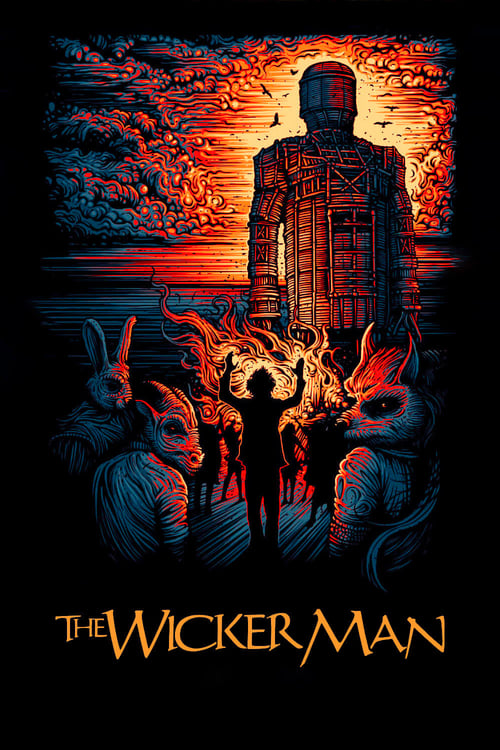
The Wicker Man poster

THE WICKER MAN

1973 GB HMDB
December 6, 1973

Police sergeant Neil Howie is called to an island village in search of a missing girl whom the locals claim never existed. The investigation is further complicated as Howie’s religious views clash with those of the island’s residents.

Directors

Cast

👍 👎 🔥 🧻 👑
Sign In or sign up to save your preferences

Comments

Comments (0)

Sign In or sign up to comment

Crew

Production: Peter Snell (Producer)
Screenplay: Anthony Shaffer (Screenplay)
Music: Paul Giovanni (Original Music Composer)
Cinematography: Harry Waxman (Director of Photography)

REVIEWS (1)

Antonluigi Pecchia aka Pax
The Verdict

Sergeant of police Howie was given the task of finding Rowan Morrison, a child mysteriously disappeared on the Scottish island of Summerisle.

Sergeant of police Howie was given the task of finding Rowan Morrison, a child mysteriously disappeared on the Scottish island of Summerisle. Arrived on the island, Sergeant Howie, a good Christian, will have difficulty getting in touch with the religion professed by the islanders, based on free sex; the inhabitants of the place, including a woman who should have been Rowan's mother, will initially deny knowing the girl. The sergeant begins to realize that there is something shady behind the whole affair, until he even finds the grave of little Rowan, but inside there is something other than the lifeless body of the girl. Meanwhile, the first of May, the day when the islanders celebrate a festival to thank their deities, is approaching more and more... "The Wicker Man" is a film that seeks to focus the viewer's attention on the feeling of estrangement in which the protagonist finds himself, thanks to the various orgiastic scenes and rituals, which make everything seem so strange and perverse, very disturbing, although there is no scene that presents splatter details throughout the film. The unease that is felt when watching "The Wicker Man" is not even softened by the presence of some songs and dances, which could almost remind in some scenes of a real musical. It is rather clear that one of the intentions of "The Wicker Man" is to denounce the concept of religion, a theme that certainly must be addressed very delicately and the film in question does it with a proper approach that does not skimp on showing and describing the degeneration of the cult in a completely explicit way. A masterpiece of psychological/religious horror that unfortunately has not yet been released in Italy, neither in VHS nor in DVD (there is only one version broadcast on television), probably due to the hot topics that go against the Catholic religion, but that make "The Wicker Man" a unique film of its kind. In the cast we also find Cristopher Lee in the role of the leader of the religious sect, who offers us here probably his best performance to date (according to himself), moreover, Lee also appears as the producer of the film. Recommended to everyone and not just to horror fans, although not particularly suitable for the most impressionable viewers, "The Wicker Man" is a gem that even today, many years after its release, manages to achieve its goal of confusing and misleading the viewer without revealing anything until the unexpected final twist. To be seen at least once in a lifetime for all lovers of thriller/horror.
👍 👎 🔥 🧻 👑

Comments

Comments (0)

Sign In or sign up to comment

Where to Watch

Powered by JustWatch

Questions about The Wicker Man

Where can I watch The Wicker Man in streaming?

The Wicker Man is currently available on Amazon Prime Video, Apple TV, Amazon Video, Google Play Movies, YouTube, Fandango At Home, BFI Player Amazon Channel, Amazon Prime Video with Ads.

  • Amazon Prime Video
  • Apple TV
  • Amazon Video
  • Google Play Movies
  • YouTube
  • Fandango At Home
  • BFI Player Amazon Channel
  • Amazon Prime Video with Ads
See all streaming options

How long is The Wicker Man?

The Wicker Man runs 93 minutes.

When did The Wicker Man come out?

The Wicker Man was released in 1973.

Who directed The Wicker Man?

The Wicker Man was directed by Robin Hardy.

What rating does The Wicker Man have?

The HorrorCult editors give The Wicker Man 5.0 skulls out of 5, from a single review.

Read the reviews

COMMUNITY REVIEWS (4)

John Chard

John Chard

10 /10

I believe in the life eternal, as promised to us by our Lord, Jesus Christ.

Mainland Sergeant Neil Howie (Edward Woodward) flies off to the remote Scottish island of Summerisle to investigate the disappearance of a 12 year old girl. What he finds is a culture steeped in Paganism, presided over by Lord Summerisle (Christopher Lee). Meeting static and indifference wherever he goes - and being driven to anger by the assault on his Christian beliefs - Howie is very much a man alone and most likely in grave danger?

Directed by Robin Hardy and adapted to screen by Anthony Shaffer from David Pinner's novel, Ritual, The Wicker Man is very much a cult masterpiece. The back stories to it could make a film all by itself, be it censor baiting, studio cuts, body doubles or just plain offending religious groups, it's a film that is well worth looking into via the top range home format releases.

From the moment Howie (a truly brilliant Woodward) lands at Summerisle everything seems off, there's a sinister atmosphere pervading the story. He is met by unnerving imagery wherever he goes, songs and rituals gnawing away at his senses, there's even eroticism deftly placed within the film's master plan. He doesn't know what's going on, and neither do we, this is a mystery right? There is after all a missing child to be found, right? But once Lord Summerisle (Lee also terrific) enters proceedings and ups his game, things unravel in edgy fashion, building up to the justifiably famous and harrowing finale.

Some modern horror fans may baulk at the lack of bloody carnage et al, but this is classic horror. A horror film bulging with intelligence and pulsing away with literate smarts. 9/10

CinemaSerf

CinemaSerf

6 /10

Well the cinema was packed as we all sat though what seemed like an interminable preamble of interviews with those connected with the film - including Britt Ekland - before it all started. Was it worth it? Well, I didn't really think so. Policeman "Howie" (Edward Woodward) arrives on a remote Scottish island after reports that a girl has gone missing. He is perplexed by the seemingly indifferent attitude of the locals who claim that she never existed or her mother who claims that she is six feet under in the graveyard. He becomes even more bemused by the general attitude of the villagers - led by their laird "Lord Summerisle" (Christopher Lee) and taught by their not quite "Jean Brodie" schoolteacher "Miss Rose" (Diane Cilento) to life in cereal, and to his presence in particular. Soon, his investigation starts to lead him a merry dance as he begins to suspect something way more sinister is afoot - and boy, is he correct. Thing is, though, can he find and save the missing girl and get to the bottom of this mystery. To be fair, it does offer us a more sophisticated, almost mythological, approach to an horror movie loaded with mysticism and pagan ritual. Indeed, I don't know that it fits well into that genre at all - it's more of a psychological thriller populated by a decent cast of household names. The thing for me is the story. I just found it all a bit weak; it takes far, far too long to build up anything like an head of steam and is really rather over-scored with music that is left do too much of the heavy lifting when it comes to generating the sparing senses of peril this film elicits. Perhaps it isn't fair to look upon it critically forty years later, when so many of our sensitivities have been eroded away, but I really couldn't figure out quite what all the fuss was about. It's now a cult film - and maybe that says it all? Worth a watch, but a television leaves nothing missing, I'd say.

OuroborosSurfer

10 /10

Here Edward Woodward stars as Sgt. Howie, a Christian Scottish policeman sent to the remote island of Summerisle to investigate the disappearance of a young girl.

The horror of the Wicker Man is not the obvious kind that hits you in the face with a hammer, but quietly creeps up on you. The way the pagan villagers act indifferently or defensively to the supposed disappearance or murder of a child is disturbing, especially as everyone seems to be hiding something, including the girl's classmates.

One criticism of the various heavily cut versions of the film is that not quite enough time is given to that subtle process of building up the suspense and atmosphere of the film. The Director's Cut, however, is a small masterpiece. The central idea of this closed-off pagan community, generally peaceful but indulging in the rare bit of ritual of human sacrifice, is delicious.

Woodward as Howie is on top acting form, as is the legendary Christopher Lee as Lord Summerisle. Economical storytelling ratchets up suspense and mystery. Additionally, the film boasts one of the best and most fitting soundtracks I've ever heard, comprised mostly of in world folk songs rather than generic "spooky" music.

The ending of The Wicker Man must go down as one of the most shocking in cinema history. Since the film plays it relatively cool until that point, the payoff is all the more harrowingly believable.

I also enjoyed the idea that, in terms of what may lie beyond death from the point of view of the characters, both Howie and the islanders get some kind of "reward" from the final ritual. The islanders get the reassurance that their crops will thrive in the coming year, while Howie gets his martyr's death and the expectation of a special place in heaven. The film made me think a lot about belief systems; who is to say paganism is less valid than any other system of religion? All religions are sustained by faith and passion rather than reason or evidence.

Thought-provoking, strangely beautiful, and just plain creepy, the restored version of The Wicker Man deserves its cult status. Even if you're not usually a fan of horror, you're likely to take something away from this burnt offering. The word "classic" was invented for this brilliant and eccentric film.

FolknHell

FolknHell

8 /10

There is something wonderfully perverse about The Wicker Man spending so much of its time refusing to look frightening.

Summerisle is bright, musical, fertile and apparently having an excellent time. People sing in the pub, copulate enthusiastically on the grass and decorate the place with enough fertility symbolism to make Sergeant Howie’s blood pressure a genuine secondary plot. Yet almost everybody he meets already knows exactly what is going to happen to him. That is where the horror really sits.

Howie arrives believing he is investigating the disappearance of Rowan Morrison, but he is actually moving through a carefully constructed ritual in which his own personality does most of the heavy lifting. His Christianity, virginity, sense of duty and magnificent capacity for outrage are not incidental character details. They are precisely what make him useful.

Edward Woodward makes that righteousness abrasive enough that Summerisle’s paganism can initially seem almost preferable. Then Christopher Lee’s Lord Summerisle appears, charming, amused and utterly certain of himself, and the film quietly removes the comforting idea that one belief system here is obviously saner than the other. Both men possess absolute faith. Only one of them knows how the day ends.

The animal masks sharpen that idea beautifully. Once the May Day procession begins, familiar villagers become anonymous creatures, individuality disappearing into ceremony. They are still the same people, but suddenly they look less like neighbours and more like a single organism carrying Howie towards its required conclusion.

And then there is the music. Because it belongs so completely to the life of the island, the songs make ritual feel ordinary. The Wicker Man does not gradually replace happiness with dread. It allows singing, dancing and communal celebration to continue right into murder. The hills really are alive. Unfortunately, so is the sacrifice.

Fifty years of imitation have made its ingredients familiar, but the peculiar mixture remains difficult to reproduce: mystery, musical, religious argument, dirty joke, pastoral idyll and finally something appalling.

The wicker man itself may be folk horror’s most famous image. The cleverer achievement is making us realise that the film has been inside it all along.


Reviewed by FolknHell, the folk horror film podcast · folknhell com

Hear the full FolknHell podcast discussion of The Wicker Man: folknhell com/the-wicker-man-review along with our other reviews, transcripts and episodes.

Reviews provided by TMDB