
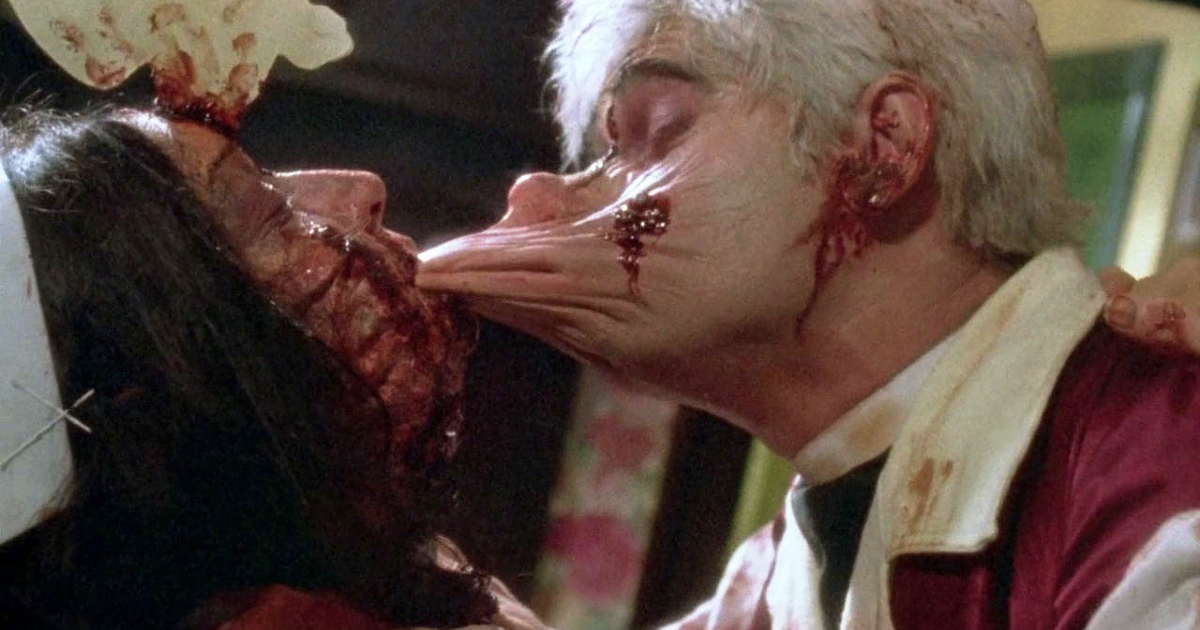
The phenomenon in question is difficult to define; it cannot be seen as a simple cinematic genre. Indeed, it is an element that characterizes and contaminates more cinematic categories, among the most diverse, from western to horror; even if it is especially in the latter type of film that we find it most often. There are two types of horror-splatter: one so exaggerated as to become grotesque, ironic, almost comic (an example for all is "Braindead" by Peter Jackson) and the other dark, realistic, of pure horror (see "Buio Omega" by D'Amato).
The horror-splatter phenomenon began to make headlines around the 1960s. Before that period, no one had dared to show violent, bloody, and gruesome scenes in cinematic works. However, this "taste for the transgressive" could already boast a respectable precedent in the Grand Guignol theater in Paris, where shock effects, especially based on abundant doses of artificial blood, were used copiously to increase tension in the spectator.
But let's talk about cinema in 1963, when the director Herschell Gordon Lewis, directing "Blood Feast," started the worldwide horror-splatter tradition. Considered the first splatter film in history, "Blood Feast," shot in just twelve days, had a phenomenal success for its time, opening the way to a new stylistic trend. Despite the rudimentary special effects available, Lewis managed to create scenes of great visual impact, especially for an audience not used to seeing rivers of blood on the screen. Among these, the violent extraction of an eye and the cutting of a tongue should be noted. Riding this success, the director made two more films between 1964 and 1965, "2000 Maniacs," in which some ghosts massacre the inhabitants of a town, and "Color Me Blood Red" in which a painter kills young women to use their blood as color for his paintings. With these two films, Lewis definitively paves the way for the birth of splatter cinema.
A few years later, another American filmmaker, Andy Milligan, began his career in this genre: with "The Ghastly Ones" (1969), a film that shows a series of massacres that occur in an eighteenth-century villa for inheritance reasons, and then with "The Torture Chamber" (1970), the story of an English nobleman who seeks to obtain a large inheritance by eliminating all the relatives who precede him in the dynastic line through a mysterious hooded executioner. But the best of it (so to speak) Milligan offers us with the subsequent "The Invasion of the Zombie Rats," in which a story of werewolves is inserted with improbable murderous rats, only to emulate the success of "Willard and the Rats" by Daniel Mann. The result is a film with an implausible plot, interesting only for the gruesome scenes that abound in the film.
But it is 1968 that sees the realization of the film that changes the history of splatter and marks world cinema indelibly. The film in question is "Night of the Living Dead" by George A. Romero, which, although not in color—a quasi-indispensable characteristic of splatter movies—contains scenes of rare violence, including the extraction of intestines, bloody bites on living bodies, and the putrefaction of flesh, entering the genre films by right. From then on, all genre directors will have to deal with this masterpiece! Strangely enough, a film from that period that gives us some of the most violent splatter scenes ever seen is a beautiful western titled "Soldier Blue" by Ralph Nelson (1970), in which, during the final sequence where we witness the attack of American soldiers on a Cheyenne village, we are shown sequences that, for their cruelty and absolute realism, can be calmly compared to the hardest images of splatter-movies: women tortured and horribly mutilated, decapitated children, young people who have their legs and limbs amputated, and mass slaughter.
To stay in the splatter-snuff vein of the 1970s, how not to mention the scandalous film by Michael and Roberta Findlay entitled "Snuff," in which there are sequences of such cruelty and realism that they can be taken for real, causing not a few problems for the directors, even in criminal court; and then "Last House on Dead End Street" (1977) by Victor Janos, which tells the story of a director who, desiring to shoot a snuff film, traps and then tortures to death two producers who had tried to deceive him; and finally "The Texas Chainsaw Massacre" (1974) by Tobe Hooper, where a family of maniacal butchers dismembers and then devours any unwitting victim who comes their way. Although, to be honest, this first film of the saga (to date we have 4 episodes) does not present a large number of splatter scenes, it remains a fundamental milestone in the horror filmography of the period.
Before moving on to the 1980s, which saw both the consecration of the splatter genre and its slow decline, a brief excursus on Italian-made splatter is in order. Blood began to flow in Italian films thanks to the master Mario Bava, who, with the extremely violent thriller "Blood and Black Lace" (1960), inaugurated the Italian splatter tradition. His subsequent "Bay of Blood" further exacerbated the characteristics of thrilling with strong tones, with serial violent murders and images that leave little to the imagination of the spectator, showing, with a wealth of details, tortured and dismembered bodies. The most illustrious disciple (although defining him as such is somewhat restrictive) of Bava is undoubtedly Dario Argento, who, continuing along the path traced by the master, directs some of the most violent gialli in the history of world cinema. His masterpiece "Deep Red" boasts a series of murders and violent deaths, captured with an attentive eye by the camera, that have nothing to envy to some of the most heinous splatter films of all time. But the two directors who in Italy brought splatter to the highest levels, both technical and artistic, taking into account the scarcity of means with which they were often forced to work, are undoubtedly Lucio Fulci and Joe D'Amato. Some of their works give us sequences from a true anthology of splatter cinema: who can forget the scene in which a girl vomits her own intestines in "City of the Living Dead" by Fulci, or the biting dismemberment of a pregnant Serena Grandi's fetus in "Antropophagus" by D'Amato, and again the bodies torn apart by the protagonist of "Buio Omega" by the same D'Amato and the famous sequence in which Olga Karlatos's eye is pierced with a wooden splinter in "Zombi 2" by Fulci. No one after them has been able to reach the transgressive and gruesome levels of their cinema.
With the 1980s, as mentioned, splatter achieved a role of great respect in world cinema. Two films in particular, thanks to their mega-success worldwide with the public and, for once, also with part of the critics, brought this particular genre to the forefront. I am talking about "Zombie" (1979) by Romero, which dispenses scenes of shocking violence with exploding heads, wounds that "vomit" blood, devoured intestines, impressive amputations in an orgy of blood perfectly realized by the "magician" of special effects Tom Savini; and then "The Evil Dead" (1982) by Sam Raimi, which, costing only $350,000, broke box office records worldwide, becoming a cult for many generations; putrefaction, amputations, dismemberment, the dissolution of entire bodies, all realized with rather homemade but absolutely overflowing and suitable effects, have decreed the success of this film. We are at the beginning of the 1980s, the golden age of splatter cinema, and on the wave of the two masterpieces by Romero (who in 1985 directs the third and final chapter of the zombie saga with the very splatter but less successful "Day of the Dead") and Raimi, a series of more or less important and more or less successful films are born that imitate their settings, plot, and prevalence for violent and bloody scenes; among these, the saga of "Return of the Living Dead" (1984) by Dan O'Bannon and the very splatter "Demon" by Lamberto Bava, both indebted to Romero's masterpiece, "The House" (1982) by J. Robertson, and the irreverent series of "Basket Case" (1981) by F. Henenlotter; all good horrors that dispense gore and splatter scenes in abundance.
In the mid-1980s, a couple of producer-directors stand out in this genre, giving us at least four films that enter the list of the best splatter films of the period. These are the mythical duo formed by Stuart Gordon and Brian Yuzna, to whom films such as "Re-Animator" (1985) and "From Beyond" (1986), directed by Gordon, and "Re-Animator 2" (1989) and "Society" (1989), directed by Yuzna, are owed. In particular, in the two chapters of the Re-Animator saga, which tell the story of a mad doctor who experiments on corpses and mutilated body parts in an attempt to bring them back to life, sequences of splatter at a very high level are wasted with severed hands, decapitations, autopsies, disembowelments, and even assemblies of different parts of bodies, all aimed at forming abominable beings. At the end of the 1980s, the public's taste changes; viewers have become accustomed to seeing violent scenes even on television, and the so-called splatter sequences of horror films no longer scandalize as much. For this reason, there is a move towards excess, beginning to show any type of indecency and atrocity possible to scandalize the public's sense of decency again; but such exaggeration inevitably descends into ridicule, and thus the splatter-demencial vein begins to assert itself.
In this situation, a newly born American production company takes on a leading role: "Troma." Directed by the producer-director Lloyd Kaufman, Troma becomes a true icon of independent cinema, giving us some of the most excessive and irreverent splatter-demencial films of the period, including the famous "The Toxic Avenger" directed by Kaufman himself. But the director who more than any other has known how to perfectly combine the most absurd demenciality and the most extreme splatter is undoubtedly the New Zealander Peter Jackson, who with two of his "works" has brought this genre to the highest levels. First of all, "Bad Taste" from 1987, a horror delirium with offal and disgusting liquids of all kinds, through which, in an ironic-grotesque key, he tells the story of some unlikely aliens who invade the earth to feed on human flesh; but above all, it is with "Splatters - The Braindead" ("Braindead") from 1992 that Jackson crosses the limit of decency: the final half-hour is a succession of skinning, eviscerations, offal, blood, and every other kind of filth you can imagine. So exaggerated as to deserve the title of the most splatter film in the history of world cinema!
But the film by Jackson represents a bit the swan song of the splatter-demencial vein and of the splatter itself in general. In the 1990s, films that can be comprehended in this genre can be counted on the fingertips of one hand, among which the only notable one is "Return of the Living Dead III" by Yuzna. It seems that the public's taste is now far from the splatter vein, which has become a niche phenomenon, loved especially by the very young or horror enthusiasts. Thus, semi-amateur productions proliferate, which achieve good success especially in some Northern European countries, such as Germany, or in Japan; among these productions, the series "Violent Shit" by Andreas Schnaas, the series "Nekromantik" by Jorg Buttgereit, and the "Tetsuo" by Tsukamoto should be mentioned. "Extreme" films in which the plot is little more than a pretext to show extremely violent scenes, at the limit of decency, often linked to rapes or violent sex scenes, which now have little to do with classic "splatter." The hope is that we can return to the original spirit of splatter and that this genre does not evolve towards films that show "only" sequences of repeated violence without some story or some logical connection.
Comments