Carnival of Souls backdrop
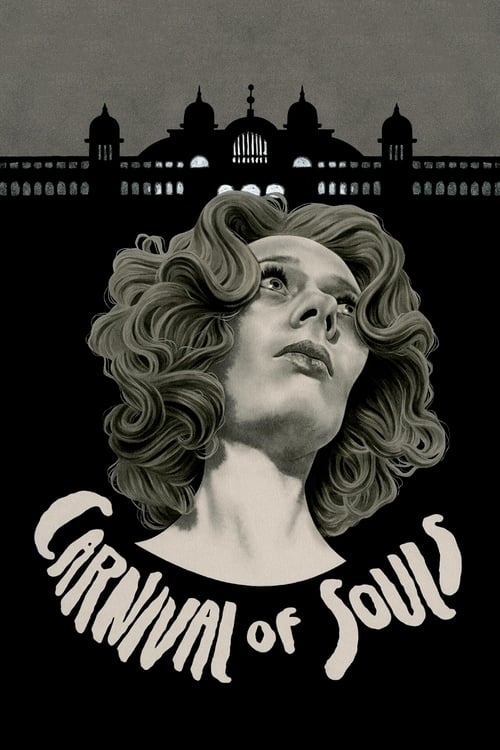
Carnival of Souls poster

CARNIVAL OF SOULS

1962 US HMDB
November 2, 1962

Mary Henry ends up the sole survivor of a fatal car accident through mysterious circumstances. Trying to put the incident behind her, she moves to Utah and takes a job as a church organist. But her fresh start is interrupted by visions of a fiendish man. As the visions begin to occur more frequently, Mary finds herself drawn to the deserted carnival on the outskirts of town. The strangely alluring carnival may hold the secret to her tragic past.

Directors

Cast

👍 👎 🔥 🧻 👑

Comments

Comments (0)

Crew

Production: Herk Harvey (Producer)
Screenplay: John Clifford (Writer)
Music: Gene Moore (Original Music Composer)
Cinematography: Maurice Prather (Director of Photography)

REVIEWS (1)

Marco Castellini
Two cars race at breakneck speed: one of them skids and plunges into a lake, sinking. Shortly after, a girl miraculously emerges from the waters, apparently unharmed, and is rescued by some passersby. Her life seems to slowly return to normal, but it is not so: the young woman is haunted by spectral apparitions, people behave strangely towards her, and she begins to feel drawn to a mysterious and gloomy abandoned amusement park. Telling the plot of this wonderful horror film from the sixties without revealing the ending is not an easy task; the most attentive viewers will have already guessed how the story ends, but even if that were the case, we still highly recommend watching it. Filmed in a livid and spectacular black and white with a very limited budget, and enhanced by a "disquieting" soundtrack, perfectly suited to the tone of the film, "Carnival of Souls" remains one of the best horror movies ever made, though, unjustly, one of the least known. Two of the most appreciated genre films of recent years, namely "Allucinazione Perversa" and "Il Sesto senso", owe a great deal to this small but great film, and some claim that even Romero drew inspiration from the atmospheres and settings of Harvey's film to shoot some of the sequences of his masterpiece "Night of the Living Dead" (see the final scene where some souls awaken and emerge from the lake's waters). Unfortunately, as often happens, while it is enough to go to any video store to find all the useless chapters of the various "Nightmare" and "Friday the 13th" sagas, masterpieces like this one (or "Ballata Macabra" by Dan Curtis, or even "Brood" by Cronenberg) are almost unfindable, and one must hope that some television channel has the good sense to air them (which, alas, is rather rare). An absolute cult film to watch and rediscover for all genre lovers. One last curiosity: the ghost that haunts the film's protagonist is played (and effectively) by the film's director himself, Herk Harvey, not because he wanted to appear in his film at all costs, but because he needed to save on the budget, and thus he managed to hire one fewer actor!
👍 👎 🔥 🧻 👑

Comments

Comments (0)

Where to Watch

Stream

Cultpix Cultpix
Chilling Chilling

COMMUNITY REVIEWS (4)

John Chard

John Chard

8 /10

We open with a car crash...

Mary and her two friends leave the road and fly off a bridge during a friendly dragster race. She is the only survivor and after her recovery she takes up a job as the church organist in a new town, but she is constantly blighted by a ghostly like visitor and periods of time when nobody seems to know she exists.

A hinted spoiler follows.

Carnival Of Souls has thankfully found a whole new audience in the new millennium, the advent of cheap triple pack DVDs and a lush Criterion release have brought it firmly to the attention of Horror/Ghost fans who were not aware that the film even existed. That said, there is no doubting that many big name directors were fully aware of it, tho, for Carnival Of Souls has influenced such luminary genre masters from Romero to Carpenter, and from Hooper to Shyamalan, be it the low budget DIY ethic, or its now genre staple twist ending, it's a film (along with it's director Herk Harvey) that is referenced as much as it is copied.

The tag often used for the film is that it's an elongated Twilight Zone episode, and sure enough I think that is a perfect fit. Its whole structure feels like a part of that wonderful and amazing Rod Serling show, and for sure this story owes a doff of the cap to An Occurrence At Owl Creek Bridge (an Ambrose Bierce short that was reworked and used on Serling's show), but to merely suggest a retread of a previously used idea would be very unfair. Carnival Of Souls is full of eerie sequences that are dream like in quality yet goose pimply in effect. Scored at frequent intervals by a jangling organ shrill, the ghostly phantoms that plague poor Mary actually bring a shiver to the spine; while a surrealistic dance of the carnival is a stunning eerie highlight. It's a wonderfully brought together story that has one pondering uneasily from the get go, managing to jolt your senses adroitly with a very special ending.

With a small budget of only $30,000 and a cast of friends, Herk Harvey crafted one of the best independent horror sub-genre films ever made. Don't believe me? Then go ask Romero, Raimi or Hooper. 8/10

Wuchak

Wuchak

7 /10

Haunting early 60's movie, like an extended episode of The Twilight Zone

A young woman (Candace Hilligoss) survives a vehicle accident in Lawrence, Kansas, and then is troubled by a specter (director Herk Harvey) and other strange occurrences as she moves to the Great Salt Lake region for a gig as a church organist.

"Carnival of Souls" (1962) is an eerie, moody cult flick shot in B&W, but not scary at all. It's similar in vibe to "Night Tide" (1961) with Dennis Hopper. The creepiest part is the girl's lecherous neighbor in Utah (Sidney Berger).

Besides the haunting ambiance, what I like best about it is the portrayal of two intersecting dimensions: Someone in the spiritual dimension can't be seen or (for the most part) heard in the physical realm. While it's overrated and predictable, it's still an interesting ghostly period piece.

The movie runs 1 hour, 24 minutes, and was shot in Lawrence, Kansas, and Magna, Great Salt Lake & Salt Lake City, Utah.

GRADE: B-/B

CinemaSerf

CinemaSerf

7 /10

When two groups of teenagers are racing their cars over a narrow bridge, an accident occurs and the car carrying the girls goes a-tumbling into the deep and muddy river below. It's during the extensive search process (a man with a bit of string with a weight tied to it) that "Mary" (Candice Hilligoss) emerges from the river, the sole survivor. Gradually, though, things start to become ambiguous - she is obsessed with a run down carnival nearby, is soon seeing apparitions and after a short while we all start to wonder if she is actually real or not! The acting from Hilligoss and from Art Ellison as the savvy preacher is quite compelling to watch (the dialogue much less so) and as the plot thickens, the drama builds nicely into quite a tense little horror story with an effective organ-based score to help raise the tension too. Watch it on a dark, wintery, night and it is a remarkably effective B-feature.

Filipe Manuel Neto

Filipe Manuel Neto

4 /10

Even bad movies deserve to have a place in history.

After seeing this movie, I'm left with the feeling that it's a bit overrated, even though it's undoubtedly a remarkable classic of psychological horror. It's more rudimentary than one would expect, and the lack of means and resources is evident. On a very tight budget, director Herk Harvey deserves praise for the way he made the most of what he had and made an authentic labor of love. After reading a little, I realized that this was the only feature film of him and actress Candace Hilligoss. Their careers took an unhappy course towards obscurity, largely because of the critical and box office failure of this film which, only years later, and at the expense of TV and VHS, would become worthy of some notoriety.

The film begins with a clash between two cars where one of them, with three girls, falls into a river. After three hours of searching, Mary Henry, one of the occupants of this car, appears miraculously alive. She is a musical performer and, after a while, moves to Salt Lake City to work as an organist in a small church. However, she is a person without faith, for whom it is just a job. Shortly after arriving, she begins to have frightening visions and trances involving a man and an abandoned building, on the shores of Salt Lake, where an amusement park once existed.

The film is happy at building a mysterious and intriguing environment, but it never crosses the border into genuine horror. The sound and an organ soundtrack contribute enormously to this atmosphere (the organ, a very erudite instrument, gradually became umbilically linked to horror). The cinematography is raw and disagreeable, and the most interesting set is the Saltair Pavilion, which still exists, very modified and different from what it was in this film. The film cleverly uses local extras and actors to save money. However, the amateurism, the bad dialogues, the poverty of the script and the lack of a capable director completely compromise the effort of the cast. Even Candace Hilligoss looks bad. As we watch the film, we understand well the reasons that dictated its failure. As a film, it's a mediocre job, it's not even disturbing. So why on earth has it become so prestigious nowadays?

I believe that the key to understanding this lies in the “cult” phenomenon itself. The essence of this cultural movement lies in the search and recapturing of original material, somewhat forgotten or poorly appreciated in its time. And this film, as it turns out, is precisely within the genre of stuff sought after by “cult” followers. It is because of their action that this film won over its audience after a long time.

Reviews provided by TMDB