








Kynodontas (Dogtooth) backdrop
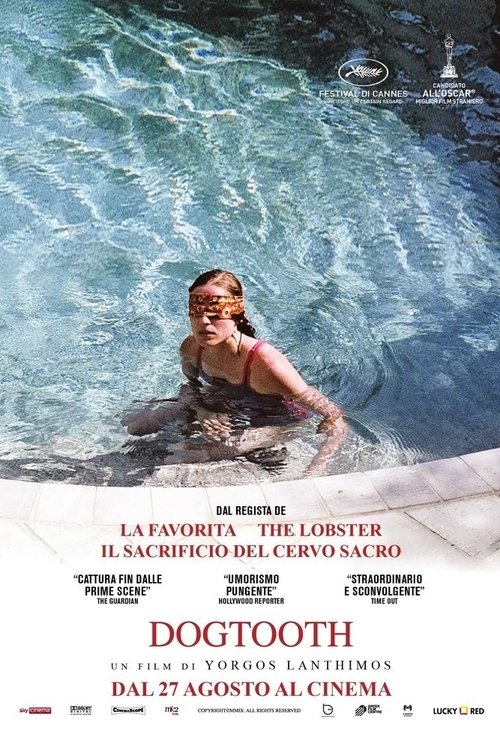
Kynodontas (Dogtooth) poster

KYNODONTAS (DOGTOOTH)

Κυνόδοντας

2009 GR HMDB
ottobre 22, 2009

Una famiglia fa vivere i propri figli segregati nella propria villetta. Essi sono completamente isolati dal mondo reale, un mondo estremamente diverso da quello posticcio ed assurdo in cui si trovano dalla loro nascita. Christina, una collega del padre che l'uomo fa prostituire per dare una vita sessuale forzata al figlio, sarà la molla che porterà la sorella maggiore ad esplorare una parte della verità negata e a sconvolgere i malati equilibri della famiglia.

Cast

👍 👎 🔥 🧻 👑

Commenti

Commenti (0)

Troupe

Produzione: Ηρακλής Μαυροειδής (Executive Producer)Άγγελος Βενέτης (Executive Producer)Γιώργος Τσούργιαννης (Producer)
Sceneggiatura: Yórgos Lánthimos (Screenplay)Ευθύμης Φιλίππου (Screenplay)Arturo Ripstein (Writer)José Emilio Pacheco (Writer)
Fotografia: Θύμιος Μπακατάκης (Director of Photography)

RECENSIONI (1)

Andrea Costantini
Una famiglia vive in una lussuosa villa con piscina alla periferia di un posto sconosciuto. La casa, immersa nel nulla con un enorme giardino, ospita una famiglia particolare composta da cinque persone: la madre, il padre e i tre figli, due femmine e un maschio. I figli, senza nome, sono stati cresciuti dai genitori all’interno della casa secondo le regole dettate dai famigliari. Ma non si tratta di una semplice scelta di educazione casalinga. I ragazzi non hanno mai messo piede fuori di casa in tutta la loro vita e hanno una visione totalmente distorta del mondo esterno. Ogni concetto che potrebbe far loro credere che esiste una vita al di fuori della villa, è stato storpiato dai genitori e completamente ridimensionato. “Le parole nuove di oggi sono: mare, autostrada, escursione e carabina. Mare è una poltrona in cuoio, autostrada è un vento molto forte, escursione è un materiale durissimo per fare i pavimenti e carabina è bellissimo uccello bianco”. Si tratta dell’incipit di “Kynodontas”, e già dalle prime parole capiamo che non stiamo guardando un film del tutto regolare. Si tratta della prima opera importante del regista Giorgos Lanthimos che, con la sua anima piuttosto controversa, ha vinto la sezione Un Certain Regard al festival di Cannes ed è addirittura arrivato a sfiorare l’Oscar come miglior film straniero. Una pellicola che quindi ha colpito positivamente pubblico e critica, nonostante tratti una storia che definire “folle” sarebbe un eufemismo. Si narra di una famiglia composta da cinque persone: il Padre, la Madre, il Figlio, la Maggiore e la Minore. Non hanno nomi, non hanno identità e la loro peculiarità è che non hanno mai avuto alcun tipo di contatto con il mondo esterno alla loro casa. Non hanno mai visto altre persone ad eccezione di Cristina, la “valvola di sfogo” del Figlio e l’unico personaggio del film ad avere un nome. Non hanno mai visto un telegiornale o una trasmissione televisiva. Ascoltano solo vecchi dischi di Frank Sinatra in cui credono che sia il loro nonno a cantare. Utilizzano il televisore solo nei momenti di festa in cui rivedono filmati di loro stessi mentre festeggiano per qualcosa di assolutamente stupido. Vivono e hanno sempre vissuto lontano da tutto e soprattutto all’oscuro di tutto. E i genitori lo hanno fatto non per cattiveria ma per preservarli dal mondo. Ma in che modo l’hanno fatto? Deviandoli completamente da ogni regola conosciuta alla civiltà. Le parole hanno un significato diverso da quello reale, gli aerei cadono abitualmente in giardino e possono essere raccolti come premio, i pesci nascono spontaneamente in piscina e i gatti sono animali pericolosi, le creature più spaventose che si possano mai incontrare. La loro vita è segregazione, ma non per sempre, “il momento in cui sono pronti per lasciare la casa è quando il canino cade. Non importa se il destro o il sinistro. Ma per lasciare la casa bisogna usare la macchina e si può usare solo quando il canino ricresce.” Frase emblematica del film che racchiude tutta la poetica folle, volta al benessere insano dei ragazzi. Ne è un esempio il fratello che vive al di là della recinzione, simbolo della ribellione e artificio per mantenerli in casa. Tutto ciò che si vede nel film è contrastante con il concetto stesso che viene espresso in quel momento. Mentre si pensa che tutto è fatto a fin di bene, nello stesso momento si cambia opinione e si punta il dito contro i genitori (indubbiamente malati) ma che provano un amore incondizionato e totalmente sbagliato per i figli. Un film folle, lento, fatto di lunghissime inquadrature che aiutano a comprendere la monotonia della vita nella casa. Il colore bianco è predominante, forse per rappresentare purezza apparente che regna sui figli, in realtà tutt’altro che puliti. Come dei bambini, scoprono il potere dello loro corpo, sperimentando tra di loro. Sempre in bilico tra dramma, horror e grottesco non è un film che non sa che direzione prendere, anzi è chiarissima la strada che vuole percorrere e racchiude tutti e tre i generi equamente. Scene come la recita con ballo, palloncini e torta oppure il Padre che annuncia che la Madre è incinta di un bambino e di un cane sono scene di così forte impatto in cui non si sa se ridere, spaventarsi o provare imbarazzo. Forse nessuna sensazione o forse tutte e tre insieme. “Kynodontas” è un film scioccante, ma non come potrebbe essere un horror d’impatto perché di fatto non è un horror, non è un film in cui la violenza psicologica è insostenibile, costruita su un escalation di tensione che lascia lo spettatore scosso per giorni interi. Non è una tragedia famigliare e non succede mai quello che ci si aspetta succeda perché è impossibile durante la visione formulare un ipotetico epilogo. Non è un sacco di cose ma al tempo stesso è tutto. Alla fine della visione lo spettatore sarà scosso e incuriosito a tal punto che non potrà fare a meno di pensare a come sia potuta venire in mente un’idea del genere. “Kynodontas” è stato tradotto per il mercato internazionale come “Dogtooth”, che letteralmente significa “canino”.
👍 👎 🔥 🧻 👑

Commenti

Commenti (0)

Dove Guardare

Noleggio

Apple TV Apple TV
Rakuten TV Rakuten TV
Timvision Timvision
Chili Chili

Acquista

Apple TV Apple TV
Rakuten TV Rakuten TV
Timvision Timvision
Chili Chili

RECENSIONI DALLA COMMUNITY (3)

MoHA

5 /10

Doogtooth, the official Greek entry to the 2011 Academy Awards, is nominated for Best Foreign Film. Released in 2009, and directed by Giorgos Lanthimos, Dogtooth is a strikingly original film that captures a world that is at once like nothing you’ve ever seen, but oddly familiar at the same time.

The story is about a family of five who live in a beautiful walled villa in Greece. It’s more like a compound because the patriarch (Christos Stergioglou) is the only one who ever gets to venture into the world beyond the tall fences that surround the property. His wife (Michele Valley) and three teenaged children live in a world that at first seems oddly Edenic.

The film opens with the children listening to an instructional cassette. They learn that the word “sea” means a leather armchair, “motorway” means a strong wind, and “excursion” means a strong, resilient material. Anything that hints at the world outside the walls of their home is obscured. Even the airplanes that fly in the air are construed to be toys, and when one is spotted, one of the parents will run into the house and through a toy plane out into the garden so the children will believe the lie.

The only outsider allowed into the compound is a woman named Christina (Anna Kalaitzidou), a security guard at the father’s place of employment who moonlights as a kind of private prostitute whom the father hires to satisfy his son’s budding sexual urges. Christina is brought to the compound blindfolded, but on the rides to and from the family home, the father tries to engage her in small talk, which amounts to questions about her hygiene, and whether she wears the perfume he has bought her as a gift.

Much time is devoted to daily routine of the family.

We see the father at work, where he has created yet another elaborate ruse to get out of having his boss over for dinner (he says that his wife, a former handball champion, is confined to a wheel chair – the result of a tragic accident). He’s such a cipher of a man that the boss, along with the children, buys into the lie without a hint of suspicion.

Life at home, though, is where the film really shines. We see the kids at play. The eldest child is the son (Hristos Passalis), who looks to be 18 or 19. Two sisters (Angelika Papoulia and Mary Toni) look to be 18 and 17. Though they are on the verge of adulthood, the behavior of the children is more pre-adolescent. There is an innocence about them that is both sad and endearing. The actors playing the kids beautifully capture the behavior and mental territory of young kids that comes through in the games they play and the way they bicker with one another and depend on their parents for all their information about the world – a world they will only be ready to experience when either their left or right dogtooth falls out.

What is a dogtooth? Exactly.

When the son asks the mother what a zombie is, she asks where he heard the word. He lies and says that he thinks he heard the father say the word. The mother pauses, then tells him a zombie is a small yellow flower. Later, the joke is paid off when the son stops in the middle of his play in the garden and yells for the mother to come and see two zombies he’s found.

Tricking children is one thing, but as they grow, certain fantasies and myths that parents create are found out to be lies. Of course, this often happens when our kids come home with conflicting information from the outside world, which is what happens to make the artificial world of the father begin to unravel.

Christina, the prostitute, wants oral sex, which the son doesn’t like, so she bribes the oldest daughter into satisfying her by bringing videos, like Rocky and Flashdance, that give the daughter a notion of what goes on in the world her father has taught her to fear.

These videos are like the bite from the fruit of the tree of knowledge of good and evil, and even though the father finds out about them and banishes both them and Christina from their lives, the damage has been done. Things will never be the same again.

The acting in Dogtooth is beautifully realized.

Stergioglou doesn’t play the father as a tyrant, but as a kind, loving, but firm parent, with only the best interests of his family – as he sees them – in mind. This father, despite what happens in the movie, never comes across as a villain, which is to Stergioglou’s great credit.

The children, especially Papoulia and Tsoni, capture a prolonged innocence that doesn’t rely on tricks or costuming, but on finely observed performances. What’s weird is that these are very damaged people, but until they are told so or try to live in the outside world, they’re just kids.

Because of how perfectly Lanthimos sets up this alternate world, I never once questioned anything that went on there. It all made sense. Dogtooth is a well constructed escape that takes a long, hard look at family and parenting and the choices we sometimes make as parents to both lock out the world and lock in our kids – and the toll those decisions sometimes take. Sometimes sad, sometimes funny, Dogtooth is a film deserving of its nomination – and your attention.

CinemaSerf

CinemaSerf

7 /10

Unnamed parents (Christos Stergioglou and Michele Valley) are so obsessed with their children that they have, over the years, created an walled environment in which they see nobody but each other and never leave their substantial rural home. There is one exception, and this is "Christina" (Anna Kalaitzidou) who is brought in from time to time as the paid sex pal of their son (Christos Passalis). Father drives to work each day whilst the remainder of the family live what can only be described as a surreal existence where even words mean different things. Did you know that a zombie was really a buttercup in disguise? Things start to get a bit out of hand, though, when "Christina" starts a friendship with their younger daughter (Mary Tsoni) and the dynamic of indoctrination and intimidation starts to unravel a little. The children (all in their late teens or older) start to question the reliability of their parental information and to become restless for new information and freedom. The parents are having none of this, though, and this leads to some drastic action from the father and some even more from their younger daughter who devises a cunning plan to break free from this silken yoke. There's something spookily controlling about the way Yorgos Lanthimos presents this story to us. It's a bit of ignorance is bliss married to you don't miss what you never had and the result is a naiveté borne of three siblings who take on blind faith a scenario that they simply can't envisage being different. The performances from Stergioglu as the sometimes quite brutal father and from Kalaitzidou, their visitor, evoke some serious feelings of discomfort and the sight on the son parading around the garden as though he were a boy fifteen years younger is distinctly disconcerting. Is it plausible? You'd like to think not.

r96sk

r96sk

9 /10

<em>'Dogtooth'</em> is certainly a Yorgos Lanthimos film! On the whole, I found this fascinating. It gets quite disturbing in parts, as you'd expect from this director, but all in all it is very good. The plot starts out difficult to read, though does quickly become clear and well portrayed.

Christos Stergioglou is a perfect fit for his role, rather intimidating and controlling. Angeliki Papoulia, Mary Tsoni and Christos Passalis bring noteworthy performances as the children, Papoulia and Tsoni particularly stand out. It's not a film that is cast reliant, but they play their part.

Looking back, it is quite a slow paced and meandering movie. However, that's basically only in retrospect because whilst watching I didn't actually feel that to be the case, which is a big positive. The film is wonderfully shot too, not that I expected any less having seen Lanthimos' most recent (similarly as great) releases.

Recensioni fornite da TMDB