














The Verdict
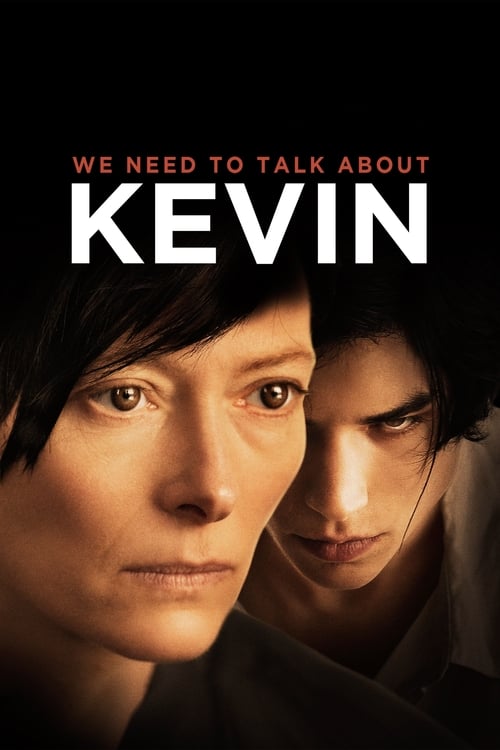
Eva is a woman in her forties who frequently has nightmares and memories of a recent tragic past. Her first son, Kevin, has always been a problem: as a newborn, he never stopped crying, and in his early years, he wouldn't say a word.
Eva is a woman in her forties who frequently has nightmares and memories of a recent tragic past. Her first son, Kevin, has always been a problem: as a newborn, he never stopped crying, and in his early years, he wouldn't say a word. As time passed, he became increasingly disobedient and "bad," as if he had truly targeted his mother. Many family problems, including a serious accident involving his younger sister for which Kevin might have been responsible. Until one day, the sad news arrives: while Eva is at work, she learns from a colleague that a massacre has occurred at the school Kevin attends, where a student armed with a bow and arrows has committed a slaughter.
A pile of bodies seen from above, tangled and dirty with a red substance that, at first glance, would seem to be blood but which we quickly discover is tomato. A folkloric ritual from an unspecified locality, a festival, in which we discover that Eva, the film's protagonist, is happily splashing in a purple river. An unusual beginning for "...And Now Talk About Kevin," visually and emotionally very strong and with undeniable symbolic value: Eva seems destined to sink in the blood, a foreboding and at the same time a memory of an announced tragedy. And blood, or things that strongly remind us of it, is a bit of a leitmotif that accompanies the entire film, as if Eva were now marked, dirty with red liquid and therefore destined to scrape it off the walls of the house, the windshield of her car, and many other places that represent everyday life. And it is precisely everyday life the territory of action for the protagonist, an adventure and exotic places writer, trapped in an ordinary life that clearly does not belong to her and that she does not accept "because" of a probably unplanned son. Kevin bursts into Eva's life and upends it to the point of catalyzing not only the attentions but also the frustrations of the woman onto himself. And here comes the focal point on which the main character, director Lynne Ramsay, and the author of the novel on which the film is based, Lionel Shriver, reflect. Is Eva responsible or not for what her son will do on the eve of his sixteenth birthday? The woman questions this subject, digs into her memory, analyzes every step of Kevin's life up to the crucial moment in search of a clue, a motivation for the formation of a "monster."
"...And Now Talk About Kevin" is not an easy film. Lynne Ramsay, who had already tackled a dramatic story with "Ratcatcher," chooses the most complex path to tell a story of double alienation, that of the mother and that of the son, seeking to understand the motivations behind the massacres that often fill the pages of crime news. As it should be, the director, as well as the author of the novel on which "...And Now Talk About Kevin" is based, do not find that motivation, and at the moment when the mother asks her son the reason for that absurd act, he looks at her confused and says that he once knew what that reason was, only that he is no longer sure now. The lack of a true motivation, the banal nature of evil, the most realistic and absurd.
However, Ramsay, who has a firm and very formal hand in directing, enjoys telling us about Kevin with a monster so loaded with negative aspects from a very young age that it makes him paradoxically unrealistic. Faced with the Kevin told here, even the young Damien from the "Omen" saga would pale, a meanness and a "stupidity" brought to maximum levels that almost clash with the film's overly authorial tone.
The actors are all good, from the absent father John C. Reilly to the teenage Kevin Ezra Miller, but she, Tilda Swinton, stands a head above all. Probably, we are facing the best performance by the actress in question, so physical, suffering, and participatory that it is practically perfect. One of those cases where the actor truly makes the film.
Interesting is the use of the soundtrack, which uses "Everyday" by Buddy Holly and "Last Christmas" by Wham with such irresponsibility that it becomes a well-chosen choice. Too ordinary sets and a modest staging make "...And Now Talk About Kevin" seem much poorer than it actually is, but probably all this is part of the overall plan of tendency toward the annihilation of the character and the world in which she lives.
Certainly, the film lasts a bit too long for what it has to tell (almost 2 hours) and often a certain narrative dragging made of repetitions and silences is perceived, surely avoidable with greater attention in editing. Ramsay plays at making an auteur film but it is evident that not everything plays in her favor; in the end, we have a fascinating hybrid between the vein of evil children and that of massacres in the style of Columbine that positions itself in that limbo that gathers films of the "pretentious" genre. And at the end of the viewing, a scene will echo in the spectator's mind: Eva, tired of the deafening cries of the newborn Kevin, stands with the stroller stopped on the road near a worker using a jackhammer. Chilling!
Comments
Comments (0)



















Comments