
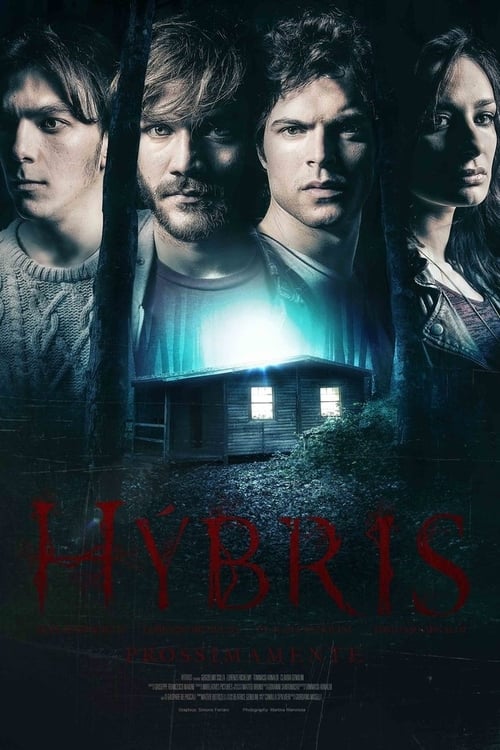


To respect the last wishes expressed by a dear friend at the point of death, four young people are forced to spend a night inside an abandoned house in a forest, with the aim of honoring the memory of the deceased and reviving the good times when they formed a happy and carefree group. The pleasant climate of nostalgia, however, is soon interrupted by a supernatural force that deprives the house of doors and windows, thus leaving the protagonists in front of their past ghosts and all the never-quenched resentments. Thus begins a slow and irreversible escalation of violence and madness that penetrates their minds.
After enjoying decades of fame and international recognition, our horror cinema has entered an irreversible phase of crisis, productive, economic, and consequently also qualitative. However, in recent years, numerous independent directors have been trying to reverse this situation, and the most pleasant thing is that most of them are of a fairly low average age. To give an additional boost to this trend, there is Mirelatives Pictures, a young production company whose main objective is to give space to emerging authors active in the field of genre cinema.
Among these is Giuseppe Francesco Maione, a Neapolitan director born in 1993, who with his debut film, titled "Hybris," ventures into the commendable attempt to take the usual clichés from 1980s horror cinema, following more specifically the model traced by "The Evil Dead" by Sam Raimi, and blend them with elements closer to drama to create a story that knows how to surprise the viewer and induce them to reflections. The result, however, is a huge hybrid, a bland and unimpactful film, despite the starting idea being anything but bad.
The story indeed starts from a rather noble and committed starting point from a cultural perspective: the concept of "hybris," a recurring theme of Greek tragedy that indicates the arrogance and pride of men towards the gods, but which here can also be read as a negative past event whose effects fall on the present. An impending threat to the four protagonists like a sword of Damocles, embodied not by the classic invincible and masked serial killer, but by a supernatural force that induces each of them to confront their conscience and bring out the real balances of their relationships. And in this sense, a not-so-veiled criticism of the feeling of friendship can also be seen, characterized at times by river hypocrisy and by many things left unsaid and repressed, ready to explode at the first good opportunity.
The ingredients to witness a good horror and a sadistic spectacle with a high grandguignolesque rate would all be there, if not for a long list of defects that undermine its success. First of all, one cannot fail to notice the absolute superficiality with which the psychologies of characters too anchored to the stereotypes of the genre and little changeable within the story are traced; here we find the usual couple of brothers with a problematic and ambiguous relationship, the typical handsome and cursed with a dark past, and her boyfriend who easily loses his temper at the first difficulties. But that's not all. Another major flaw of the film, perhaps the main one, is the absolute lack of rhythm caused by an excessive amount of long and useless dialogues that far surpass the action, thus creating numerous dead moments that never allow the film to take that extra something to captivate the viewer and end up making it a tedious version of "The Evil Dead" in an intellectual key. To this must be added the absolute indecision that the screenplay shows in the path to follow, with the imprint of the psychological thriller to which suggestions of pure demonic horror are added - with bones that crack in an unnatural way - decidedly unsuited to the spirit of the film and placed with the simple intent of enriching improbable sequences of tension with a rather inconclusive ending.
A boat that is taking on water from all sides from which only the happy choice of the interior environments of the house, made quite unsettling by a photography that privileges warm colors, and the cast, formed by the former "liceali" Tommaso Arnaldi (who is also the film's screenwriter) and Lorenzo Richelmy and two stars of the web world like Guglielmo Scilla and Claudia Genolini, whose good performances are nullified by all the above-mentioned limits, are saved.
"Hybris," in conclusion, has the bitter aftertaste of a missed opportunity and is the classic demonstration of how the saying "I would like to, but I can't" is always up-to-date. The idea was there, the realization a little less.
Comments
Comments (0)

Comments