



















The Verdict
Spain, 1944. The war has just ended.
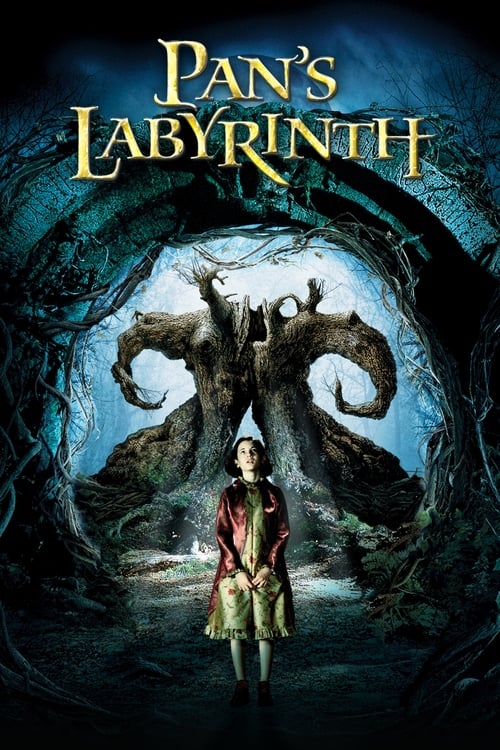
Spain, 1944. The war has just ended. Ofelia moves in with her pregnant mother, Carmen, to the residence of her stepfather, Captain Vidal, a despotic military officer commanding a Francoist detachment. On the very night of her arrival, Ofelia encounters a fairy who asks her to follow her to a labyrinth located in the garden of the house; here, Ofelia meets a Faun, a mythological creature who reveals himself to be the guardian of a fantastical world and that she herself is the princess of this world, but to be recognized as such, Ofelia will have to face and overcome three trials. Meanwhile, while Ofelia prepares to execute the Faun's orders, a group of anti-Francoist rebels tries in every way to penetrate Vidal's residence.
Presented in competition at Cannes 2006 and nominated for the upcoming Oscars as Best Foreign Film, "Pan's Labyrinth" is presented as the final work of the talented Mexican Guillermo del Toro, an already established author of fata-horror cinema, capable of alternating small but impactful films produced in his country ("The Devil's Backbone") with Hollywood megaproductions ("Hellboy"), never missing the target.
"Pan's Labyrinth" is the second chapter of a very personal trilogy that Del Toro has wanted to dedicate to the Spanish Civil War and of which the first chapter was "The Devil's Backbone" and the last will be "3993". As in the previous film, here too the film's point of view is that of a child, as if to minimize the horror of war, filtered through the innocent eyes of an individual surely more interested in comic books or fairy tales, although inevitably destined to confront suffering and death. However, if in his previous film Del Toro put into action an inner growth of the young protagonist, making the entire story a metaphor for the loss of innocence, in "Pan's Labyrinth" he takes the opposite direction, emphasizing the importance of childlike imagination and encouraging not to be carried away by dramatic events and, therefore, not to lose innocence, because only this state of purity can save the soul. The young Ofelia is immediately presented as a girl perpetually with her head in the clouds, capable of imagining stories of fairies and elves on every occasion and, thanks to her vivid imagination, she will be able to distract herself from the horror that surrounds her, from the vengeful moles infiltrated in Vidal's palace and above all from Vidal himself, a selfish, arrogant man of almost inhuman cruelty, concerned only with executing Franco's orders and ensuring offspring that can bear his name and that of his esteemed father.
The film unfolds on two parallel planes, apparently antithetical but entirely functional to each other: on the one hand, we have the real world, dirty with blood and loaded with hate; on the other, we have the fairy world with which Ofelia interacts, populated by wooden monsters, child-eating ogres, giant frogs, and insect-fairies; a world that can ensure the girl a happy life far from the people who can harm her. The two planes will tend to confuse and merge several times, insinuating doubt in the spectator's mind about what is real and what is not, in a perfect synchronicity of genres ranging from fantasy to war.
It is due to clarify that "Pan's Labyrinth" cannot be considered a true horror film, but rather a black fairy tale, which follows (and pays homage) in several points to "Alice in Wonderland" by Carroll, although it does not skimp on crude scenes bordering on splatter (in Italy the film is banned to those under 14) and truly frightening sequences, as happens in the splendid banquet scene, in which Ofelia will meet an Ogre with eyes on the palm of his hands, very hungry.
Del Toro's direction is, as usual, impeccable, here supported by good photography by Guillermo Navarro and some suggestive sets. The special effects (both makeup and digital) are also of high level, as are the performances of all the actors, among whom stand out for talent and characterization of the characters, the young Ivana Baquero, in the role of Ofelia (incredibly resembling Asia Argento as a child) and Sergi Lopez, in the role of the sadistic and ruthless Captain Vidal. A separate mention goes to the talented and heavily made-up Doug Jones who here plays both the Faun and the Ogre, undergoing hours and hours of exhausting makeup sessions, just as he had already done in "Hellboy", where he played the amphibious monster Abe Sapien.
In conclusion, "Pan's Labyrinth" is a must-see film, capable of captivating, scaring, moving, and making you think; a great surprise for the public and a confirmation of talent for Del Toro.
Comments
Comments (0)




Comments