














The Verdict
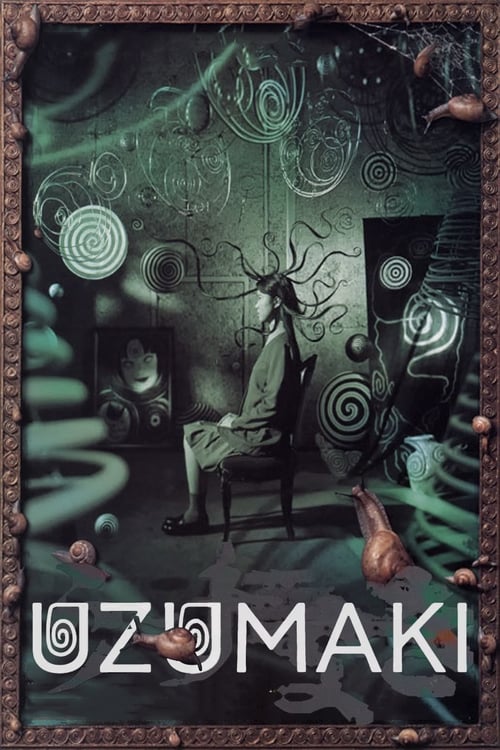
In a small village in Japan, mysterious events are disrupting the lives of some inhabitants. Many begin to be obsessed by the figure of the spiral to the point of madness or, in more severe cases, death.
In a small village in Japan, mysterious events are disrupting the lives of some inhabitants. Many begin to be obsessed by the figure of the spiral to the point of madness or, in more severe cases, death. Among them is Shuichi's father, who, initially attracted and intrigued by anything shaped like a spiral, will go as far as a tragic suicide that seems to always call upon the mysterious shape of the spiral. From this moment on, Shuichi, along with his girlfriend Kirie, will plunge into a strange world of delusions and madness caused by strange spirals and mysterious vortices that open up in the village's skies.
"Uzumaki" is a horror, but at times it appears more fantasy than horror, directed by Higuchinsky in 2000, but it arrived in our country only in 2007, distributed (naturally) exclusively for home video by the distribution company Dynit (a distribution company particularly fond of Eastern productions).
"Uzumaki" is an unusual and very original horror, perhaps too original as it offers nothing concrete but only many abstract ideas (a spiral as a threat??), which differs greatly from what the Eastern cinematic landscape generally offers, as well as the Western one.
After watching "Uzumaki," the audience that has seen it can be divided into two quite different streams of thought: there will be the judgment of the average viewer, who will remain terribly disappointed by what they have just seen and will surely have watched the film with a fixed eye on the clock to see the minutes remaining until the end of the film; but on the other hand, we can find the judgment of the cinephile viewer who will surely find positive aspects thanks to excellent (but one could use the adjective "exceptional") technical qualities.
The film, as already mentioned, deals with an original, bizarre story, a story that, although extravagant and innovative, turns out to be somewhat unsuitable for making a film;
it is a bit strange, in fact, to see a film that has as its narrative focus that of the spiral ("Uzumaki" translated into Italian would be exactly "Spiral"), a curved line that winds around a fixed point without ever returning to itself, so much so that during the viewing the viewer may have the impression that the film goes in circles without ever focusing precisely on a specific concrete story and that, in doing so, risks inducing sleep in the average viewer who never manages to feel involved by what the story offers.
But as previously mentioned, while on one hand the film risks boring the viewer due to a story a bit far-fetched and therefore not engaging, and a rhythm a bit too weak and stale that pervades from beginning to end, on the other hand, the technical side, the film can certainly fascinate all those who in a film do not only look at the substance but also at the form.
Indeed, "Uzumaki" is characterized and differentiated from the average of products coming from the East thanks to a particularly well-crafted photography that tends towards green hues, and a decisively admirable direction. Higuchinsky, in fact, is very diligent in his work and tends to give a personal and original touch to the work, so much so that the film gives the impression of having been only an experiment to test directorial skills; here we could witness sought-after and studied shots, innovative camera movements (these often tend to a movement that resembles the spiral) and above all a particular care for details (a spiral-shaped object is inserted in every scene).
Among the other positive aspects offered by "Uzumaki," we can find a particularly intriguing and quite fascinating ending in which we can witness human bodies twisting upon themselves,
large spiral-shaped shells emerging from the backs of the village inhabitants, and even humans transforming into large slugs… in short, all things as bizarre as remarkable; but among the other negative aspects, we can also find a screenplay that pays little attention to the dialogues, which, most of the time, turn out to be terribly banal and silly.
In conclusion, this "Uzumaki" could be considered as yet another overrated product from the East. It is difficult to say if it could have been better because the basic story is a bit too abstract and surreal, but in any case, it turns out to be a film not entirely to be thrown away and that perhaps deserves an extra half clapper!
Recommended especially (or rather, only) to fans of Japanese horror.
Comments
Comments (0)









Comments