
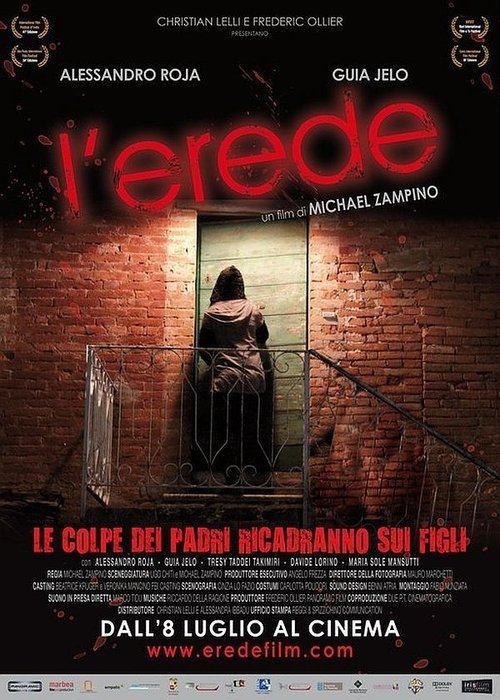





Bruno inherits a farmhouse in the Marche countryside from his father. The first impression of the environment is not the best: a house to be renovated, vegetation that spreads over everything, and intrusive neighbors. The neighbors turn out to be Bruno's nightmare; initially kind and available, they suddenly become hostile because they see their territory "threatened" by the newcomer, to whom they try to extort the sale of the house... in every possible way!
The theme of conflict between civilization and the rural world, between progress and tradition, is certainly not new in cinema, neither to "high" cinema nor to genre cinema. And it is precisely in our reference genre that Italian cinema has often offered excellent examples that address this theme directly or indirectly. Think of a certain Lucio Fulci in the '70s, Pupi Avati, or - more recently - Lorenzo Bianchini, just to name a few, and we realize how the immersion of a character from an urban context into a rural one can find reasons for ancestral horror and normalized violence. The Italo-French Michael Zampino, for his feature film debut, decides to address this very topic, reading it through the coordinates of dramatic cinema with thriller overtones.
Zampino recounted having found inspiration for "L'Erede" from an autobiographical episode when he found himself, to his surprise, the heir of a property left to him by his father; the typical dramatization of cinema pushes Zampino to immerse his character in a "A Quiet Weekend of Fear" situation, emphasizing little the horrific aspect of the story. And perhaps this is where the greatest limitation of "L'Erede" lies, a film with great genre potential not fully developed. Zampino has in his hands undeniably suitable material for the crude and truculent European-style thriller, for extreme drama, and yet he holds back in every scene, self-censors in every choice made, throws the stone and then hides the hand. For example, at one point, there is a reference to incest, but in the next scene, everything is already resolved in a normalizing way, denying the possibilities of developments in that direction. It seems that Zampino is making a genre film adapted for a broader audience with a more delicate palate.
Overlooking this evident idiosyncrasy, "L'Erede" presents itself as a good drama that finds its strength in the construction and description of the characters as well as in the succession of events. Zampino, who writes the screenplay together with Ugo Chiti ("Gomorra"; "Manuale d'amore 3"), uses some excellent actors to outline characters that are sometimes stereotypical but have a good impact. Those who stand out the most are the "villains," namely the three members of the local family, three redneck-like Italians who embody the characteristic traits of this type of redneck while personalizing them appropriately. Among the three, the most convincing is the matriarch Paola, played by a brilliant Guia Jelo ("La scomparsa di Patò"), who brings to life a character who is both strong and fragile but always promptly determined to achieve her goal, which in this case is the farmhouse left in inheritance to Bruno. Paola's character plays a subtle game of kindness and blackmail, outbursts of anger, and contemplative moments, using the expedient of the family twist on her victim Bruno, annihilating in him every certainty related to the past. Paola is flanked by her two children, the eldest, Giovanni (a suitable Davide Iorio), and the beautiful Angela (Tresy Taddei). The former is a rough and robust farmer who needs little to go up in flames, the guardian of the domestic hearth, ready to defend it in every way. Angela, on the other hand, is a fragile girl, perhaps a bit childish for her age, visibly unsuited to the environment around her and indeed intent on escaping it thanks to the salvific appearance of Bruno. The latter, played by Alessandro Roja, the Dandi of the "Romanzo Criminale" TV series, here a bit understated, is the straw man of the turn, though this time much less predisposed to catch fire. The assimilation of Bruno's character to the image of the rabbit is no coincidence; a coward incapable of reacting to others' abuses.
"L'Erede" presents a linear and orderly narration, built on a crescendo of tension that should culminate in the "torture" section relegated, as usual, to the end. The problem - and here we return to that lack of willingness to dare mentioned above - is that the final climax is paradoxically the worst part of the film. "L'Erede" tends to fade away slowly rather than ignite in the closing moments; the spiral of drama in which the narration was leading us finds a hasty solution and out of tune with what is happening on the screen. There is something that does not work, a washer of the gear that risks leaving us stranded right at the most beautiful moment.
In general, the film is more than sufficient, supported also by a good visual rendering given by the fact that "L'Erede" was shot on 16mm film, a more unique than rare thing in contemporary independent cinema, which seeks to cut costs by primarily resorting to digital.
Comments
Comments (0)

Comments