


The Verdict
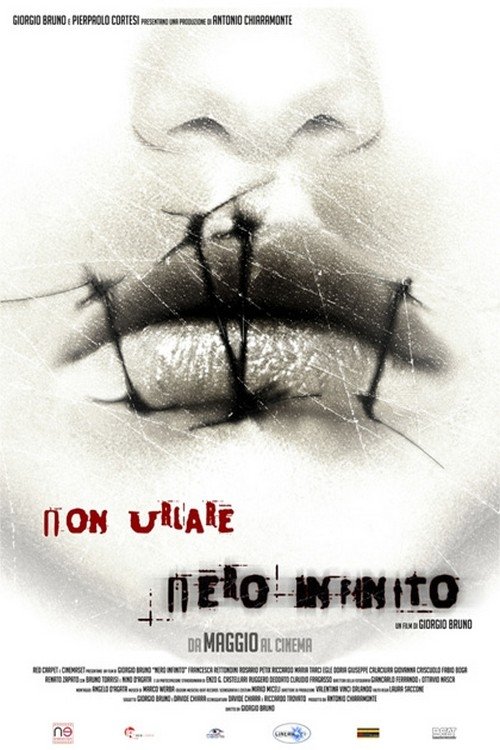
A serial killer is terrorizing a small town in southern Italy. The murderer kidnaps young women and, before killing them, tortures them, respecting the methods in which the victims are killed in the thriller novels of successful writer Dora Pelser.
A serial killer is terrorizing a small town in southern Italy. The murderer kidnaps young women and, before killing them, tortures them, respecting the methods in which the victims are killed in the thriller novels of successful writer Dora Pelser. The case is investigated by Chief Inspector Elena D'Aquino and Inspector Valerio Costa, who immediately focus their investigation on the writer and those around her.
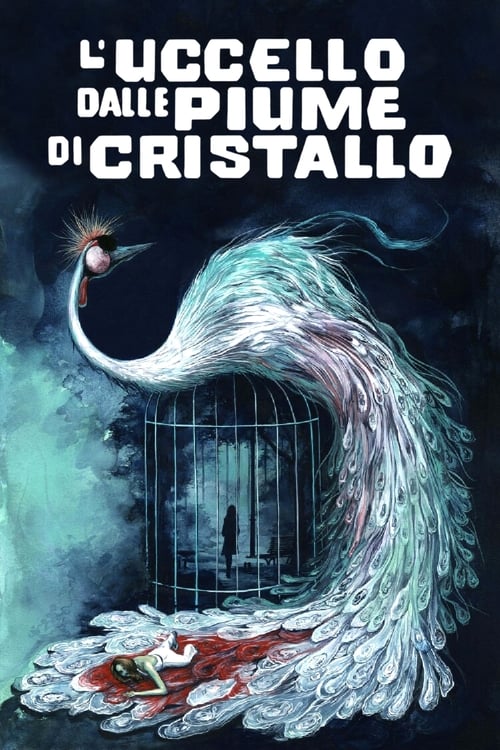
In the renewed desire to make horror and thriller cinema in Italy, unfortunately relegated almost exclusively to the independent sector, it has been possible to notice an often very explicit call to the good Italian thriller that was, the "spaghetti thriller" – as it was called abroad – which marked an era of our cinematography and was often envied by other countries. The cinema of Mario Bava, Umberto Lenzi, Sergio Martino and, of course, Dario Argento, who in one way or another has been cited in several indie works of recent years, from "Come un crisalide" by Luigi Pastore to "Ubaldo Terzani Horror Show" by Gabriele Albanesi, passing through "Darkness Surround Roberta" by Giovanni Pianigiani. Now comes a new title that draws with force from that imaginative world so vivid in the mind of the cinephile spectator and in the more cultured and genuinely nerd filmmakers, it is called "Nero infinito" and is the debut work of Giorgio Bruno.
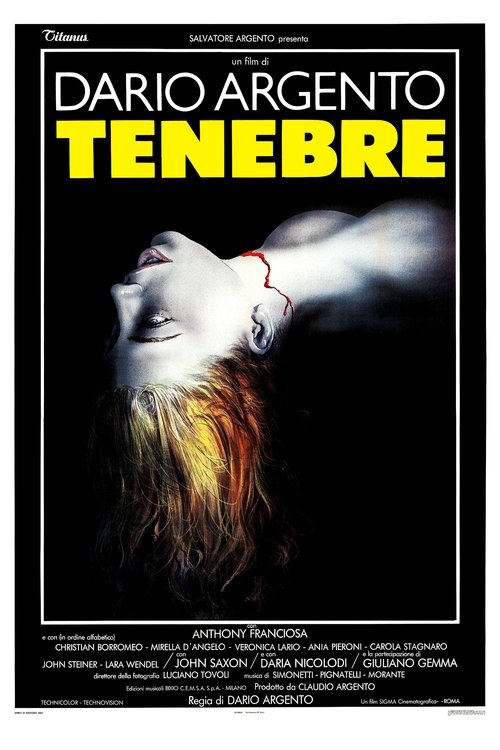
The director's references are clearly identifiable from the start and extend, precisely, to the Italian thriller of the 1970s and perhaps even more of the 1980s, with a heavy wink to "Tenebre" by Dario Argento (is the title "Nero infinito" not perhaps a synonym for darkness?), taken up both by some key moments of the narrative plot and by the beautiful music of Marco Werba. The device of the novel that stimulates the killer's imagination, the camera that lingers on the details in the "beast's" lair as an Argentinian characteristic and a certain ferocity in staging some murders. The Catanzaro Giorgio Bruno thus has solid reference points that he recalls with gusto, also proving rather skillful in the search for never banal framing cuts.
However, "Nero infinito" does not convince in all its components. Despite this powerful desire to remake the "spaghetti thriller", on more than one occasion Bruno's debut ends up resembling certain police fiction that has crowded prime-time television for too long, with points of sloppiness that touch many technical/artistic aspects of the work. First of all, the film's packaging is not one of the most refined and a flat and glossy photography can be noticed that recalls certain TV programs, as well as the care for the sets shows too much the low-low-budget nature of the work. The actors are also not fully convincing and if Rosario Petix turns out to be sympathetic and capable, as well as the former TV showgirl Francesca Rettondini does not displease in the role of the tough policewoman, the rest of the cast shows interpretative shortcomings at times evident.
A point against "Nero infinito" is also the screenplay that relies on some "scult" dialogues that sometimes make you smile involuntarily and relies on a somewhat weak mystery plot, with twists widely predictable.
Lovers of gore and violence will be satisfied on more than one occasion with a couple of very strong scenes, starting with the one of the cooked tongue and the sewn lips that perhaps cite "La Casa 4", or perhaps not.
In general, "Nero infinto" only convinces in part, if the more experienced spectator may appreciate the desire and passion to evoke certain good Italian genre cinema, the common spectator will probably end up focusing mainly on the defects that the film bears. For the moment, we leave the judgment in suspense and wait for Giorgio Bruno for a second work that perhaps puts aside the cinephile passion and focuses on other aspects necessary to make a film a good film.
In affectionate cameos, appear as actors the cult directors Enzo G. Castellari, Claudio Fragasso and (in one scene) Ruggero Deodato.
Comments
Comments (0)


Comments