















The Verdict
Bill Boss is the director of a Texas maximum-security prison. The economic situation of the facility is not rosy and, as if that were not enough, the sadistic head, despite his inhuman punitive methods, cannot keep his inmates in check.
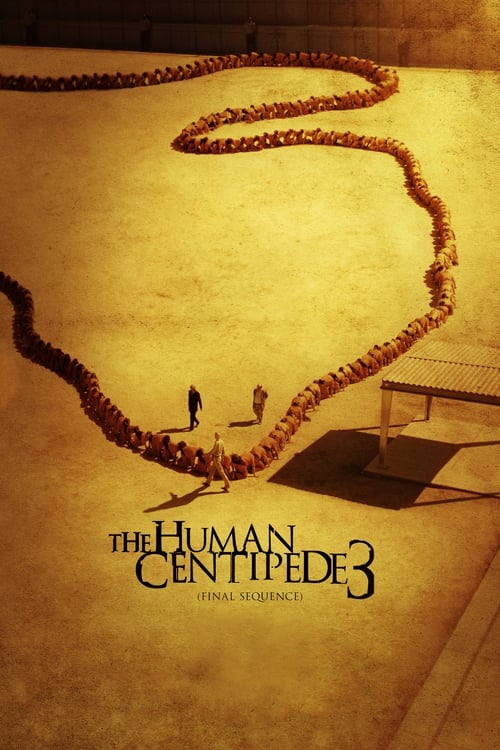
Bill Boss is the director of a Texas maximum-security prison. The economic situation of the facility is not rosy and, as if that were not enough, the sadistic head, despite his inhuman punitive methods, cannot keep his inmates in check. Under the threat of dismissal by the State Governor, the accountant Dwight - inspired by the saga of "The Human Centipede" - proposes using the prisoners to form a human centipede: an idea useful both as a deterrent to crime and as a solution that allows minimizing management costs. The exasperated Boss, under the grip of the summer heatwave, will let himself go a bit too far... There was great anticipation for the release of the third and final chapter of "The Human Centipede", which, as was quite predictable, has clearly divided the public between detractors and admirers. From the few frames and the synopsis circulating on the web, it was clear that Tom Six had opted for another change of style and genre, remaining faithful to the line adopted for the realization of the trilogy. An atypical saga, that of the human centipede, based not on narrative continuity, as happens in most cases (with results that often draw a descending parabola), but on the staging of the central idea proposed always in a different context. An idea that seemed brilliant in the first episode, rather canonical in structure and aesthetics, but with a villain of all respect destined to remain impressed in the iconography of horror cinema (and excuse me if it is little), to then transform into a punch in the stomach in the sequel, an indigestible concentrate of excesses and unspeakable violence, steeped in black humor, that rode the wave of the most extreme torture porn. If the public had frowned in "First Sequence" because they did not see enough and in "Full Sequence" because they saw too much, in the third "Final Sequence" they frown because the tone of the film is excessively cacophonous. Six, in fact, plays without brakes on the concept of excess, expressed this time in a humorous key. Halfway between comedy, prison movie, and torture porn, "Human Centipede III" brutally strays towards grotesque waters that totally disconcert the spectator. The latter falls into the psychological trap - and inevitable - of identifying the two protagonists with the characters of the two previous films, struggling to frame them in completely different roles and reunited in the same film. Dieter Laser, who in the first film embodied the mad Dr. Heiter, wears this time the clothes of the unbalanced prison director, giving us a superb and over-the-top acting performance: making use of emphatic gesticulation and theatrical physicality, he manages to tear out more than one (very black) laugh, thanks also to the coarse language that characterizes him. No less is Laurence R. Harvey (irresistible with his Hitler-like mustache), who surprises us with the spontaneity linked to the character he portrays, loquacious and light-years away from the viscous and awkward maniac of the second episode, who unsettled at the mere sight. The strange couple exploits their expressiveness to the fullest and demonstrates a versatility and adaptability truly commendable and fundamental for the success of the film, which enjoys an excellent final rendering. If it is true that the film's tone is forcibly caricatured - starting from the characterization of the characters - it is also true that the splatter component is not at all absent, some scenes are really strong and extremely cruel: the tortures perpetrated against the inmates, realized with technically impeccable effects, are consumed in a farcical framework that makes them anything but "light", amplifying, on the contrary, the sense of disgust and repugnance. The Dutch director (whom we see interpreting a cameo in his own role) mocks his detractors (but also his fans and his own works) and mocks - with irony and more often with a coarse and liberating laugh - those who, with zeal worthy of better cause, attribute to horror films meanings and responsibilities that they have never had. He does so by creating a work intentionally self-referential, enriched by a self-citation so complacent and exaggerated that it causes irritation to that (large) part of the public incapable of grasping the prankster spirit of the operation and who probably expected a work on the same line as the previous chapter. Wrong and misleading to analyze this final chapter by comparing it to the two predecessors: each segment of the trilogy is, in fact, self-contained and limits itself to exploiting the common thread of the saga without giving a real follow-up to the narrative plot. The protagonists' sympathetic interludes are consumed on a saturated and inflamed chromatic background (like the Texan temperature), in a stylistic context formally less elegant compared to the second film - which with its black and white punctured the screen - but equally sought after and effective. This time, Six has preferred to concentrate much of the attention on the parodic aspect, dosing the appearances of his "creature" (the human centipede appears only at the end) and pushing to the maximum the accelerator of the "politically incorrect": the characters know neither pity nor humanity, the dialogues are peppered with bad taste jokes, there is no respect for women and for no race or religion. In short, the triumph of gratuitous insult for a proclamation of irreverence in its purest state. In conclusion, "The Human Centipede III" is a film that, if adequately contextualized, can turn out to be a tragicomic guilty pleasure seasoned with misdeeds here and there; the more serious and intransigent cinephiles had better stay away.
Comments
Comments (0)















Comments