




The Verdict
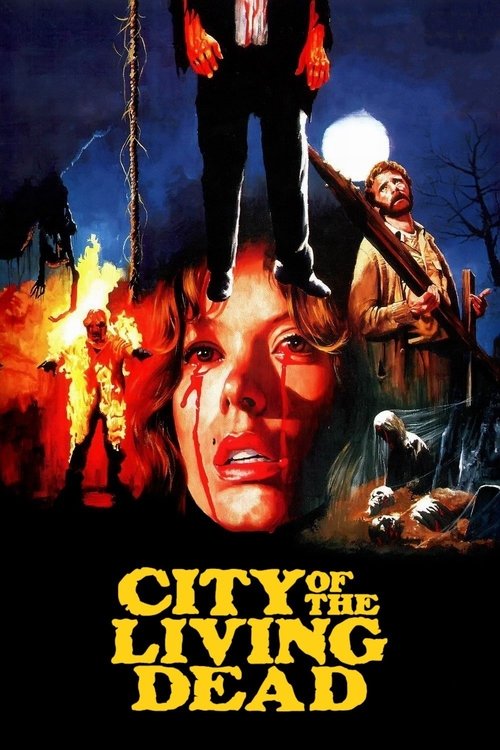
Father Thomas, the Catholic priest of Dunwich, hangs himself from a tree branch and as a consequence of his death, unspeakable horrors are unleashed upon the town's inhabitants. The medium Mary Woodhouse and the reporter Peter Bell travel to Dunwich to investigate the sinister events.
Father Thomas, the Catholic priest of Dunwich, hangs himself from a tree branch and as a consequence of his death, unspeakable horrors are unleashed upon the town's inhabitants. The medium Mary Woodhouse and the reporter Peter Bell travel to Dunwich to investigate the sinister events. What they will discover is chilling: the dead are returning to life under Father Thomas's guidance to invade the world of the living…
One of the peaks of Lucio Fulci's cinema, the initial chapter of the so-called "Trilogy of Death" which also includes the notable "That House Near the Cemetery" and the masterpiece "Beyond". Thanks to the international success of "Zombie 2", Fulci suddenly found himself considered a leading name in horror cinema, which is why he was commissioned a new film to ride the wave of his previous work. The title initially thought for this film was the more sparse and evocative "Fear", but it was later decided to include a nod to the living dead to create a link with the aforementioned "Zombie 2".
With "City of the Living Dead", Fulci takes a decisive step in his personal interpretation of horror cinema: starting from a deconstruction of the established rules of the genre, he renounces a coherent plot and, privileging the technical-visual aspect, immerses the viewer in a hallucinated nightmare on film, with vague references to the narrative universe of H.P. Lovecraft (the town of Dunwich: namesake of the cursed village described by the American writer).
The terrifying images of the film take shape thanks to Fulci's usual directorial taste, combined with the photography of Sergio Salvati and the fundamental contribution of Antonello Geleng as a set designer; it is the latter who is responsible, among other things, for the creation of one of the strengths of this title: the unsettling underground world in which the "final confrontation" takes place between the film's protagonists and the malevolent forces unleashed by Father Thomas. The editing is by Vincenzo Tomassi (Fulci's trusted collaborator) to whom is also due the famous and enigmatic ending, based on one of his intuitions. Another name involved is that of Michele Soavi, then twenty-three years old, in the dual role of actor and uncredited assistant director.
When talking about visual choices, it is impossible not to mention the truculent gore effects, with girls vomiting their entrails and smashed heads, the splatter enthusiast has plenty to indulge in abundantly. The paternity of these effects is generally attributed to Giannetto De Rossi, but in reality, it is almost certain that Franco Rufini and his assistant Rosario Prestopino made them. The confusion probably arose from the presence of special effects by Gino De Rossi, who, however, never dealt with makeup and splatter scenes, but with effects such as explosions and the like. Giannetto himself has denied ever having set foot on the film set.
The plot, as mentioned earlier, is little more than a pretext, but it would be incorrect to consider it completely devoid of meaning, it does contain some elements of interest and some Fulcian themes. The irreverence towards the religious institution immediately stands out: the victims of the horror that unleashes in Dunwich cry blood as in Christian iconography and Father Thomas hangs himself from a tree like Judas Iscariot. A suicidal priest seems to undermine the certainties of religion about the immortality of the soul and the hope of eternal life, these certainties fallen, fear and horror cannot but unleash with devastating effects. Fulci, although he was a joyful anticlerical, defined himself as "Catholic although full of doubts", and in "City of the Living Dead" the doubts seem to take over and give voice to a typically Lovecraftian argument: religious cult seen as a pious lie placed to safeguard the mental health of men.
Among the events that occurred during the film's production period, some anecdotes are noteworthy. Such as the visceral antipathy that arose between Cristopher George and Lucio Fulci, the actress Antonella Interlenghi arrested for indecent exposure during a car ride (!?) and a cruel prank orchestrated at Fulci's expense. Someone, it seems Cristopher George himself, mixed some fly larvae into the director's pipe tobacco and the unfortunate man, before realizing, inhaled some of that infernal mixture. Years later Fulci encountered various health problems and according to him, the cause was to be found precisely in those very unhealthy puffs of smoke.
Comments
Comments (0)








Comments