
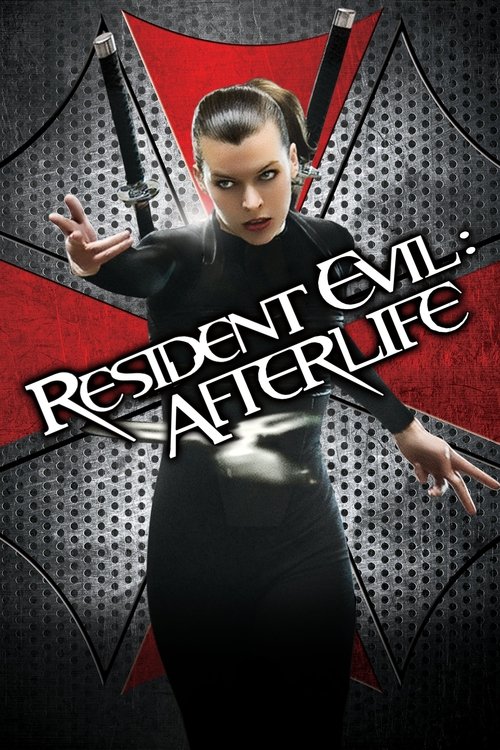















Alice and her clones arrive at the Umbrella Corporation laboratories in Tokyo to eliminate Wesker, the head of the multinational that created the T-Virus. After a hand-to-hand fight between the woman and the diabolical Wesker, both are put out of action by an accident. Alice loses her powers, Wesker seems dead in the confrontation.
Six months later, Alice arrives in Arcadia, an outpost in Alaska untouched by the virus, where she reunites with Claire. The woman, however, has lost her memory and the place has remained practically deserted. Together, the two women head by plane towards Los Angeles and find refuge in an abandoned prison along with a group of survivors. Now, the goal is to reach a ship anchored near the coast from which a radio communication invites all survivors to join them to find salvation elsewhere.
In a period literally invaded by the undead on celluloid ("Survival of the Dead", "Welcome to Zombieland", "The Horde"), the fourth chapter of the "Resident Evil" cinematic saga also arrives on time, an unmissable appointment for fans of hard-boiled fantasy-action-horror and for fans of the beautiful Milla Jovovich. But upon leaving the room where "Resident Evil: Afterlife" is projected, strictly in native 3D, one does not have a beautiful feeling of satisfaction at all. Rather, between a dozen shootings and a dozen explosions in stereoscopy, one leaves, in addition to inevitably dazed, with the terrible sensation of having witnessed the cosmic void, an unsettling sideral black hole that has sucked in the entire infrastructure that usually supports a film.
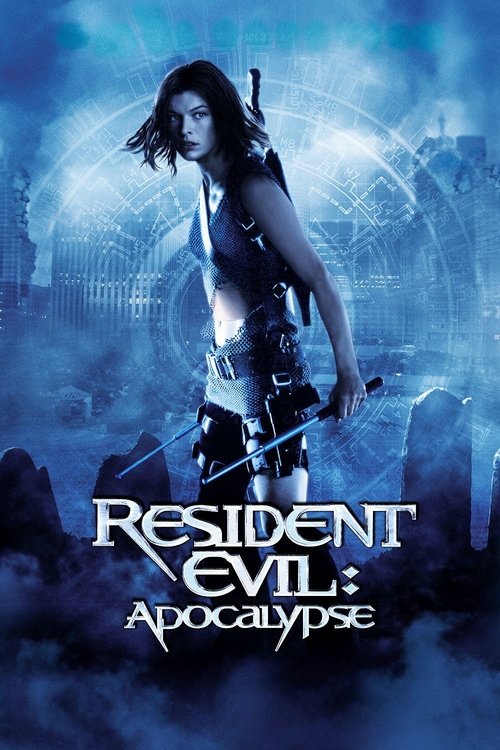
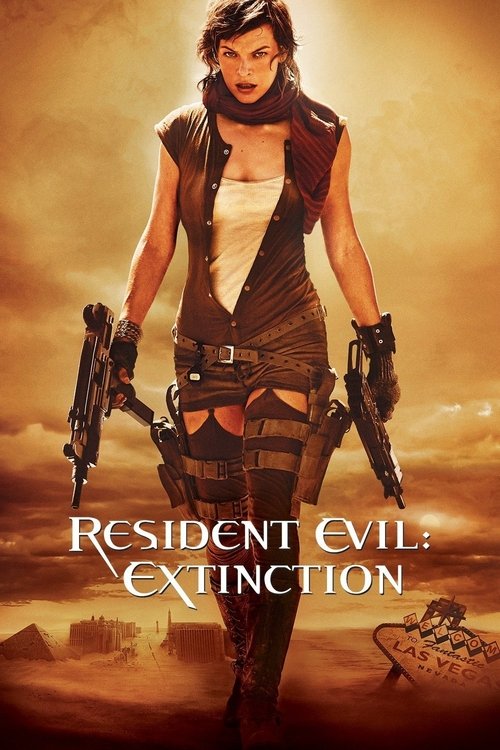
It begins exactly where number 3 ended, with an Alice multiplied by a cloning process heading to Tokyo to kick the asses of the top brass of the Umbrella Corporation. "Afterlife" starts with a whirlwind of action at the limits of the incredible, but one is not surprised by the admirable quality of the frizzes and lazzi made in Anderson, but by the confusion and the kitsch that reigns sovereign in every frame. Paul W.S. Anderson, father of the film saga, as director of the first admirable film and producer and screenwriter of all the others, returns here behind the camera and crafts perhaps his worst feature film. "Resident Evil: Afterlife" is a bad example of devouring action, of a product without ideas that entrusts everything and for everything to the bangs and Hollywood kung-fu. Unfortunately, we are faced with that type of cold and computer-graphic action made entirely of slow motion (too many, for God's sake!), bullet-time and pixel doubles that do acrobatics and are already launched from skyscrapers. And it's a bit of a pity that "Resident Evil" has gone astray in this way, since chapter after chapter a rather gripping story was being created and, if we exclude the mediocre chapter 2 ("Resident Evil: Apocalypse"), even the quality standard of the films was good. "Afterlife", however, shows the dead point, it practically adds nothing to the story - if not the character of Chris Renfield, but we will talk about it later - and goes forward looting the fantasy cinema of the last 35 years. If "Matrix" is annoyingly omnipresent in the look of some characters and in the action scenes, visible references also go to "District 13" (the prisoner who turns out to be a hero) and above all to "Zombie"... or rather to its remake "Dawn of the Dead", given the large crowd and the fury of the undead who populate the outer perimeter of the prison/refuge.
On its part, "Resident Evil: Afterlife" has a couple of action scenes indisputably successful, some beautiful sets (in CGI) and a cool monster (the executioner), taken straight from the video game and inserted hastily in the middle of the horde of zombies (but after all, it was like that in the video game too). From the video game series, this time a little more than usual is fished, but unfortunately it is almost accidental references that do not follow the narrative iteration of the Capcom game. Almost all the references come from "Resident Evil 5", the last chapter for console, and the most evident are: the aforementioned executioner, the zombies that open the mouth in flower, the zombie dogs that open vertically, the mechanical beetle that controls the will of the living, Wesker's powers and the character of Chris Renfield. And it is precisely Chris who, punctually, disappoints. As now always happens in this saga, when the main characters of the video game are introduced, they are not done justice: it happened with Jill Valentine, with Claire Renfield and naturally, Chris also betrays expectations. Wentworth Miller (the TV series "Prison Break") is an inexpressive actor who does not make the cinematic Chris that civil war mercenary he should be and the winks (involuntary?) to the carpenterian Napoleon Wilson seem totally out of place. Then, just like his sister Claire - played once again by Ali Larter ("Final Destination"; "The Mystery of the House on the Hill") - Chris is also an intruder in native land, a character who should be fundamental but who in fact always remains marginal, since the scene is always stolen from him by Alice/Milla Jovovich.
There are many zombies but they do little, the characters if they are not one-dimensional (the slimy one that we all know will betray, the generous black who sacrifices himself) are totally evanescent (the Asian, the failed actress and that other Hispanic dressed as a soldier whose role I even forgot). The 3D has been advertised as first quality (it's the one used by James Cameron in "Avatar"!) but in the end it does not leave a mark, it rather cancels out the beautiful dark photography of the film.
In the end, what remains of this "Resident Evil: Afterlife"? Nothing, just a one hour and forty minutes long advertisement that involuntarily does nothing but emphasize the importance that "Matrix" has had for the world of special effects. And twelve years have passed!
Comments
Comments (0)










Comments