




The Verdict
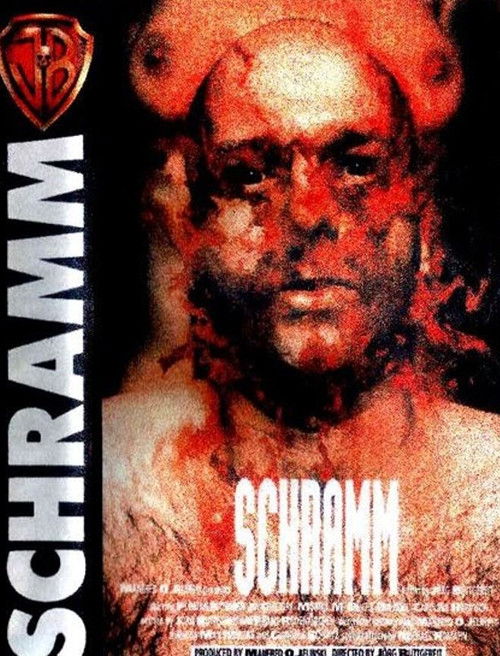
Lothar Schramm is face down on the floor, at the foot of a staircase, in a pool of blood. The newspapers headline “Death of the Lipstick Killer.” Alone and defenseless, the man relives some episodes of his life, moments before dying, in a whirlwind of delirium and alienation.
Lothar Schramm is face down on the floor, at the foot of a staircase, in a pool of blood. The newspapers headline “Death of the Lipstick Killer.” Alone and defenseless, the man relives some episodes of his life, moments before dying, in a whirlwind of delirium and alienation.
Fourth work by German director Jorg Buttgereit, who debuted with one of the most controversial and unsavory films in the history of niche cinema: “Nekromantik,” a story of love and necrophilia to which the director also gave a sequel (less successful), after attempting an episodic film whose sole and central theme is death, “Der Todesking,” which stands out in his filmography mainly for certain stylistic mannerisms. “Schramm” tells the story of a serial killer, and does so through continuous flashbacks, showcasing not so much the killer’s deeds, but rather his sick existence; transforming his thoughts and emotions into a series of dreamlike and crazy images. The focus is indeed almost exclusively on the most “human” side of the protagonist, his existential malaise, the miserable life he leads in total solitude. The only person he relates to is a frustrated prostitute (played by Monika M., already the protagonist of “Nekromantik 2”), who lives in the apartment next to his and towards whom he seems to harbor ambiguous feelings. Behind the kindness and availability that the man reserves for the friend, lies the coldness and cruelty of a killer, with a deviant sexuality and a twisted mind. The film is a crescendo of delirious visions, repeated over and over again, that blend and intertwine with reality, giving rise to a chaotic and surreal scenario that disorients and surprises the viewer. The locations, sparse and squalid, only accentuate the desolation in which Schramm and the woman drown, with a resignation that almost evokes compassion and understanding. Scenes of purely physical violence are not lacking, supported by good special effects, made with a rather limited budget. Of course, we are not spared the man’s sexual perversions, tormented by hallucinations with a Cronenbergian taste, whose madness drives him to commit extreme acts of violence even on his own intimate parts, making even the least sensitive viewer shiver.
An aura of drama envelops the film: the protagonist’s reprehensible deeds alternate with moments where he is seen happy and carefree: whether it is the product of imagination or memory is not known, but in any case this almost schizophrenic duality gives us moments of anguish and sadness that are hard to forget.
Technically, we find a more careful and lucid direction than in “Nekromantik,” but certainly less pretentious than in “Der Todesking,” characterized by the usual circular shots to which the director has accustomed us, and by a play of colors to emphasize the non-linearity of the film. Also worth mentioning is the chilling soundtrack (as in the other films), composed among others by some members of the band in which Florian Koerner Von Gustorf, the actor who plays Schramm, performs.
A masterpiece of weird, dirty, intense cinema, but also rich in meaning and unique in its kind, born from the brilliant mind of a director who has (almost) never missed a beat.
In conclusion, I point out the Special European Edition of the DVD, containing two discs, one of which is rich in very interesting special features; the only flaw is the subtitles, but fortunately the dialogues are reduced to the bone.
If you feel like embarking on a shocking and suggestive journey, this is the right film.
Comments
Comments (0)



Comments