



Twixt backdrop
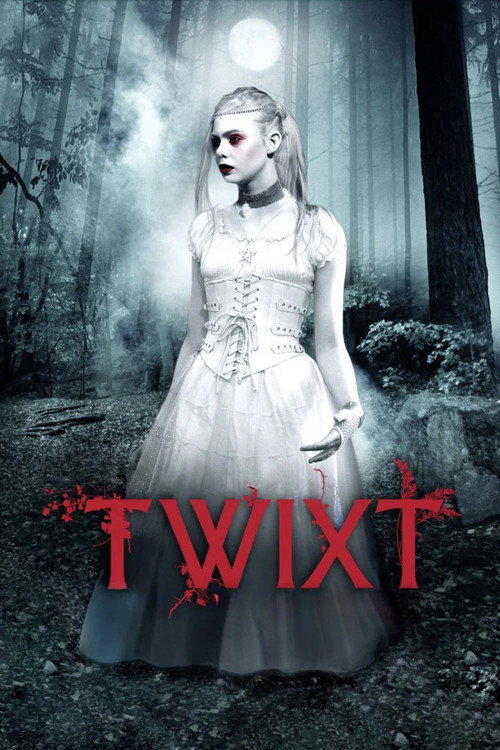
Twixt poster

TWIXT

2011 US HMDB
September 10, 2011

A washed-up horror novelist arrives in a sleepy town on a book tour, only to stumble into a string of eerie murders. Haunted by dreams of a ghostly girl named V and guided by the spirit of Edgar Allan Poe, he’s drawn into a nightmarish world where fiction and reality blur—and the story he’s chasing leads back to his own buried guilt.

Cast

👍 👎 🔥 🧻 👑

Comments

Comments (0)

Crew

Production: Francis Ford Coppola (Producer)Anahid Nazarian (Executive Producer)Fred Roos (Executive Producer)
Music: Osvaldo Golijov (Original Music Composer)Dan Deacon (Original Music Composer)
Cinematography: Mihai Malaimare Jr. (Director of Photography)

REVIEWS (1)

Andrea Costantini
Hall Baltimore is a horror novelist whose specialty is witchcraft. In a creative and financial crisis, Baltimore begins a promotional tour for his new novel, ending up in a small town called Swan Valley. Here he will meet the local sheriff, a half-crazy man who involves him in the investigations of a girl assassinated with a wooden stake in the heart. While on the other side of the lake a group of young people spend their time having orgies and worshiping evil, Hall Baltimore will get emotionally involved with the ghosts of that country and those living inside him. Universally known as one of the greatest living directors, Francis Ford Coppola is a true myth of the seventh art. He has over twenty films to his credit, including absolute masterpieces such as the saga of "The Godfather," "Apocalypse Now," and "The Conversation." In his long career, he has also explored, in his own way, horror cinema with "Dementia 13" and the faithful reimagining of Bram Stoker's novel "Dracula." In 2011, after a couple of introspective and personal films, Coppola returns to the genre we love so much with a film that split the public in two: "Twix." It is the story of a horror novelist in a creative crisis who, during the promotional tour of his book, will end up in a town where evil seems to lurk. Hall Baltimore, with the help of the crazy sheriff of the country, takes to heart a bizarre murder and, thanks to the strange stories circulating about those places, glimpses a glimmer of light for his new novel. But first, he will have to deal with his painful past. Watching "Twix," some things typical of the director immediately stand out. One above all is the masterful management of colors. As already happened in other previous works, images in black and white characterized by a single chromatic element are often present: in "Rusty the Wild," there were the fish, in "Family Secrets," the memories, here we have Edgar Allan Poe's lantern, V's makeup, and the blood, elements that take on color in Hall's black-and-white dreams. It is not a true horror film; it is a film about vampires but that in reality does not talk about vampires. It talks about the pain of a man who cannot exorcise the loss of his daughter except by drowning his sorrows in alcohol and searching for a solution to his guilt. Until he finds a gap thanks to Edgar Allan Poe, who, like a Dante's Virgil, guides him through the dark forest of his personal hell, showing him the horrors of that country and the horrors hidden within his mind. "Twix" is a very personal film for Coppola, addressing the theme of the loss of a son, just as it happened to the director during the filming of the film "The Gardens of Stone" in a similar way to that shown in the film. Visually stunning, the film unfortunately lacks in understanding. If at first the plot seems linear and gripping, as soon as Baltimore meets V in the woods, everything changes. At the beginning, one plays along, gets passionate, and seems to witness the Lynchian version of "The Seme of Madness" (many elements recall it, such as the motel, the children, and the bell tower, as bizarre as the Byzantine church) with crazy characters and speeches without head or tail. Then, however, there are no more twists, and the film continues in this way, continuously alternating the protagonist's dreams with reality, creating a lot of confusion and a consequent drop in attention. However, despite the plot's flaws, the film remains an interesting product, naturally not at the level of many of his previous films. It is beautiful to see an artist like Coppola, who could lie down from morning to evening living on the glory of past works, trying to renew his style while always maintaining sobriety and class. And if you overlook the slightly messy plot, you remain fascinated by the staging. The cast of declining and rising stars is composed of Val Kilmer, bloated as never before, Bruce Dern the giggling character actor, a monotone Ben Chaplin, and the young Elle Fanning, sister of the more famous Dakota, who risks outshining her sister in skill, the only one who truly stands out in the film. Some scenes of the film were shot in 3D. Add half a pumpkin to the final rating.
👍 👎 🔥 🧻 👑

Comments

Comments (0)

Where to Watch

Rent

Amazon Video Amazon Video
Google Play Movies Google Play Movies

Buy

Amazon Video Amazon Video
Google Play Movies Google Play Movies

COMMUNITY REVIEWS (3)

John Chard

John Chard

6 /10

The bit in between the dream and waking worlds.

Twixt is written and directed by Francis Ford Coppola. It stars Val Kilmer, Bruce Dern, Elle Fanning, Ben Chaplin, Joanne Whalley and Don Novello. Music is by Dan Deacon and Osvaldo Golijov and cinematography by Mihai Malaimare.

Hall Baltimore (Kilmer) is a struggling writer of witchcraft based novels, during a book signing stop over in a sleepy backwater American town, he finds himself involved with evil, murder and Edgar Allan Poe’s Ghost. But just what is real here?...

Twixt finds Coppola in relaxed mode, in the later stages of his film making career, he’s clearly made an adventurous movie based on a dream and personal instances. Very much operating in the realm of dreamscaping, both on visual and narrative terms, it’s an often silly picture yet one that still beguiles with its weirdness and daring visual touches. There’s also a good quotient of humour, both self aware and absurd, but if searching for a horror movie here you will be very disappointed. The Lynchian feel to it ensures it’s an interesting misfire, while the cast are all very enjoyable, but it’s not a film for a concrete recommendation. 6/10

Wuchak

Wuchak

6 /10

"The horror, the horror" of the creative process

Val Kilmer stars as Hall Baltimore, a third string mystery/horror writer on his latest book tour staying in a small town where he gets involved in a murder mystery upon meeting the eccentric sheriff, Bobby LaGrange (Bruce Dern). He meets a quasi-goth girl named V (Elle Fanning) who reminds him of his pubescent daughter. There's also a camp of weirdo goth-kids across the lake and Edgar Allen Poe shows up now and then as a kind of spirit-guide (Ben Chaplin), but what's dream and what's reality? And who murdered the female in the morgue with a stake?

"Twixt" (2011) was reedited and renamed as “B'Twixt Now and Sunrise” by creator Francis Ford Coppola’s in 2022. It’s a mystery/dramedy with elements of horror, combining the look of Coppola's "Bram Stoker's Dracula" with the inscrutableness of his "Youth Without Youth," plus a welcome side of humor. It's a quirky mystery that leaves you scratching your head, but you find yourself enjoying the ride, a Gothic tale with beautifully haunting cinematography & atmosphere, highlighted by Poe, bell towers, ghosts and bats in the belfry. The enhanced moonlighting and otherworldly blueish gray tones are awesome.

It tackles the creative process as we observe the desperation of a writer scraping the bottom of the barrel, often under the influence of sundry intoxicants. Will he come up with a best seller? Will he solve the murder mystery? Will he come to terms with his specters and demons that arise from his guilt over what happened to his daughter? That element, by the way, brings to mind Francis' 23 years-old son, Gian-Carlo Coppola, who was tragically killed in a similar boating accident in May, 1986. The reckless driver was Griffin O'Neal (Ryan's son).

A lot of the movie is an internal dialogue with the author's own ghosts and literary influences. Charles Baudelaire (a notorious substance abuser) is referenced, with the aforementioned Poe intermittently appearing, but only when Baltimore is under the influence, or dreaming. Did the abuse and murder of the children happen as shown? Or did Poe and the vampire incarnation of Hall’s own daughter serve as muses as he works his way through creating a story that might turn his career around? Coppola leaves it up to you to decide what is real and what is imagination, but the answers are there if you want 'em.

Francis got the story from a dream he had while staying in Istanbul. This sets-up the criticism that Coppola's dream is the audience's nightmare. While "Twixt" and this reedit are too ambiguous for their own good, it’s obviously intentional and he wanted the viewer to leave with questions to ponder. Besides, does everything need to be spelled out?

As for comparing the two versions, this one’s 8 minutes shorter and I think I liked it better (it’s hard to say because I saw the former version 8 years earlier).

It was shot at Kelseyville and the Clear Lake area of Northern California.

GRADE: B+

MISC. INSIGHTS SPOILER ALERT (Don't read further unless you've watched the movie)

A lot of what happens in the town was the author working out his story, but most of it isn't real. The sheriff and deputy are real, as are their deaths at the end, not to mention Baltimore's wife. The sheriff really wanted to write with him. The movie shows what Baltimore experienced as he journeys through his creative process. His book is completed by the end, selling 30,000 copies.

The bell tower strangely features seven different times, perhaps figurative of when Baltimore couldn't join his daughter for a trip due to setting his alarm clock with the wrong time. If he was there, she wouldn't have died, he reasons. So "time" is useless and naturally the antagonist. Even V says keeping track of time "here" is meaningless, which explains her missing the book signing.

An important part of the movie is Hall's loss of his daughter. Time is the 'villain.' By not dealing with the tragic accident Baltimore is figuratively keeping his daughter undead. He's fighting time somehow.

The age of his daughter when she died is also pertinent. She was betwixt a child and a teenager. And Hall was perhaps between deadlines and going on tours, thus missing out on some of her late childhood/early adolescence ("I thought they would be small boats... children's boats...").

The vampire kids represent the sometimes-startling changes children go through as they enter their teens, e.g. their music and the clothes they wear, as they start developing a disposition of their own. It seems weird to their parents who unexpectedly discover themselves "on the outside looking in." The Sheriff symbolizes the older generation; basically saying, "Bah, these kids today!"

The psycho pastor slays the kids to prevent them from "becoming vampires," that is, becoming teenagers who will lose their innocence as they make many mistakes learning to decide for themselves.

Flamingo (Alden Ehrenreich) is akin to the Pied Piper; he "gets away" at the climax because he'll always be around. In short, there will always be a teenage spirit of rebellion, regardless of the clothes it wears.

If these comments sound like dubiously-linking threads, it’s because the movie leaves you with this impression.

Rela Blue Jones

Rela Blue Jones

Now re-released as "B'Twixt Now & Sunrise" the director's cut is actually a little shorter than the 2011 initial release.

This film is a dreamscape with lots of nightmarish, surreal visuals which, unfortunately, are not helped by a flat, cheap, shot-on-digital look (the technology has gotten a lot better since then).

However, there is a lot to like here -- the horror and literary references, plus the cast. And, of course, Francis Ford Coppola movies are worth watching, especially some of the lesser known ones... for example, I liked his 'ageing backward' movie, Youth Without Youth, better than the far more popular Benjamin Button.

Reviews provided by TMDB