
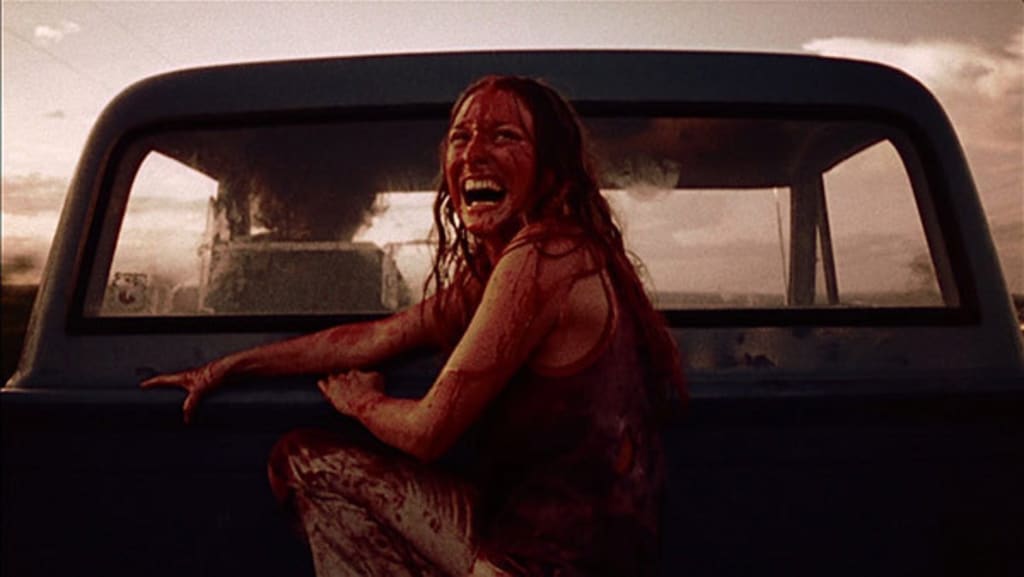

Some horror films are simply remembered, while others continue to reinvent themselves. The Texas Chain Saw Massacre, the masterpiece directed by Tobe Hooper in 1974, clearly belongs to the latter category. After sequels, remakes, prequels, reboots, and new interpretations of Leatherface, the franchise is now preparing for one of its most surprising transformations: an entire animated version created using rotoscope technique. The news was announced in the United States in July 2026 by Dark Sky Films and Exurbia Films, confirming that the project is currently in production and aims to debut in 2027. But this isn't simply digital animation layered over the original film. The project seeks to revive a handcrafted technique over a century old: every frame is processed by animators working from live-action images and redrawing them manually.
A New Texas Chain Saw Massacre, Without Forgetting the Original
The starting point remains Hooper's 1974 film, one of the works that helped define modern horror cinema. The story follows Sally Hardesty, her brother Franklin, and their friends, who during a journey through the Texas countryside stumble into the territory of a family of killers. At the center of the nightmare is Leatherface, played in the original by Gunnar Hansen, who became one of the most recognizable faces in cinematic horror.
What has always made Hooper's film distinctive is its ability to feel terrifyingly real. The gritty cinematography, the suffocating heat, the decrepit settings, and the unpredictable behavior of the characters create an almost documentary-like atmosphere. Precisely because of this, transforming The Texas Chain Saw Massacre into an animated work represents a considerable challenge. The stated goal of the new creators would not be to replace the original's identity, but to reinterpret it through a completely different visual language.
The Chosen Technique: Rotoscopy
The key term for the project is rotoscopy. The technique was invented in 1915 by Max Fleischer and essentially involves using live-action images as a reference to recreate movement, expressions, and gestures through drawing. Throughout animation history, it has been used in vastly different productions, including some Disney works and films like Waking Life and A Scanner Darkly by Richard Linklater. In the case of The Texas Chain Saw Massacre, the procedure takes on a particularly ambitious dimension: artists are manually redrawing images frame by frame, transforming the actors' performances into animation. This means the movements of Sally, Leatherface, and other characters aren't simply recreated from scratch in a traditional cartoon style. Their physicality stems from the original performances, which become the foundation upon which animators build the new version. It's an approach that could preserve part of the unsettling naturalism of Hooper's film while bringing it into an illustrated visual universe.
No Artificial Intelligence
One of the most interesting aspects of the announcement concerns the production process itself. Project leaders have emphasized that artificial intelligence will not be used to create the animation. Instead, the work relies on manual labor by artists. In an entertainment industry increasingly interested in generative tools, this choice carries particular significance. The new version of The Texas Chain Saw Massacre is betting on an extremely labor-intensive method: manually tracing, modifying, and composing images. It's a decision that makes the project even more intriguing, because animation isn't being used as a production shortcut. On the contrary, it becomes the very heart of the experiment.
Who's Working on the Project
Leading the operation is Paul Beck, Animation Director and Art Director based in Austin, Texas. Beck has already worked with Richard Linklater and participated in productions such as Waking Life, A Scanner Darkly, and Apollo 10½: A Space Age Childhood. His experience with rotoscopy makes his involvement in the new Texas Chain Saw Massacre particularly significant. The team also includes:
- Max Peake, Lead Animator;
- Nate Bayless, Special Effects Animation Director;
- Jeremy Martinez, Background Artist.
Why The Texas Chain Saw Massacre?
The most natural question is also the most interesting one: why transform this particular film into animation? The answer might lie in the nature of Hooper's work itself. Unlike many modern horror films, The Texas Chain Saw Massacre doesn't base its terror exclusively on the amount of blood shown. Its effect comes primarily from atmosphere, sounds, faces, sudden movements, and the feeling that something terrible could happen at any moment. Animation can therefore intervene precisely on these elements. A realistic environment can become distorted. A human figure can assume unnatural proportions. Shadows can be intensified. The motion of a chainsaw can become almost abstract. And Leatherface, with his mask of human skin, could be particularly suited to a hand-drawn reinterpretation.
When Will the New Animated Texas Chain Saw Massacre Be Released?
Currently, production is still underway and the release is scheduled for 2027. No specific date has been announced, nor have full details about international distribution been disclosed. So the project is still in development. But the first material shown in August 2026 has already transformed what seemed like a curious idea on paper into something concrete. And most importantly, there's one element that could make the difference: the production isn't trying to make The Texas Chain Saw Massacre more modern through spectacular digital effects. It's doing almost the opposite. It's returning to hand-drawn animation.
A New Skin for Leatherface
More than fifty years after the release of Tobe Hooper's film, Leatherface is preparing to wear a new mask: not that of another actor, but that of animation. The choice of rotoscopy is perhaps the most intriguing part of the entire project. It allows for maintaining a direct connection to the original images while simultaneously transforming them into something new. The creators' promise is to preserve the power of the performances and the atmosphere of the 1974 work, but through a completely different visual experience. The final result will only be seen in 2027. For now, though, one thing is certain: The Texas Chain Saw Massacre isn't simply returning. It's being redrawn. And for a film built on the idea that horror can hide behind a mask, there could be no more fitting transformation.
Comments