



The Verdict
California, late 1960s to early 1970s: the workday of a traveling salesman, David Mann, begins in the garage of his house, in the city, in the open desert, always on the road with his anonymous Plymouth Valiant.
California, late 1960s to early 1970s: the workday of a traveling salesman, David Mann, begins in the garage of his house, in the city, in the open desert, always on the road with his anonymous Plymouth Valiant. But what seems to be an ordinary day for an ordinary man becomes an endless nightmare due to a stupid overtaking of a strange truck, which turns from a normal heavy transport vehicle into a prehistoric creature driven by a supernatural desire for revenge. Soon, David Mann begins a long chase where his life is at stake...
Shot in just 12 or 13 days for the American network ABC in 1971, "Duel" is Steven Spielberg's first film, but certainly it should not be remembered only for this: watching the film today, it is hard to believe that a film of this kind was shot in less than two weeks by a 25-year-old director and, moreover, that it is a TV production. But it is so. "Duel" presents itself as a high-level product, for interpretation and production, while the direction is simply stunning, with brilliant technical solutions: ground-level shots to increase the sensation of speed of the truck, the idea of always filming with rocks by the side of the road to achieve the same effect, close-ups of the protagonist in the throes of anguish when the car loses speed, up to the wonderful final scene with the fall from the cliff of the car and the tanker in a cloud of dust, slowed down to increase the effect of liberation at the end of the exhausting pursuit. This film seems to have been shot by a great master of suspense like Hitchcock, given the absolute perfection of the timing, the sensation of anguish of the impending threat symbolized in this case by an enormous old-model truck, circa the 1940s, antiquated in a way that it really resembles a mechanical monster that emits thick black smoke from the chimney, as if it came from another era... so much that its own fall into the cliff emits a cry of pain that, according to the director, was taken from the end of "Godzilla".
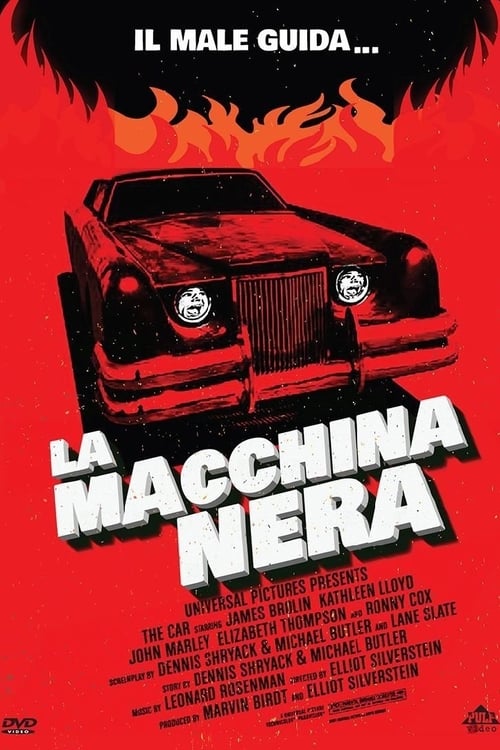
The vision of this truck anticipates by a few years the arrival on the big screen of the "cursed" cars, possessed by demonic spirits, such as the "black car" of 1976 and "Christine the demon car" of 1983; and with the 1958 black Lincoln Mark III and Plymouth Fury it shares some "physical" characteristics: round and protruding headlights like eyes, a pronounced muzzle similar to a threatening face, a chrome grille that resembles a mouth (appropriately toothed...) and naturally, reinforced bumpers! Unlike these cars, the truck is driven by a man of flesh and blood, who, for another brilliant choice by the director, is never seen in the face: all that is known about him is his name, Keller...
Originally the story "Duel" was published in the well-known men's magazine "Playboy" and brought to the attention of a young television director, who later became the producer of the TV movie, George Eckstein. The screenplay would indeed prove to be an excellent basis for Spielberg's work, providing a solid subject adapted for the small screen by one of the best writers available at the time (Matheson also took care of the screenplay). Told in this way, it seems that there were ideal conditions for shooting a great film, except for the fact that the director, whose most important work up to then had been episodes of the famous series "Columbo," was given the impossible task of finishing the film in 10 days: a schedule considered "unrealistic" even by the executive producers on the field, especially for the choice to shoot the photography outdoors, dictated by the desire to direct a quality film that did not have that "artificial" idea typical of television productions in interiors (in which the interior of the car with the protagonist at the wheel is shot and pre-shot images are projected behind the windshield), a choice that was considered unacceptable for what would become one of the greatest directors in the history of Cinema.
It is also interesting to remember that for these shots a special lowered machine with an integrated camera was used, originally thought for the action film "Bullitt" with Steve McQueen (in which a good part of the scenes are chases between sports cars). All this was made available on the sole condition of respecting the production times and managing to make the film as expensive as a standard interior production, but with more time available. In fact, it seems that the television experiences, with their very tight schedules, represented an excellent training ground for the young Spielberg, also in the subsequent experiences, giving him the ability to work under very high pressure from the Studios without affecting the final artistic result. "Duel" is certainly not a film for everyone, but those who love cinema cannot fail to appreciate this now little-known film but whose viewing is certainly a must not only for the hardcore Spielberg fans. To be seen preferably in the new DVD edition with short but valuable extra contents, with interviews to Steven Spielberg (and photos of him with Fellini, who apparently appreciated the film very much) and to Richard Matheson.
Comments
Comments (0)





Comments