





The Verdict
Evilenko is a Ukrainian citizen from Rostov, who blindly believes in the communist regime of a Russia in the mid-1980s... Before the disastrous economic period, before the division into many small independent and poor states.
Evilenko - The Communist Who Ate Children
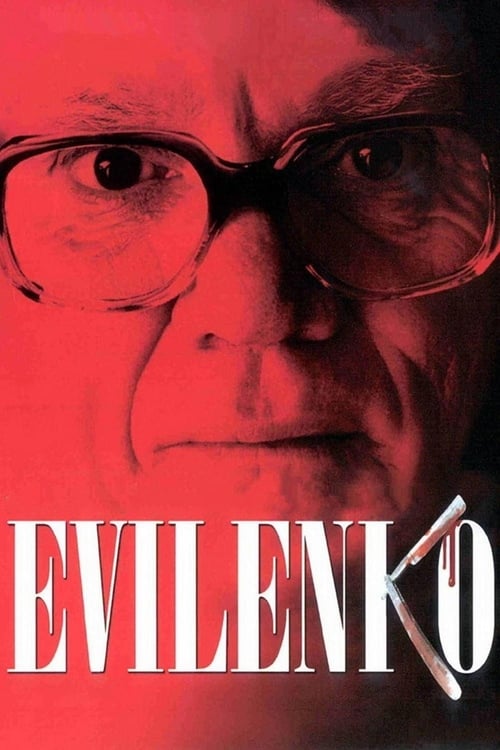
Evilenko is a Ukrainian citizen from Rostov, who blindly believes in the communist regime of a Russia in the mid-1980s... Before the disastrous economic period, before the division into many small independent and poor states. He has no social life, he is frustrated, follows his dark design of death and therefore kills and devours his victims: strictly of infant or pre-adolescent age. He is a language and literature teacher. He reads books, gives himself airs of an intellectual, but his mind is in dangerous decline as is the society, communist and Russian, that surrounds him. He thinks his crimes are covered by the KGB, by that state that he has served and loved for years and that perhaps is the primary cause of his dark evil, and therefore he is firmly convinced that no one will hinder his murderous madness, until he meets on his path an upright policeman determined to unmask him forever, studying more his psychology than the dynamics of his crimes. 100% Italian film, distributed by Mikado and produced by Mario Cotone; "Evilenko" (title evocative of the English Evil = evil) recreates the terrible, and unfortunately real, deeds of Andrei Romanovich Chikatilo, whom the world has come to know as the monster of Rostov: place where he killed, before being sentenced to death, undisturbedly for 12 years, more than 50 children and devoured their corpses. Hovers like a specter, over the entire film, the classic whim of civil commitment cinema, typically Italian, thanks above all to a "dossier screenplay" daughter of the book: "The Communist Who Ate Children" by the same Grieco. Those who had the opportunity to see the original poster of the film, perhaps did not have the opportunity to recall the unrecognizable face of the very good Malcom McDowell who in the poster looks more like Ennio Morricone than the Alex of the Kubrickian "A Clockwork Orange" (1971) for which he deserved his fame. In the role of the upright policeman is Marton Csokas who turns out to be an excellent actor. "Evilenko" is neither a thriller nor a horror, but rather a film that, through its character, tries to give us a psychiatric connotation of the end of communism and Russia. The state, the system, which annuls the human being and in its complexity makes him regress to a primordial, murderous state. Analogies can be found with the Dostoevskian "Crime and Punishment", at least in the relationship between murderer/investigator and between society and the contextualization of the monster's crimes. David Grieco, former film critic who worked for "L'Unità", debuts with a film without splatter or thrilling after being irresistibly attracted by the figure of Chikatilo seen at night, on TV, during a trial. Deplorable the aesthetic choice of using the sickle and hammer within the stylized original poster. Cinema, as a great amusement park of emotions, and its public prefer the Anthony Hopkins of "The Silence of the Lambs" in his sublime role of Hannibal Lecter, rather than this mixture between documentary and crime, with moral message and whims of low historiography, set in a Ukraine of milky and cold colors.
Comments
Comments (0)




Comments