
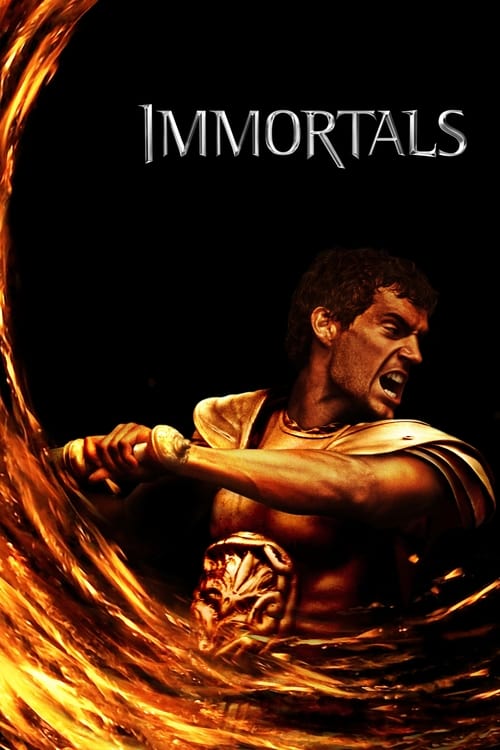





















The Verdict
King and warlord Hyperion intends to expand his supremacy over all of Greece to reach Olympus and thus dominate all of humanity, but to do so he must defeat the immortal Gods. The only thing that can kill a god is another god, and so Hyperion sets out to search for the mythical Bow of Epirus, the only weapon that can help him free the Titans from their prison in Tartarus.
King and warlord Hyperion intends to expand his supremacy over all of Greece to reach Olympus and thus dominate all of humanity, but to do so he must defeat the immortal Gods. The only thing that can kill a god is another god, and so Hyperion sets out to search for the mythical Bow of Epirus, the only weapon that can help him free the Titans from their prison in Tartarus. The Titans are defeated deities imprisoned by Zeus, and only their fury could facilitate the cruel warlord's endeavor. Meanwhile, the young farmer Theseus watches his mother die before his eyes at the hands of Hyperion and thus plots revenge. Imprisoned by the bloodthirsty king, Theseus manages to escape thanks to the help of the oracle Phedra and, unbeknownst to him, is about to become a defensive weapon in the hands of the Gods.
The beautiful "300" by Zack Snyder was a money-making machine, so it was predictable a wave of neo-peplum products, preferably in pulp sauce. Strangely, this did not happen, and while on consoles the magnificent chapters of the "God of War" saga succeeded with success, in cinema the only product comparable to the genre in the span of four years was the equally successful "Clash of the Titans", the beloved/hated remake of the 1980s children's classic. It was only a matter of time, so here come the neo-peplum in a downpour: "Immortals", "Wrath of the Titans" and "300: Battle of Artemisia". If the latter two, arriving next year, are sequels to the aforementioned blockbusters, the first represents the novelty of the group. Well, novelty is a strong word, since, in the end, "Immortals" is a sort of fusion between "300" and "Clash of the Titans", but a specific personality distinguishes it from the pot of copies produced to strike the iron while it is hot.
The producers of "Immortals" are the same as those of "300", Gianni Nunnari and Mark Canton, but the director is Tarsem Singh, the crazy visionary of Indian origin who directed "The Cell - The Cell" and "The Fall". You will understand, therefore, that a director of this kind is difficult to keep under maximum control and consequently we find ourselves facing an explosive b-movie full of action and splatter, but at the same time with a unique stylistic search. The same Tarsem says he was inspired by the pictorial compositions of Caravaggio and, in fact, the games of light and the sets give him almost the reason, thanks to a massive use of visual effects that simulate precisely a pictorial effect without inflating the rendering in an unrealistic way as it happened in the film by Zack Snyder.
"Immortals" was born from a short story by Charley Parlapanides, transformed into a screenplay by him together with his screenwriter brother Vlas ("Everything for a Reason"). Producers Nunnari and Canton smelled the business defining the work of the Parlapanides brothers as a cross between Homer and Joseph Campbell and, in fact, "Immortals" takes up Greek myths to insert them into a story of classic structure that follows to the letter the skeleton of "The Hero with a Thousand Faces" with the concepts of "The Mask of God". But as happens in almost every Hollywood product, the reference source is altered, so Hyperion is not a Titan but a cruel mortal king and warlord, Theseus has nothing to do with Minos, Ariadne and the monstrous Minotaur (although a "Minotaur" has been included here too), Phedra acquires prophetic powers and a fantastic Bow of Epirus appears that has the same power as the one seen in the fulcian "Conquest". In short, this "Immortals" has even less to do with Greek mythology than "Troy" had to do with "The Iliad". But there is a scene at the end of the film that justifies a bit every alteration, as to create a distinction between the reality of the facts and the reworking of the myth through fantasy. Everything clashes anyway, but in the end, what do they know in America about who Theseus, Hyperion and company are? Probably nothing, random names attributed to cool, muscular and half-naked characters who populate a movie of an immense cool extent.
What is certain is that "Immortals", despite Tarsem's artistic ambitions, is a fun pulp comic book that puts death, cruelty and destruction on stage in abundance. For almost two hours we witness the bastardly exploits of Hyperion, played by a perfect Mickey Rourke who dominates the scene continuously. In front of the bloodthirsty tyrant, everyone is in the shadow, both the Theseus of future Superman Henry Cavill, and the somewhat anonymous Zeus of Luke Evans ("Clash of the Titans"; "The Three Musketeers 3D"). Only Freida Pinto ("The Millionaire"; "Dawn of the Planet of the Apes") stands out for her hypnotic beauty, also offering a nude scene to applaud.
Visually, "Immortals" is very sought after, thanks to the aforementioned visual effects that manage to bring to life even the sets, often exaggerated in pure Tarsem style. To represent this, it would suffice to see the scene of the war in the sky to realize the vision of some of the choices. But what ultimately entertains us the most is the taste for pulp excess given to the film, which fills the screen with blood, severed heads, testicles hammered and amputated limbs in a splatter delirium that will make pale a good part of the horrors in circulation. The scene in which Ares comes to the aid of Theseus or the clash between Gods and Titans in the end are sequences that will whet every splatter fan who respects themselves.
"Immortals", like many films in circulation, has been converted into 3D and - like many films in circulation - does not benefit from stereoscopy, adding a often fake depth and a practically non-existent out-of-screen effect.
Do you want to have fun with a pulp-peplum full of adrenaline and splatter atrocities? Well, "Immortals" is for you. Abstain purists of Greek mythology and high school classics students with an average of 9 in Greek literature.
Comments
Comments (0)








Comments