















The Verdict
While plowing a field, farmer Ralph Gower finds a strange skull underground, with patches of fur and a terrifying gaze. After informing the village judge, the two return to the site, but strangely the head has disappeared.
While plowing a field, farmer Ralph Gower finds a strange skull underground, with patches of fur and a terrifying gaze. After informing the village judge, the two return to the site, but strangely the head has disappeared. From that moment on, strange things start happening in the village, and the inhabitants who undergo the most changes are the teenagers. One of them is Angela Blake, who transforms from a model girl to a sensual temptress, also due to strange patches of fur forming on her skin.
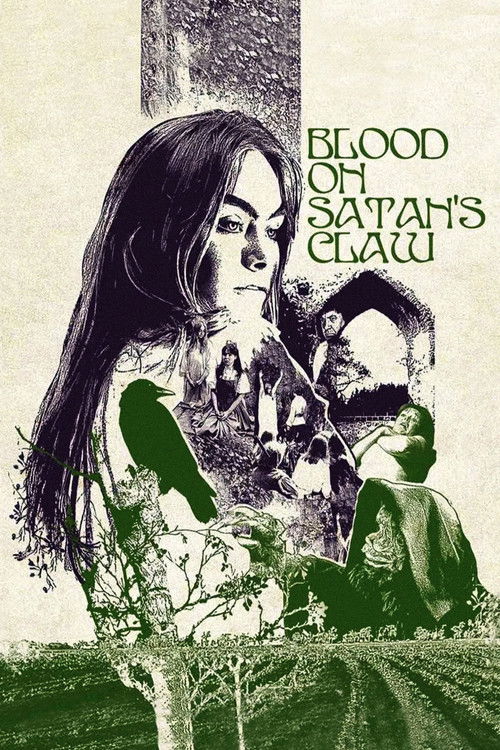
Released under the title "Blood of Satan's Claw" and retitled in the USA as "Satan's Skin," "La pelle di Satana" is a 1971 B-movie of demonic nature directed by television director Piers Haggard, which is chronologically placed between "Rosemary's Baby" and "The Exorcist." In reality, it has nothing to do with the two masterpieces of horror, being a period film set in 17th-century England, where the devil was worshipped with orgiastic rituals.
The film starts off decently with the discovery of a head with a demonic appearance by a farmer. Initially, the villagers do not believe him, especially the judge, an upright and bigoted figure who governs the country. From then on, strange events begin to occur, starting with the inexplicable behavior of a young girl, who, apparently mad, is locked up in an asylum. The plot is clear up to this point, and although there are no moments of true terror (it is, after all, a B-movie from the seventies), there is curiosity to see the development of the events. Then, some things start not to add up, such as the total disappearance of the girl mentioned above, initially a character of apparent importance and then forgotten.
Later, there is the inexplicable contagion of the village's youth, who begin to behave like true worshippers of evil with orgies, sacrifices, and so on, but whose motivation is not fully understood. It is understood that they have been touched by evil and that the initial discovery of the head has unleashed something, but no more detailed explanations are provided. This is a drawback from some points of view, as at the end of the film there are many doubts about what has just been seen, and one leaves the film with a sense of incompleteness that unfortunately hurts. It's a shame because the potential was there, and many sequences are really well made (and, to be honest, also a bit strong for the period), such as the dream of the young man who, believing himself possessed, amputates his hand, or the scene of the rape in the forest against a poor adolescent, satanic and full of perversion, given that the ones witnessing the violence are old men and boys. But the scene that remains etched is undoubtedly the inevitable female nude, an omnipresent element in the horror films of this period. This time it's Angela's turn (in name but not in fact), played by the talented Linda Hayden, who takes off her clothes, remaining naked in front of the priest, between whom there is an exchange of lines worthy of being remembered. "You are beautiful like an angel," says the reverend. "But I can love like a demon," Angela replies.
Another positive aspect of the film is undoubtedly the rural Gothic setting. A credible period film, despite the not very high budget. On the contrary, one cannot say that the makeup and special effects are noteworthy. The creature's makeup is limited to the appearance of some claws, and the curse that affects the boys is represented by ridiculous patches of fur on the skin of the possessed. Angela's thick eyebrows are more ridiculous than terrifying.
In summary, the film is not to be thrown away. It is a collage of beautiful scenes, sometimes self-contained, inserted into a poorly developed plot but which nevertheless allows the passionate viewer to watch it until the end, without regretting having wasted an hour and a half of their life.
Comments
Comments (0)

















Comments