










The Verdict
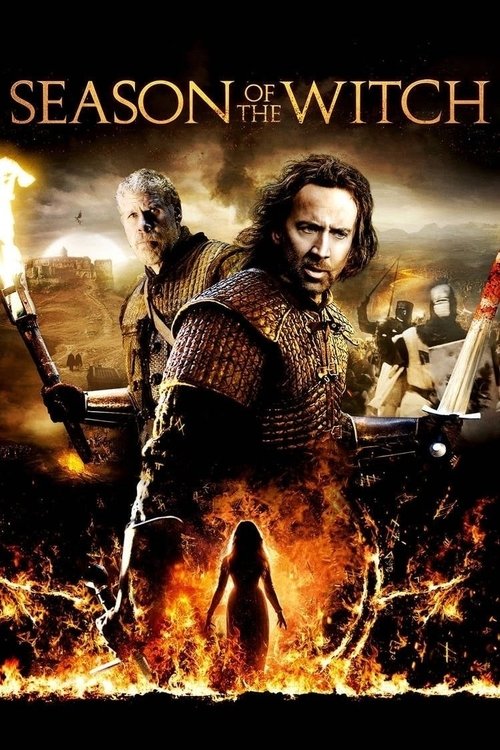
Europe, 14th century. Behmen and his friend Felson, two deserter crusaders, arrive in Marburg, one of the many cities affected by the Black Plague that is ravaging the entire region.
Europe, 14th century. Behmen and his friend Felson, two deserter crusaders, arrive in Marburg, one of the many cities affected by the Black Plague that is ravaging the entire region. The two knights are stopped and brought before the local dying Cardinal who threatens to have them arrested for desertion, unless they accept a dangerous mission: they must escort a young woman accused of being one of the witches carrying the plague to the Severako Abbey where the monks will celebrate the trial and an ancient ritual to free the region from its curse. Behmen and Felson accept and embark on the journey accompanied by a stern priest, a disillusioned knight, a swindler who knows the territory, and a young aspiring knight. The journey will be fraught with dangers that border on the supernatural.
The original title of the latest film by action-maker Dominic Sena ("Swordfish"; "Whiteout") is "Season of the Witch" and the memory of the more seasoned viewer takes off towards the second feature film by George Romero, in which the "Witch" of the title stood as a symbol of female emancipation. Rest assured, Sena's film, despite the titological similarity, is not a remake of the forgotten Romerian work, but a medieval horror that tells of witches, plague, and demonic possession.
The Italian distribution, perhaps in consideration of the modestest box office returns in the United States, is pushing "Season of the Witch" towards territories that do not belong to it, decidedly misleading, starting with a re-titling - "The Last of the Templars" - which cunningly evokes the first successful film of the diptych "National Treasure" - "The Mystery of the Templars" - which only shares with Sena's film Nicholas Cage in the lead role. The trailer focuses heavily on action and spectacular battles, which, upon watching the film, we realize are relegated as a preamble in a handful of initial minutes. The warlike spirit exhausted, "The Last of the Templars" presents itself as a solid historical setting horror, very American - perhaps too much - for some narrative choices and for the magniloquent staging.
Sena's film has a series of absolutely non-negligible merits. Let's start by saying that you can immediately notice a fresh and original approach to the horror genre that successfully mixes action, fear, atmosphere, a touch of fantasy, and - why not - a pinch of buddy comedy.
In the end, the predominant element is precisely the horror, which already stems from a very successful introduction that brings on stage one of the most successful scenes with a witch since "Army of Darkness". Sena also has the merit of always keeping the viewer's attention with a well-managed rhythm and fear and/or disgust scenes dosed with effectiveness. For the most part, it plays with the gruesome effects of the plague, but there are no lack of attacks by hungry and manifestly demonic wolves, incursions of zombie plague monks, and adrenaline-filled crossings over a precipice (the bridge scene, one of the best in the film).
The element in which Sena's film overflows due to excess of kitsch is the booming finale that does not skimp on monsters and computer graphics. Let's be clear, a similar deviation can exist and is in perfect harmony with the overall narrative construction of the film, as well as the special effects appear to be of good craftsmanship, but you cannot help but smile at what appears before your eyes. Another sore point are the dialogues. Bragi Schut signs an orderly screenplay with characters of almost B-movie characterization, effective enough; the problem is many dialogues written as if they should be pronounced in a 21st-century context and not the 14th, thus removing credibility from some scenes. Curious to find also in this film an explicit criticism of the Church, as a manipulative institution, strongly politicized and embodiment of a selfish evil that affects the community in its entirety. In recent months, the attack on the Church by American horror cinema (see also "Priest" and "The Last Exorcism", just to name a couple of titles) is becoming a fact that would be interesting to analyze (certainly not here).
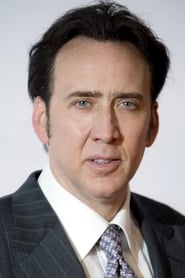
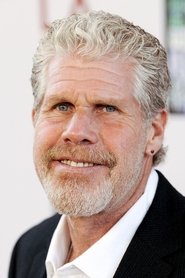
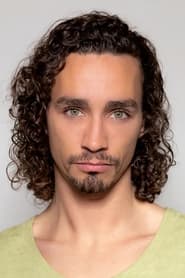
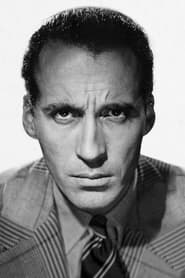
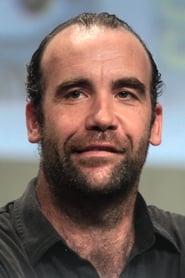
The cast of "The Last of the Templars" is heterogeneous and well-assorted, with the always excellent Nicholas Cage ("Drive Angry") and Ron Perlman ("Hellboy") in the leading roles, supported by the good Stephen Graham ("Pirates of the Caribbean: On Stranger Tides") and the young Claire Foy ("Being Human"), in the role of the presumed witch, and Robert Sheehan ("Misfits") in that of the aspiring knight. In a small part also Christopher Lee, who plays the dying Cardinal who assigns the mission to Behmen and friends.
"The Last of the Templars" is a film that certainly lends itself to being criticized by those seeking a serious and dark film that addresses the pestilent Middle Ages. To perform this task, there is already the good "Black Death" by Christopher Smith, with "The Last of the Templars" we are in the realm of the Hollywood blockbuster, good entertainment cinema that presents a series of aces up its sleeve not to be underestimated in terms of rhythm and witchy horror finds that will not disappoint horror movie lovers.
Comments
Comments (0)













Comments