
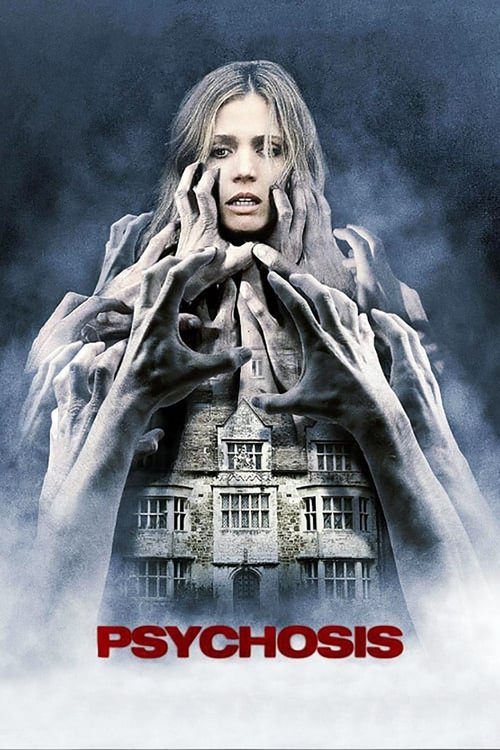






The Verdict
A group of anarchic young people set up camp at a site where a highway is being built. During the night, they are killed one by one by a madman, who is captured by the police the next day.
A group of anarchic young people set up camp at a site where a highway is being built. During the night, they are killed one by one by a madman, who is captured by the police the next day. Meanwhile, writer Susan, in an artistic crisis after a severe nervous breakdown, moves with her husband David into a large house on the outskirts of London. Often left alone because of her husband's work in the city center, Susan will soon begin to see unknown people walking around the house and garden, starting with the depraved gamekeeper Peck.
How many times have we found ourselves reading a plot like this over the course of our long career as horror movie devotees? Too many.
Sometimes we've been lucky, and the result has been praiseworthy. All the other times, as in the case of "Psychosis," the result is far from the threshold of sufficiency.
The film begins with a long, actually very long prologue of over ten minutes in which the young
rebels are massacred by a madman. After this part, the story of Charisma Carpenter and her new home, which she has moved into with her ambiguous husband, begins—a part completely unrelated to the events at the beginning except for some flashes of Susan during her hallucinations. And then comes the mess.
The first part, although a banal example of a slasher made with little care for details, has its own sense. From the moment Susan appears, everything takes on an aura of incompleteness. At first, one goes along with the game, and the woman's visions, unusual for a horror film (a boy playing soccer alone in the courtyard, a hippy painting a window), arouse curiosity and seem to have something more to say than the usual horrifying ghosts that make you jump in your seat. The problem is that these visions continue throughout the film, never assuming a real role in the movie. These hallucinations are then more or less explained in the "surprise" ending that would have surprised twenty years ago but today is standard, hence predictable. Not to mention the many abandoned pieces lying around, forgetting to explain them at the end.
What is completely missing is a turning point in the story. Doors are opened, many of which are useless, and remain wide open. This annoys the viewer who, after spending an hour and a half watching Susan's fantasies, is entitled to a plausible explanation for all the events shown in that time.
So many, too many questions remain unanswered. What does the prologue have to do with it? Did it really happen or not? And the figure of the gardener who shows up at the house? Not to mention the mysterious gamekeeper, who is first caught by Susan in unromantic behavior, then a friend of the husband, and later a maniac again? And David's party he attends on a business trip?
Of course, these last elements are just devices to showcase some steamy moments, elements that never hurt in a horror film if inserted into the story with a minimum of sense. Which does not happen in "Psychosis" for two substantial reasons: first, the sex scenes are completely disconnected from the plot (like the orgy in which
Susan's husband participates, where only the girl without underwear sitting on the glass table stands out) and secondly, they are not even pushed enough to be provocative. Paradoxically, the only explicit scene is a male nude.
The performance of the actors does not raise the film's morale either. It is hard to define Charisma Carpenter as a good protagonist, who, however charming she may be, has remained at the collegiate acting level where she fought vampires in Sunnydale. The rest of the cast follows suit, adding fuel to the fire of mediocrity.
One should not ask too many questions in front of a screenplay that does not have the answers. If one has the patience to watch the entire film, perhaps something positive could be found. But these are really small things that pale in the face of the general confusion.
Add half a pumpkin, just to give courage to the authors.
Comments
Comments (0)








Comments