



























badelf
Summary: 8/10: a hilarious, unnervingly well-constructed portrait of a serious disorder, carried by a fearless performance from Kristine Kujath Thorp, that fools its characters and its audience by the same method.
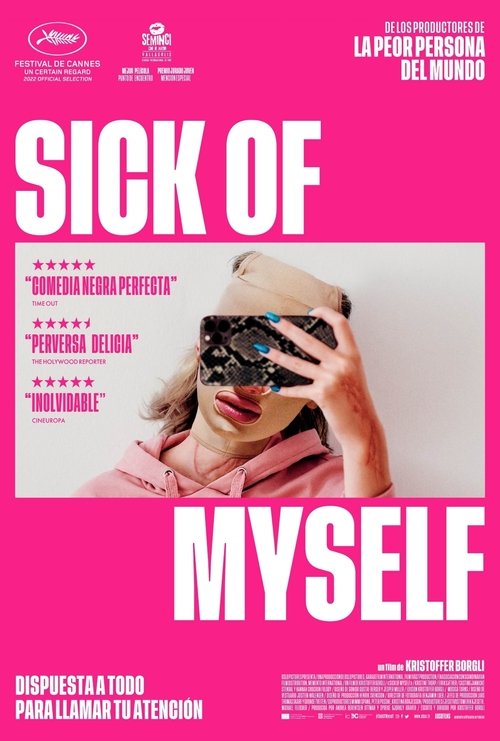
The direction is the film's real feat, considering the material. Kristoffer Borgli's black comedy starts its two leads close to caricature, a narcissist and a bigger narcissist, locked in a competition neither will admit they're having. Signe (Kristine Kujath Thorp) is losing her boyfriend Thomas (Eirik Sæther) to his sudden fame as a sculptor who builds his pieces from furniture he's stolen. Rather than compete on any axis where she might actually win, she chooses illness, poisoning herself with a black-market drug to trigger a disfiguring skin reaction, then riding the sympathy it generates like a woman who has finally found her calling.
But director Kristoffer Borgli and Thorp keep pulling you back from the cartoon; every so often the film lets you see the panic underneath Signe's performance, the real emotional hunger driving the con, and suddenly she stops being a type and becomes a person you recognize, possibly from your own worst behavior at a dinner party. That's a difficult juggling act to hold for ninety minutes, but this film holds it, in spite of some slowness toward the end of act two.
Thorp's performance is the engine, and it's a genuinely brilliant one. She has to play a woman lying to everyone around her while also, in a sense, lying to the audience, and she does it by never breaking the fiction from the inside; Signe believes her own performance so completely that we start to as well.
The film's cleverest trick is structural. Signe's elaborate fantasies, the magazine profiles, the modeling contracts, the tearful public vindications she imagines for herself, are staged with the same visual conviction as the film's reality, so that you, like Signe's friends, absorb them as plausible before you catch yourself and realize you've been had. That's not a cheap gag; it's the whole thesis rendered as form. The friends who enable her aren't stupid, and neither is the audience. We all wanted to believe the more interesting version of the story.
Which makes the support-group scene the moral hinge of the film. It's the one room where Signe's routine doesn't work, where people who have genuinely suffered simply have no patience for her performance of suffering, and the flatness of their response lands harder than any confrontation could. It's the film's version of a truth I keep coming back to: people tell you exactly who they are right up front, we just aren't listening, except here, the group listens perfectly and simply refuses to be fooled. Signe's friends fail that test. We, briefly, fail it too.
The satire around the edges, the contemporary art world's appetite for a good backstory, the way social media and NGO-adjacent sympathy culture reward victimhood as a kind of currency, gives the film its bite without ever letting the comedy overwhelm the character study at its center.
It's very funny, and it's also genuinely upsetting once you sit with what you've watched, which is a person destroying her own body because she has no other language left for asking to be loved. That destruction has a clinical name. What the DSM-5 calls Factitious Disorder Imposed on Self, most people still know by its older name, Munchausen syndrome, named after a Baron famous for his tall tales. The clinical picture is grim: patients deliberately falsify or induce symptoms in themselves with no external incentive beyond the attention, care, and sympathy the sick role provides, and the prognosis, once the behavior is chronic, is poor. This is a movie about a real and serious disorder that never mocks the disorder itself; it mocks the culture that makes faking it look like a rational career move.
 Intro
Comentarios