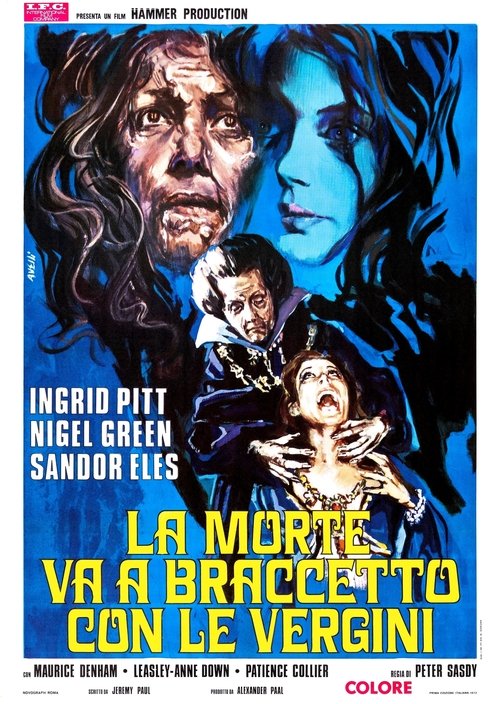
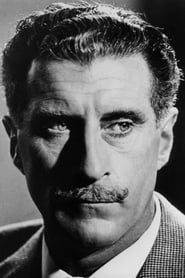
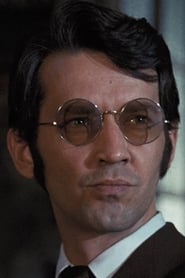
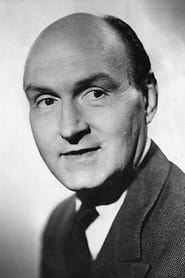

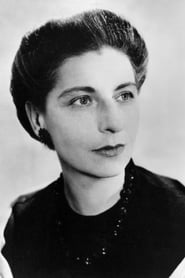
Countess Dracula - La Morte Va a Braccetto con le Vergini backdrop
Countess Dracula - La Morte Va a Braccetto con le Vergini poster

COUNTESS DRACULA - LA MORTE VA A BRACCETTO CON LE VERGINI

Countess Dracula

1971 GB HMDB
gennaio 30, 1971

Ungheria, XVII secolo. Dopo essere rimasta vedova, l'anziana contessa Elizabeth Nádasdy, della casata dei Báthory, scopre fortunatamente un modo per tornare giovane; ma il prezzo da pagare per coloro che la circondano sarà alto e sanguinoso.

Cast

👍 👎 🔥 🧻 👑

Commenti

Commenti (0)

Troupe

Sceneggiatura: Alexander Paal (Story)Peter Sasdy (Story)Jeremy Paul (Screenplay)
Musica: Harry Robertson (Original Music Composer)
Fotografia: Kenneth Talbot (Director of Photography)

RECENSIONI (1)

Roberto Giacomelli
Elizabeth Nodosheen è un’anziana contessa ungherese che ha appena ereditato gran parte dei patrimoni del marito appena defunto. Tra gli altri ereditieri c’è anche Ilona, la figlia ventenne del conte e Imre, un giovane ufficiale di cui la contessa si è invaghita. Un giorno Elizabeth, durante una lite con una sua serva, viene accidentalmente bagnata con il sangue della ragazza e ringiovanisce magicamente; l’effetto ha però una breve durata. La contessa allora decide di fare periodici bagni nel sangue di giovani donne che rapisce e uccide con la complicità del suo ex amante e della sua governante. Nel frattempo tiene segregata sua figlia Ilona appena giunta in paese e si spaccia per lei, instaurando una relazione amorosa con il giovane ufficiale ereditiere. Nei primi anni ’70 la celebre casa di produzione inglese Hammer si trovava in un periodo di incertezza che anticipava la futura crisi che portò alla chiusura proprio alla fine di quel decennio. Il mercato era profondamente cambiato, le vecchie suggestioni gotiche che avevano fatto al fortuna della casa specializzata in horror non bastavano più al pubblico, ormai smaliziato dal gore e dal cannibalismo romeriano. Anche la figura del vampiro stava cambiando profondamente e all’archetipo del succhiasangue rappresentato dal fascinoso nobile stokeriano, si stava pian piano sostituendo la figura della vampira lesbica di Jean Rollin e di Jesus Franco, protagonista di una serie di film che contaminavano l’horror al genere erotico. Colto il segnale di cambiamento, anche la Hammer declinò su ciò che il gusto del pubblico dell’epoca premiava e così furono prodotti una serie di film che univano la figura del vampiro a suggestioni erotiche. Uno dei personaggi maggiormente esplorati dal cinema di genere del periodo fu la contessa ungherese Erzsbeth Bathory, la famosa contessa sanguinaria che il mito descrive come feroce assassina che si immerge nel sangue di giovani vergini per rimanere giovane, protagonista di una serie incredibile di film che vanno da “La vestale di Satana” all’italiano “Il plenilunio delle vergini”. “La morte va a braccetto con le vergini”, fantasioso titolo sostituito dalla distribuzione italiana al fuorviante “Countess Dracula”, prende in esame proprio il mito della Bathory e, essendo datato 1971, si inserisce proprio in quel periodo di transito della Hammer. In realtà con questo film la Hammer non centra in pieno i suoi intenti poiché, malgrado la presenza di un’attrice come Ingrid Pitt (grande protagonista l’anno prima di “Vampiri Amanti”, film sempre Hammer, ben più riuscito), l’elemento erotico è appena accennato e anche quello orrorifico tende a latitare. Con “La morte va a braccetto con le vergini” abbiamo a che fare con il racconto piuttosto fedele delle gesta della contessa sanguinaria e dunque l’elemento soprannaturale viene quasi abbandonato, relegato solamente all’improvviso ringiovanimento/invecchiamento della protagonista. Anche se l’elemento focale della storia sono i famigerati bagni nel sangue, non assistiamo mai realmente a questa pratica, per cui anche l’elemento emoglobinico viene celato all’occhio dello spettatore voglioso di emozioni forti. Dunque cosa rimane in questo film? Rimane una messa in scena dignitosissima, come da sempre la Hammer ci ha abituato, e un lavoro certosino un po’ sotto tutti i punti di vista. Se la ricostruzione storica delle scenografie e dei costumi è dunque molto credibile, anche la regia e gli interpreti sono di buon livello. Peter Sasdy veniva da “Una messa per Dracula”, un film intriso di critica ideologica che in parte rinnovava la figura del conte vampiro, dunque era una buona carta da giocare per la Hammer, e infatti si è dimostrato decisamente competente nello svolgimento del suo compito. Anche gli interpreti appaiono tutti piuttosto adatti, a cominciare dalla bellissima Ingrid Pitt, qui a volte nascosta dal pesante make-up. Insomma, “La morte va a braccetto con le vergini” è un film nel complesso un po’ troppo diseguale: ben fatto ma privo di quel mordente che lo avrebbe contraddistinto dalla massa delle produzioni dedicate alla contessa Bathory. Vedibile, ma per nulla necessario.
👍 👎 🔥 🧻 👑

Commenti

Commenti (0)

Dove Guardare

Streaming

Cultpix Cultpix

RECENSIONI DALLA COMMUNITY (3)

John Chard

John Chard

6 /10

Countess Bathory.

Countess Dracula is directed by Peter Sasdy and written by Jeremy Paul. It stars Ingrid Pitt, Nigel Green, Sandor Eles, Maurice Denham, Patience Collier and Lesley-Anne Down. Out of Hammer Film Productions, music is by Harry Robertson and Eastmancolor cinematography by Kenneth Talbot.

Why didn’t they just call it Countess Bathory? Or just Elizabeth Bathory? Film has nothing to do with Dracula or Vampires, and is basically an interpretation of Madame Bathory, who back in olde Hungary killed any number of girls for kicks and a vain belief that bathing in virginal blood would keep her young. It’s this last aspect that Hammer focus on, unfurling a story where the Countess strikes on the secret of eternal youth, and who then promptly has her daughter kidnapped and proceeds to impersonate her. Thus with that she gets to romance a young man, but of course as the bodies start to pile up, and the Countess’ suitor and confidant's begin to get their noses pushed out of joint, things quickly go downhill fast.

As a technical production it’s good Hammer fare. Costuming, colour photography, set design and acting performances are perfectly pleasing. Unfortunately it’s all very predictable, and worse still considering the plot points of interest, it’s pretty bloodless, playing out as some sort of period based drama with the odd bit of dastard behaviour thrown in for good measure. Nothing really happens to perk up the story, and sadly the finale is something of a damp squib. The red blooded amongst us can’t help but enjoy the twin lovelies of Pitt and Down, and the wonderful Nigel Green can’t believe his luck as he gets to canoodle with our Ingrid! But all told it’s not very sexy, not very horror and only works as a good period drama if you set expectation at that level. 6/10

Wuchak

Wuchak

7 /10

Hammer’s Gothic drama/horror based on the infamous Countess Bathory

RELEASED IN 1971-1972 and directed by Peter Sasdy, "Countess Dracula" chronicles events in medieval Hungary where the aging Countess Elisabeth (Ingrid Pitt) cruelly reigns with her Steward, Captain Dobi (Nigel Green). She discovers that washing in the blood of maidens makes her youthful and orders her servants to apprehend victims. Pretending to be her daughter, Ilona, the Countess seeks the affections of a young Lieutenant, Imre Toth (Sandor Elès). Maurice Denham plays the wise old scribe of the castle, Master Fabio, while Lesley-Anne Down appears as the real Ilona, held captive by a mute peasant.

The real Elizabeth Báthory lived in Čachtice Castle, which was surrounded by a village and crop lands (and still is), bordered by bluffs of the Little Carpathians in Hungary. Her chief servant was into witchcraft and encouraged Bathory in her diabolic endeavors. Patience Collier plays this role in the movie, but she’s not a witch.

More than 300 witnesses testified to Bathory’s atrocities with Priests, noblemen and commoners being questioned. Her crimes included cruel beatings, burning of hands, mutilation, biting the flesh off of faces, as wells as limbs and other body parts, freezing to death or starving. Her early targets were serving girls 10-14 years old, the kin of local peasants, who were usually lured to the castle as well-paid servants. She later was said to have apprehended daughters of the lesser nobility, which was the beginning of the end.

In those times Hungarian nobles were allowed to reprove their servants by whatever means they saw fit, even death, and were not reprimanded for it, which obviously facilitated Bathory’s offenses. Three of four of her closest servants were executed and she was under house arrest limited to one room the last four years of her life. She died at 54 in 1614. While some argue that she was politically set-up, and that’s always a possibility, there’s just too much documentation verifying her crimes to dismiss them. The incredible number of her victims (650) is probably exaggerated and the bathing-in-blood angle is likely just lore emerging well after her death.

The film’s cheesy title is figurative because there’s no vampirism; “Dracula” was a hot item at the time and producers simply hoped to capitalize on the name. Yet there is the supernatural element of becoming young & beautiful again. It’s an engaging theme because most aging women (and men) long to restore the beauty of their prime. Have you ever seen a woman in her late 50s or whatever acting like she’s a college girl on spring break? It’s pathetic.

In any case, this is a quasi-historical drama with gothic horror. I love the castle & sets, the costumes and torch-lit hallways. It brings to life the late/post Medieval Age. Some parts are predictable (e.g. the outcome of the closing wedding), but the story is compelling and gives you a good taste of feudal life in central Europe back then.

On a side note, Lesley-Anne Down was one of the most beautiful women to walk the earth in the 70s-90s and she was only around 16.5 years-old during shooting. While her screen time is scant in the first two acts, she comes to the fore in the final act and is definitely a highlight.

THE MOVIE RUNS 1 hour, 33 minutes and was shot in Iver Heath, Buckinghamshire, England. WRITERS: Jeremy Paul (screenplay) and Alexander Paal (story) inspired by Valentine Penrose’s book “The Bloody Countess: Atrocities of Erzsébet Báthory.”

GRADE: B+

CinemaSerf

CinemaSerf

6 /10

The elderly, and recently widowed “Countess Elizabeth” (Ingrid Pitt) is not quite ready to give up the ghost just yet, especially when she discovers a rather macabre method of regaining - for a time - her own youth. Of course, there’s no such thing as a free lunch, especially if you are one of the charming young girls who unwittingly end up on the menu. Initially, her devoted ex-beau “Dobi” (Nigel Green) helps her to purloin her victims but even he realises that it can’t go on for ever especially when she starts to turn her attentions to the dashing “Toth” (Sandor Elés) and really puts his nose out of joint. What can make this transformation permanent, though? Well, of course - what won’t the blood of a virgin do? It’s all your standard Hammer costumed fayre, this, but it steers clear of pantomime gore for the most part and just relies on the hard-working make-up team to convince us that Pitt can age or rejuvenate at the drop of a hat. There’s a lot of dialogue and a fair degree of repetition too, but you always know what you are getting with these films and though I doubt you’ll remember it for long, it does what it says on the tin/coffin.

Recensioni fornite da TMDB