





















The Verdict
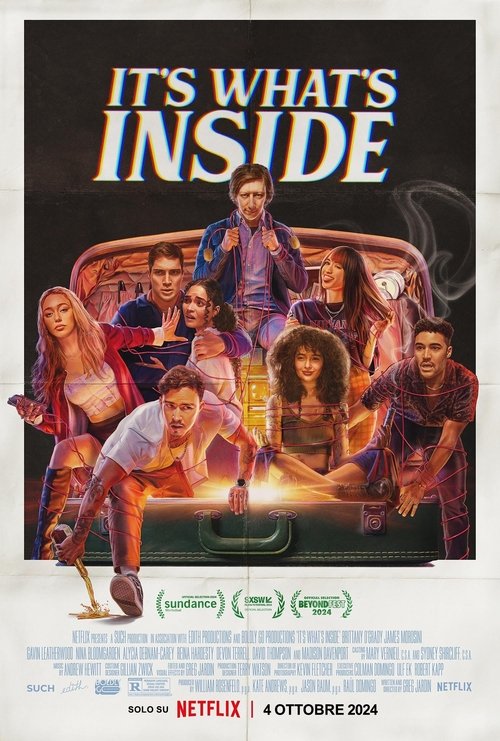
We are at the party of the century organized by Angad. At the party, there is David, whose only goal is to win back the heart of Jill after a stupid mistake made without thinking.
We are at the party of the century organized by Angad. At the party, there is David, whose only goal is to win back the heart of Jill after a stupid mistake made without thinking. With him is Teddy, who must absolutely have sex before the end of the party, and Alison, an introvert searching for herself. During the evening, an electrical blackout occurs and something strange begins to happen. Some copies of the guys present at the party, completely identical in appearance and clothing, start appearing out of nowhere and interacting with the others.
What would happen if suddenly we found ourselves face to face with an exact copy of ourselves? It is not accurate to say a "copy" but rather ourselves coming from the past. So what would happen if we saw ourselves repeating the exact same things we did an hour before? A paradox that could trigger devastating consequences.
The theme of time travel and the paradoxes that result from it has been used and abused in cinema many times, starting with the classics of fantasy cinema like "Back to the Future" up to lesser-known but interesting films like "Los cronocrímenes – Time Crimes". All these films revolve, precisely, around the idea of what would happen if one could play with time, going back and forth at will. "Plus One" revisits this concept slightly differently because it is not properly a time travel that the protagonists participate in. It is a mistake, a blackout that causes a kind of delay and the duplicates from the past intersect with the current ones, with all the consequences that follow. All set at the party of the century, a party organized in which alcohol, drugs, sex, and strippers are not spared. On this scenario of fun, actor Wakefield moves with difficulty, who had positively surprised as the educated leader of the assailants in "The Night of the Judge", in love and repentant after a stupid gesture.
Therefore, the acting is not the strong point of the film.
To be honest, there are not many strong points. The idea of the blackout and the arrival of the duplicates is interesting, but it is dragged out too much. After an hour of the movie, the much-anticipated encounter still hasn't happened, and the attention drops drastically. The party is the true protagonist of the film, and for almost the entire time, we see only people dancing, drinking, and having fun, setting aside the interesting aspect of the plot. But not everyone is looking for fun. Some are trying to recover lost love, others are simply looking for a connection. They tried to include slightly more delicate themes compared to pure fun, but the result is not entirely convincing. Even when the duplicates finally arrive, the moment of delirium right before the end is calm and does not exceed even in splatter. There are some funny moments, like the long sex scene, but even in this case, everything is dragged out too much, and you can't wait to move on to the next scene.
It's a shame because if they had played up the exaggeration, maybe with some nice splatter scenes or emphasizing the tones of the comedy even more, the product would have taken on different connotations, typical of those that sooner or later take the name of cult movie.
Comments
Comments (0)






Comments