













The Verdict
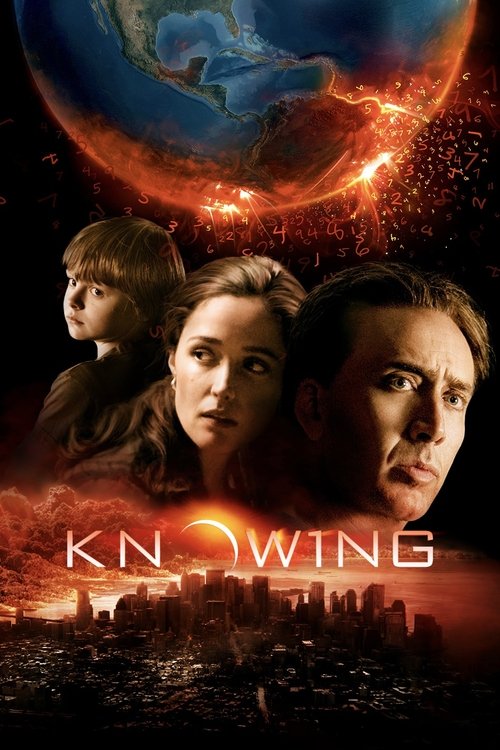
In 1959, at an elementary school in Massachusetts, some students are invited to draw pictures of how they imagine the future. The drawings are then placed in a cylinder specially named the "time capsule" and kept for half a century to be shown to new generations.
In 1959, at an elementary school in Massachusetts, some students are invited to draw pictures of how they imagine the future. The drawings are then placed in a cylinder specially named the "time capsule" and kept for half a century to be shown to new generations. In the present day, the capsule is opened, and each child is given a drawing contained within. The young Caleb Kostler happens to get a strange sheet completely covered with numbers, apparently without any meaning. Caleb's father, the astrophysicist John Koetler, accidentally discovers that those numbers are actually precise coordinates of all the greatest disasters that have shaken humanity in the last fifty years. Initially incredulous, John becomes convinced of the truth of the predictions, among which is also the fire that caused the death of his wife, and realizes that three of the predictions have yet to occur. "Signs from the Future" ("Knowing" in the original) is a very delicate object, a film with an interesting and original subject that, however, already on paper walks the dangerous bridge that divides the theoretically appetizing from the potentially disastrous. Keeping a work of this kind under control is a very difficult task, and the slightest misstep could compromise the success of the whole. Inevitably, Proyas and company fail to stay on the right track, and a first excellent part is followed by a second terrible part. The former enfant prodige director of "The Crow" and "Dark City" scripts "Signs from the Future" with four other authors—Stuart Halzedine, Ryne Douglas Pearson, Juliet Snowden, and Stiles White—mixing science fiction, disaster film, and horror suggestions. But evidently, five minds dealing with a subject of this kind have more opportunities to cause disasters, since one has the feeling that in the film there are macroscopic problems related precisely to the glue that holds the structure together: more ideas that do not fit well, held together with forced transitions that prejudice the success of the film. The two hours of duration of "Signs from the Future" can be perfectly divided into two parts. The first hour serves to introduce the subject, pose questions, accumulate elements, and slowly unravel them with relevant events; the second part, on the other hand, has the task of finding an answer to the questions and building a climax that leads to the end. The first part is highly satisfying, one breathes an atmosphere reminiscent of Shyamalan, an original and engaging story is built, characters that are not particularly innovative but well-drawn are introduced, and one witnesses two action scenes that are brought to the stage in a stunning, textbook manner. Here one already begins to glimpse a few too many simplifications in the screenplay (the protagonist discovers the "power" of the numbers in a somewhat too casual way, as is his presence at the scene of the first disaster), but just before the screenwriters had taken cover by having the protagonist give a university lecture on the relationship between determinism and casualty, so one tends to overlook and remains captivated by the surroundings. In particular, it is difficult to remain indifferent to the staging of the airplane accident, a very long planosequence that goes from the crash of the aircraft on the highway to the arrival of the first rescuers, showing horror and death in a terribly realistic way. Then the screenplay shortcuts continue in an no longer acceptable manner: the disasters that have occurred in fifty years have taken place in the most disparate areas of the globe, and by chance the last three that must occur all concern the area where the protagonist lives; John lacks the last digits of the code and in a completely casual way manages to find where to look for them, moreover thanks to an involuntary suggestion provided by his son in a scene that is far too gratuitous. In short, if before one was willing to give in to the mechanism of casualty, after a while one begins to feel lost. But the real reason that makes the film degenerate is the science fiction turn that the story takes in the last quarter of an hour, which I will not reveal here. An added element, important but without which the story would have gained in coherence, which manages to ruin what good and original the film had managed to offer up to that moment. One has the impression that an attempt was made to temper the excessive pessimism with which the film was loading itself by adding an element of hopeful optimism, absolutely inappropriate and capable of changing the meaning of the work, trivializing it and even pushing it towards a slight involuntary turn of ridicule. And this is a shame because the apocalyptic climax, supported by excellent special effects, had a certain emotional and visual impact that was not marginal. In short, for the series "how I ruin two hours of film in fifteen minutes." For the rest? As has been said, Alex Proyas' direction is very good, in some moments excellent, and the photography of Simon Duggan, which uses muted and autumnal tones, sometimes even dark, contributes to enhancing it. In the cast, we find a good but not exceptional Nicholas Cage, kept in check by a melancholic character, and a Rose Byrne ("Sunshine"; "28 Weeks Later") in part. If the first part of "Signs from the Future" deserves three abundant pumpkins, the second deserves only one. So we take the average.
Comments
Comments (0)









Comments