


Tetsuo, el hombre de hierro backdrop
Tetsuo, el hombre de hierro poster

TETSUO, EL HOMBRE DE HIERRO

鉄男

1989 JP HMDB
julio 1, 1989

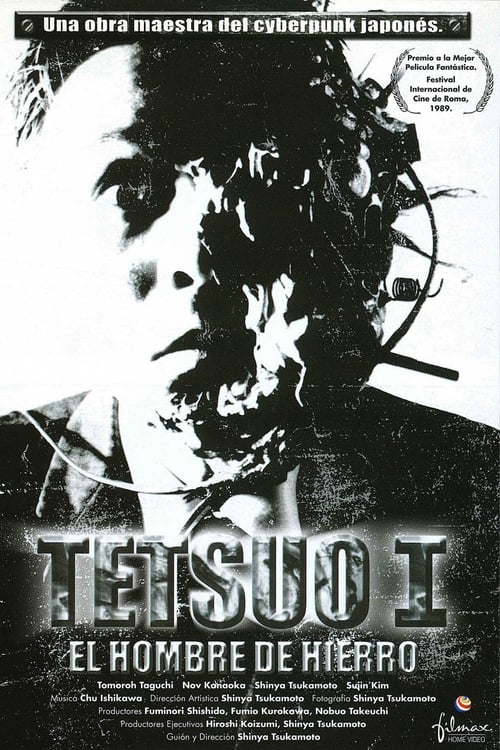
El protagonista es un extraño hombre conocido como ”el fetichista de metales”, que tiene la insana costumbre de clavarse trozos de metal en el cuerpo. Un buen día, sufre un accidente de coche y choca contra otro hombre quien, a partir de ese momento, empezará a sufrir extraños síntomas en su propio cuerpo. Extrañas protuberancias metálicas surgen de su cara y extremidades. Mientras, el hombre fetichista, sueña con un mundo de metal en el cual todos sufrieran una mutación hasta conseguir una transformación total y absoluta. (FILMAFFINITY)

Directores

Reparto

👍 👎 🔥 🧻 👑

Comentarios

Comentarios (0)

Equipo

Guion: 塚本晋也 (Writer)
Musica: 石川忠 (Original Music Composer)
Fotografia: 不二稿京 (Director of Photography)

RESEÑAS (1)

Luca Pivetti
Un hombre, fetichista del metal, se inserta un tubo de acero en una pierna: a partir de ese momento, su cuerpo comienza una mutación que lo llevará a convertirse en un ser totalmente nuevo, una mezcla de carne y metal que traerá sangre y destrucción. Revisar una obra del calibre de "Tetsuo" es una tarea ardua, si no imposible, al límite del masoquismo. ¿Por qué "Tetsuo" no es una película: el trabajo de Shinya Tsukamoto es una bala disparada a quemarropa que va a adherirse directamente al cerebro, y en un movimiento rotatorio perpetuo sigue viajando por la caja craneana del espectador, liberando rápidamente el veneno en su interior que completará la obra de aniquilación de la mente. "Tetsuo", antes que nada, es una experiencia, porque no solo es un trabajo sobre la "mutación" sin hablar realmente de nada (no hay trama, no encontramos un claro desarrollo de eventos), sino que es en sí mismo "mutación", "infección", "cambio": por lo tanto, es imposible catalogar o insertar la obra de Tsukamoto dentro de un género (aunque se dirá que estamos ante el manifiesto del "cyberpunk") porque en primer lugar "Tetsuo" es una mezcla indisoluble de estilos e influencias mezclados a nivel genético-molecular. Encontramos ecos lynchianos, obsesiones cronenberghianas sobre la nueva carne y el poder de los medios ("Videodrome") llevadas a sus consecuencias más extremas, montaje de videoclip, películas de monstruos japonesas, samuráis (post)postmodernos urbanos con tubos metálicos en lugar de katana y estética "Manga" mezclados de manera meticulosa sin que sea posible entender dónde termina una influencia y comienza la siguiente. Todo esto, por supuesto, disparado a una velocidad loca, a menudo hiperacelerado, casi como si estuviéramos frente a un bombardeo de fotogramas acompañado por una sinfonía de clangs metálicos, tapices rítmicos de engranajes y gritos espeluznantes. Al observar "Tetsuo", nos encontramos ante un trabajo sin precedentes en la historia del cine, una película que es en primer lugar "Otro", "Novedad", "Punto de Ruptura" en su deseo de impactar y ser extremo solo por el gusto de serlo. En este delirio de tecnología, carne, sangre, violencia y sexo (presente en dosis masivas, que luego será dejado de lado en "Tetsuo 2-Body Hammer"), Tsukamoto logra transmitir un mensaje, también porque estamos ante el ejemplo clásico de cómo la "forma" coincide con el "contenido": Tsukamoto nos está diciendo que estamos confiando demasiado en la tecnología y los medios de comunicación, que la obra de infección del metal con nuestra carne ya comenzó hace mucho tiempo y ni siquiera nos hemos dado cuenta. Ya ni siquiera somos capaces de distinguir la realidad de la ficción televisiva. Lo que sale del tubo catódico tiene el mismo valor que lo real, o tal vez lo real solo es capaz de adquirir este estatus cuando es confirmado por la televisión. Tal vez ambas cosas. Este mensaje, que nos muestra que Tsukamoto en 1989 tenía una visión clara, es más actual que nunca y tiene como fondo una ciudad mostrada de manera frenética, fragmentada, casi como esquirlas locas de una metrópolis demasiado grande y aterradora para ser capturada en su totalidad, porque ella también refleja el progreso desmedido del ser humano. La puesta en escena sigue la locura del mensaje/contenido: la dirección es psicótica y errática, el montaje hipercinético, los movimientos de la cámara nerviosos y a menudo la estética de videoclip (muy diferente de la de los diversos "Saw" que imperan hoy) hace que todo sea aún más frenético y difícil de seguir, también porque, a menudo y voluntariamente, se procede por una acumulación de imágenes casi como si se tratara de un lavado de cerebro auténtico. Una obra difícil de seguir y asimilar, pero de un encanto más único que raro dentro de la cinematografía Extrema (con E mayúscula), que captura a nivel subliminal y que se adhiere al cerebro del espectador, sin dejarlo más; un trabajo potente y visionario (a menudo esta palabra se utiliza inapropiadamente, pero aquí parece más que nunca justificada) que deja boquiabierto por riqueza de contenidos a pesar del hermetismo de las elecciones del director. "Tetsuo" es una película extrema en cada una de sus facetas y que, precisamente por eso, no admite compromisos ni medias tintas: o se ama o se odia. Y si se ama, no se trata de una película para insertar en el reproductor de DVD para pasar un poco más de una hora agradable frente a la pantalla; "Tetsuo" es una película que requiere la disposición mental adecuada del espectador cada vez que se decide verla, porque no se trata de una visión agradable, al menos no en la manera en que estamos acostumbrados a entenderla en la vida cotidiana. "Tetsuo" es una experiencia agotadora, mareante, de la cual, si se sobrevive, se sale cambiado, infectado, mutado. A menudo, en casos como estos, se dice "Para muchos, pero no para todos". Con la película de Tsukamoto no vale ni eso: "Tetsuo no es para muchos, mucho menos para todos... es realmente para muy pocos". Se merecería media calabaza más.
👍 👎 🔥 🧻 👑

Comentarios

Comentarios (0)

Dónde Ver

Streaming

Raro Video Amazon Channel Raro Video Amazon Channel

Alquilar

Amazon Video Amazon Video
Chili Chili

Comprar

Amazon Video Amazon Video
Chili Chili

RESEÑAS DE LA COMUNIDAD (2)

Jeff Larsen

Jeff Larsen

“The penis is evil.” - Zardoz

When was the last time your city was torn apart by a towering metal penis?

A button-down wage earner and his girlfriend are driving in the city when they hit a man. They then cart him to a field and dump him. Seems the two were having sex while driving, and their hit-&-run arouses them still further until they are having sex at the scene in the full knowledge that their (presumably dying) victim is watching them.

The next morning, salaryman finds his cheek has sprouted a shiny metal zit. Soon he'll be having scary encounters with transformed strangers and having sexually charged nightmares of his girlfriend as a demonic hermaphrodite (or at least sporting a bionic strap-on of more than regular size).

What's going on here?

Shinya Tsukamoto's 1989 professional debut is a retelling and expansion of his homemade short Futsu Saizu no kaijin (“Monster of Regular Size”). It's more of a primal scream of suppressed rage and lust than a movie, really. With no budget to speak of, Tsukamoto has drawn on techniques not too removed from early Sam Raimi and applied them to an inspired vision of urban Hell that could the same neighborhood from Eraserhead, with a heavy dose of Cronenberg's body horror, Tetsuo seems to draw influence from manga and the pioneering days of Mtv (think Talking Heads videos). Tetsuo is filmed in stark black and white 16mm, lending a grain to convey the grit and inhuman decay of Tokyo city, and maniacally edited to the point that it's difficult to follow without several viewings. the images are of a world buried in the debris of society, metal refuse of every sort heaped and heaving like a fungus over civilization, nothing natural in sight but for the human body itself. Tetsuo has a sound design that matches its frantic and disjointed look. Feverish in pitch and tone, what not many mention when talking about the movie is that Tetsuo is also wickedly funny. Tsukamoto infuses it with a sick sense of humor from absurdist to slapstick.

So what is really going on? That's up for interpretation. Some see an anti-homosexual plea at work, others see it as pro-gay (Tsukamoto, a humanist with an empathetic bent, is far from the type to deliver a message of intolerance). The director claims that it grew from his love/hate relationship with the city itself, living removed from nature. The facts of the story are that the man hit by the wage earner has a fetish for metal and a sexual appetite for violence. He had already tried to fuse his body with bits of metal inserted under the meat of his limbs. When he sees the driver's lusty response to having hit and nearly killed him, the fetishist sees a kindred spirit and becomes infatuated with the driver. He begins to harass the man through bizarre psychic methods (we see his POV, memories, and messages to the businessman via televisual imagery), an insane courtship aimed at bringing out the salaryman's latent sexual thirst for destruction. The driver's transformation of psyche manifests in the man's biological body becoming more and more am abstract mass of iron. More than that and you're reading what you want into the film. It's highly suggestive but never explicates itself.

Tsukamoto structures his tale around two men and a woman, the same setup he's reused for the bulk of his early screen career with the woman often transformed through her relationships with the men. What I find fascinating in Tetsuo (Is that the name of the fetishist or the salary man? I don't know!) is that the business drone seems to have an ambivalent attitude about sex and possibly women (he flees an encounter with a prim businesswoman in the subway, though admittedly she's pretty damn scary) while the metal fetishist positively identifies with women and female sexuality, choosing to use both the girlfriend and the subway patron as his avatars, and ultimately appearing as an androgynous punk sprite during his final seduction.

Testsuo is not my favorite from Shinya Tsukamoto, but it gets better every time I see it. In fact, the first time left me exhilarated by the ferocity of it but lukewarm to its substance. I've now seen it a number of times, and it...grows on me. Tetsuo would make a great double-feature with Cronenberg's Crash.

tmdb76622195

10 /10

Just another Japanese-language, surreal, horrifying, chilling, gross, sadistic, industrial sixty seven minute nightmare in glorious black and white. What can I say about the plot? A victim of a hit-and-run accident has his revenge on the couple that ran him over. That sounds like a pitch to an average Hollywood movie, and it has been done, but "Tetsuo: The Iron Man" quickly leaves all safe Hollywood ingredients in its wake. The victim somehow gets the male driver to slowly turn into a raging machine. It starts with a small wire sticking out of his cheek. Soon, he is being chased in a subway terminal by a woman with the mechanical affliction. He escapes her, but still tries to make it with his girlfriend. In the film's most horrific scenes, he grows a giant ugly drill, and the two spend many minutes both trying to kill and love each other. Halfway through, we find out what the victim is trying to do, and the climax involves the two men joining together in more ways than one.

Surrealism is so hard to describe- quick, give me the plot of "Un Chien Andalou," but this film is one of the most violent films I have seen. So much can be read into this, from machines taking over our world, to impersonal love relationships, but all in all, director and writer Tsukamoto stuns the viewer with eye imploding visuals. The stop motion special effects work well, and everyone involved seems to be in actual pain in many scenes. The makeup and mechanical costuming are top notch, and the music totally kills- not quite heavy industrial, but not just another rock soundtrack, either. There is not a lot of blood here- there are torrents of it. This is a blood monsoon. The soundtrack has little dialogue, and the sound effects consist of a lot of metal scraping metal, which had me climbing the walls. Watch for the now infamous scene as the unnamed man feeds his girlfriend breakfast. "Tetsuo: The Iron Man" is a hard core sci-fi/horror fan's dream, I'll never curse my car or microwave again.

Reseñas proporcionadas por TMDB