






Saltar al contenido
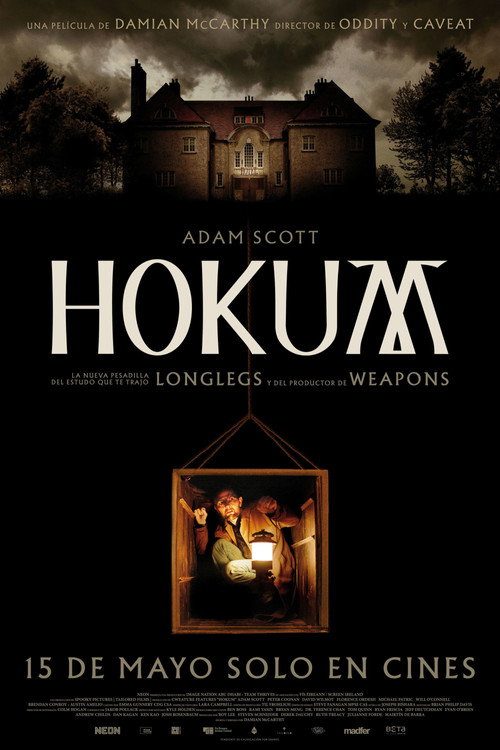
Hokum poster

HOKUM

2026 US HMDB
abril 29, 2026

Un escritor especializado en historias de terror decide viajar a una posada de Irlanda con la intención de esparcir en la zona las cenizas de sus difuntos padres. Lo que no sabe es que la posada es un lugar maldito habitado por una bruja. O eso cuentan los lugareños que viven cerca del lugar...

Reparto

👍 2 👎 🔥 🧻 👑 (2)
Iniciar sesion o regístrate para guardar tus preferencias

Comentarios

Comentarios (0)
Equipo

Produccion: Roy Lee (Producer)Steven Schneider (Producer)Derek Dauchy (Producer)Ruth Treacy (Producer)Mairtín de Barra (Producer)Ben Ross (Executive Producer)Dan Kagan (Executive Producer)Rami Yasin (Executive Producer)Andrew Childs (Executive Producer)Julianne Forde (Producer)Tom Quinn (Executive Producer)Josh Rosenbaum (Executive Producer)Keith Potter (Executive Producer)Bryan Meng (Executive Producer)Terence Chan (Executive Producer)Ryan Friscia (Executive Producer)Jeff Deutchman (Executive Producer)Evan O'Brien (Executive Producer)Ken Kao (Executive Producer)
Guion: Damian McCarthy (Writer)
Musica: Joseph Bishara (Original Music Composer)
Fotografia: Colm Hogan (Director of Photography)

RESEÑAS (1)

Roberto Giacomelli
El Veredicto

¿Qué es realmente el miedo? Según la definición común que encontramos en los diccionarios, es un estado emocional provocado por la percepción de un peligro real o imaginario, una respuesta instintiva que prepara al individuo para huir o defenderse.

¿Qué es realmente el miedo? Según la definición común que encontramos en los diccionarios, es un estado emocional provocado por la percepción de un peligro real o imaginario, una respuesta instintiva que prepara al individuo para huir o defenderse. Sin embargo, el cine de horror siempre ha buscado algo más complejo: no solo asustar, sino evocar esa sensación irracional que continúa atormentando al espectador incluso después de que termina la película. Es un objetivo que pocos directores contemporáneos logran alcanzar. En los últimos meses lo ha conseguido brillantemente Ian Tuason con el inquietante Undertone. Damian McCarthy demuestra pertenecer a la misma categoría muy restringida con Hokum, probablemente su trabajo más maduro y aterrador hasta la fecha. Ohm Bauman es un escritor de enorme éxito, dedicado a escribir el último capítulo de la saga de fantasía sobre los Conquistadores que lo hizo famoso en todo el mundo. Incapaz aún de procesar la culpa por la muerte de su madre, un evento del que se siente parcialmente responsable, decide viajar a un remoto pueblo de Irlanda para dispersar las cenizas de sus padres. Es el mismo lugar donde su madre y su padre pasaron su luna de miel, conservando un recuerdo maravilloso de ella. Ohm se hospeda precisamente en el antiguo Bilberry Woods Hotel, pero pronto descubre que el último piso de la estructura ha estado cerrado después de una larga serie de eventos inexplicables. La suite nupcial del ático estaría supuestamente infestada por el espíritu de una bruja. Cuando una serie de circunstancias obliguen al escritor a pasar una noche precisamente en esa habitación, la leyenda comenzará a transformarse en una pesadilla. Con Caveat y especialmente Oddity, Damian McCarthy ya había demostrado poseer un talento extraordinario en la construcción de atmósfera. Con Hokum, respaldado por una coproducción estadounidense y la distribución de Neon, el director irlandés da un paso más en calidad, fusionando todo lo que funcionó en sus obras anteriores en un horror sorprendentemente compacto y maduro. La primera intuición ganadora consiste en no confiar todo el peso de la historia a la mera presencia sobrenatural. El centro emocional de la película es de hecho Ohm Bauman, magníficamente interpretado por Adam Scott (Severance) en lo que podría ser una de las mejores actuaciones de su carrera. El escritor es un hombre brillante, sarcástico, frecuentemente abiertamente insoportable. Trata a todos con suficiencia, alternando críticas constantes con una actitud casi hostil hacia el mundo entero. Es una máscara que oculta una fragilidad enorme. La culpa por el pasado, un evidente problema con el alcohol y una depresión nunca espectacularizada pero contada con dolorosa sinceridad transforman al protagonista en un hombre perseguido incluso antes que por fantasmas, por sí mismo. Cuando lo sobrenatural irrumpe en su vida, la película deliberadamente deja en suspenso el límite entre obsesión psicológica e infestación real, aumentando aún más la inquietud del espectador. Desde esta base profundamente introspectiva McCarthy desarrolla una historia de casas encantadas que encuentra nueva vitalidad en el folclore irlandés. En el centro de la trama hay una Cailleach, figura antiquísima de la tradición celta, una especie de bruja ancestral asociada al invierno, las montañas, la muerte y el poder de la naturaleza. Más que una simple antagonista, la Cailleach representa una presencia primordial, casi mitológica, que la película introduce con gran elegancia a través de una historia para niños contada por el excéntrico propietario del hotel. Es un recurso narrativo simple pero muy efectivo, porque permite que el folclore se infiltre lentamente en la realidad sin recurrir a explicaciones pedantes. El verdadero co-protagonista, sin embargo, es probablemente el Bilberry Woods Hotel. McCarthy transforma la estructura en un gigantesco organismo hostil, aprovechando sus pasillos, escaleras, ascensores, sótanos y especialmente el ático prohibido como elementos de una puesta en escena construida sobre la sustracción. El último piso, con la célebre suite nupcial, burlonamente conectado con los sótanos por un montacargas, se convierte en un lugar del que parece imposible escapar, un laberinto donde el espacio pierde progresivamente toda lógica. Y es precisamente aquí donde el director firma una de las secuencias más aterradoras vistas en años, la primera huida de la bruja: un crescendo de tensión donde cada ruido, cada sombra y cada detalle del encuadre contribuyen a generar un sentido de terror genuino, sin abusar de los fáciles sustos. También sorprende el tono de la historia. Manteniendo una atmósfera muy sombría, Hokum inserta aquí y allá destellos de ironía grotesca y surrealista que alivian momentáneamente la tensión sin nunca comprometer la credibilidad del conjunto. Y hay también una subtrama de misterio/thriller que, por el contrario, contribuye a mantener alto el interés del espectador también en el desarrollo narrativo de la trama. El aspecto quizá más interesante de la película es precisamente su capacidad de poner en diálogo dos almas aparentemente distantes. Por un lado hay un drama intimista sobre la depresión, la culpa y la imposibilidad de dejar atrás el pasado; por el otro un horror que fusiona la historia de lugares encantados con el folk horror irlandés. McCarthy nunca sacrifica uno de los dos elementos en favor del otro: el componente psicológico hace más creíble el sobrenatural y viceversa, en un equilibrio raro de encontrar en el cine de género contemporáneo. Hokum es una de esas películas que recuerdan cómo el miedo no depende del número de criaturas en pantalla, sino de la capacidad de infiltrarse en la mente del espectador. Damian McCarthy confirma ser hoy una de las voces más interesantes del horror contemporáneo, un autor que no busca el susto fácil sino que construye el terror con paciencia, atmósfera e inteligencia. Si Caveat y Oddity habían permitido vislumbrar su talento, Hokum representa la consagración definitiva de un director capaz de transformar el folclore, el dolor humano y los espacios cerrados en una experiencia cinematográfica muy satisfactoria.
👍 👎 🔥 🧻 👑

Comentarios

Comentarios (0)

Reseñas de Influencers

Dónde Ver

Datos proporcionados por JustWatch

Preguntas sobre Hokum

¿Dónde ver Hokum en streaming?

Hokum está disponible en Movistar Plus+ Ficción Total , Apple TV, Amazon Video, Rakuten TV.

  • Movistar Plus+ Ficción Total
  • Apple TV
  • Amazon Video
  • Rakuten TV
Ver dónde verla

¿Cuánto dura Hokum?

Hokum dura 108 minutos.

¿Cuándo se estrenó Hokum?

Hokum se estrenó en 2026.

¿Quién dirigió Hokum?

Hokum está dirigida por Damian McCarthy.

¿Qué nota tiene Hokum?

La redacción de HorrorCult le da a Hokum 3,0 calaveras sobre 5, con una sola reseña.

Leer las reseñas

RESEÑAS DE LA COMUNIDAD (6)

CinemaSerf

CinemaSerf

7 /10

Perhaps the vicar was just clearing his throat at his Christening, but anyway it's author "Ohm" (Adam Scott) who is about to conclude the final instalment of his legendary "Conquistador" trilogy when he is reminded that he still has the ashes of his parents in a cupboard, alongside a photograph of his mum leaning against a giant tree. He decides that the best place for them to rest is under that very tree, so he sets off to Ireland and a remote country hotel. His arrival gives him (and us) an idea of just how quirky this place is, and the fact that he's a bit attitudinal suggests the trip isn't going to go so well. That turns out not to be the half of it, though, as a timely intervention by barmaid "Fiona" (Florence Ordesh) proves just the start of an intrigue that involves her disappearance, a dead goat, a crossbow, a locked honeymoon suite, an enigmatic vagrant (David Wilmot) and a very busy dumb waiter. Of course the woodland setting plays an huge part in creating the sense of tension, and from that it's the wind howling audio that works best as well as some dim - but plausible - shadowy lighting. Ok, so this hotel does appear more labyrinthine than Churchill's War rooms and the story itself isn't without the odd hole or two, but I felt Scott (who reminded me of David Tennant) held this together quite well as his character's current predicament is woven in with an historical one that fills in a few gaps as to why mum and dad lay around in the wardrobe for a while and why he is so antsy. It's tensely directed, there is a little humour amidst the craic, and this is certainly amongst the best cinema releases from this genre so far this year.

Sierbahnn

Sierbahnn

6 /10

It struggles to build tension and meanders at times, but this is not a bad movie. I get a very similar vibe to 1408, which came out in 2007, and Grave Encounters, especially the first one. The casting here is good and carries a lot of the movie, but the pacing is a bit slow and it's difficult to feel for the protagonist, which means that the tension doesn't quite build the way it should.

Sejian

5 /10

I must have a short attention span today because 10 minutes in and... yeah, I'm bored.

I'll revisit this some other day when I'm not frustrated out of my skull at everything and everyone.

BUT ALSO, [SPOILERS]:

Did he really go from hallucinating a creepy old woman in his house twice, to nonchalantly playing with a gun that is implied to be connected to his parent's death? Maybe the creepy old woman was mommy dearest.

The Fixate & Binge Podcast, w/ Joe Curdy

The Fixate & Binge Podcast, w/ Joe Curdy

8 /10

The Irish woods are dark and deep in everything Damian McCarthy has written and directed, following a terrifying tradition of depicting isolated homes, and buildings -- possessing terrible secrets, curses, and presences. Natch, the Irish Tourism Board may ask McCarthy to start setting his films elsewhere!

From CAVEAT to ODDITY, and now HOKUM, McCarthy succeeds presenting unnerving atmosphere for his protagonists -- especially for those who have it coming.

In HOKUM, Adam Scott plays a troubled, misanthropic author Ohm Bauman, an American who makes a pilgrimage to an isolated, gothic hotel in Ireland (where his parents went on their honeymoon) to scatter their ashes.

There, Ohm discovers that the locals who work at the hotel carry an unhealthy belief in superstitions, principally that the owner has successfully trapped a Cailleach -- ie, a "witch" in the Honeymoon Suite.

Amused by the hotel's off-limits Honeymoon Suite—the source of the film's title—Ohm cannot resist investigating for himself. What follows may initially recall 1408 or SESSION 9, albeit filtered through an unmistakably Irish folk-horror sensibility. As Ohm's curiosity deepens, so too does the audience's fixation on whatever may—or may not—be lurking within those storied chambers. Or is it all, as he scoffs, merely "hokum"?

Like his excellent ODDITY, McCarthy wrings terror from atmosphere alone, transforming dark hotel rooms and dimly lit corridors into spaces of mounting dread. Scott's performance proves essential to the film's success, grounding Ohm's skepticism, arrogance, and unraveling sanity with just the right balance of wit and unease.

As a suspense thriller, HOKUM is one of McCarthy's best yet, deserving of its Big Screen release, and I can't wait to see what he does next.

moviefan3030

This is a nice little horror movie set around halloween time. It stars adam scott as this author who is trying to complete the final book in a trilogy but has writers block. He travels to an old hotel in ireland where his parents had their honeymoon years ago to spread their ashes. While there he is quite rude with people even burning the bellboys hand with a hot spoon after the bellboy explains he is a fan of his and an aspiring writer who wants him to review his manuscript. Theres some twists and turns and overall i liked the direction and adam scotts acting was solid. I reccomend watching if your a fan of horror films.

FolknHell

FolknHell

5 /10

Hokum has a rather irritating problem: some of its best ideas seem to belong to films it never actually gets around to making.

Damian McCarthy’s remote Irish hotel gives us a haunted honeymoon suite, a huge buried cellar, a local witch, chalk sigils, protective circles, psychedelic mushrooms, a missing woman and a novelist carrying some very substantial parental baggage. Any two of those might comfortably sustain a horror film. Hokum keeps introducing another one.

What it does extraordinarily well is frighten you. Faces appear from darkness, figures materialise behind Owen Bauman’s shoulder, and the long cellar sequences generate proper, physical tension. Even knowing where the scares were coming on a second viewing did little to defuse them. McCarthy understands the ugly little mechanics of making an audience jump.

The trouble is that the mechanisms rarely connect.

The ghost repeatedly looming behind Owen eventually turns out to be his mother, but the film withholds the emotional context needed to make that revelation land as anything more than retroactive explanation. Owen himself is made needlessly unpleasant, most bizarrely when he deliberately heats a spoon and burns the aspiring young writer Alby with it. His later trauma may explain his hostility, but by then the damage is done.

Meanwhile, the genuinely fascinating material is sitting downstairs. Owen finds a doorway covered in chalk symbols, learns that a protective circle can keep something out, then discovers rather importantly that an unfinished one cannot. It is one of the film’s best ideas. We wanted to know why those symbols were there, what the hotel knew about them and how the witch belonged to the place.

Instead, the witch largely becomes another delivery system for scares while the main plot mutates into a murder mystery involving Mel, whose increasingly desperate attempts to conceal what he has done become so catastrophically misguided that Hokum briefly threatens to turn into a black comedy.

That might actually have been the more interesting film.

So is it folk horror? It certainly occupies the scenery: isolated community, old folklore, witch, buried spaces, inherited stories. But remove those elements and the murder mystery still functions almost unchanged. Folk horror is the wallpaper rather than the building.

Hokum is therefore a peculiar recommendation. Watch it once and it can absolutely get you. Think about it afterwards and the chalk circle is not the only thing with some conspicuous gaps.


Reviewed by FolknHell, the folk horror film podcast · folknhell com

Hear the full FolknHell podcast discussion of Hokum: folknhell com/hokum-review along with our other reviews, transcripts and episodes.

Reseñas proporcionadas por TMDB