






Salta al contenuto
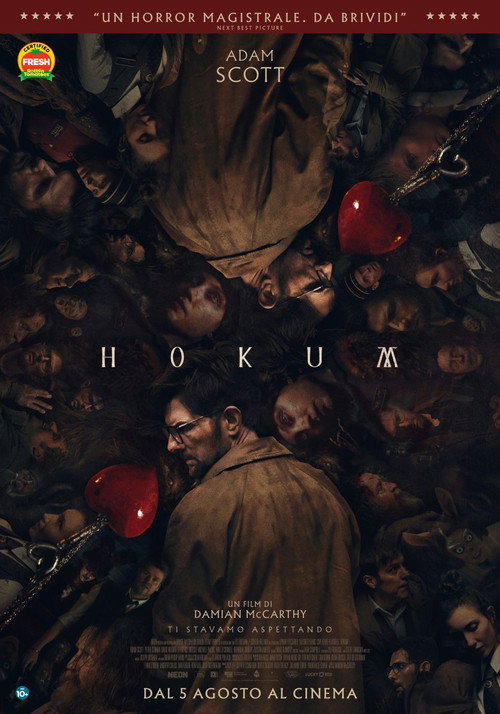
Hokum poster

HOKUM

2026 US HMDB
aprile 29, 2026

Quando lo scrittore Ohm Bauman si ritira in una locanda isolata per spargere le ceneri dei suoi genitori, viene ossessionato dai racconti di una strega che infesta la suite nuziale. Visioni inquietanti e una scioccante scomparsa lo costringono a confrontarsi con gli angoli oscuri del suo passato.

Cast

👍 2 👎 🔥 🧻 👑 (2)
Accedi oppure registrati per salvare le tue preferenze

Commenti

Commenti (0)
Accedi oppure registrati per commentare

Troupe

Produzione: Roy Lee (Producer)Steven Schneider (Producer)Derek Dauchy (Producer)Ruth Treacy (Producer)Mairtín de Barra (Producer)Ben Ross (Executive Producer)Dan Kagan (Executive Producer)Rami Yasin (Executive Producer)Andrew Childs (Executive Producer)Julianne Forde (Producer)Tom Quinn (Executive Producer)Josh Rosenbaum (Executive Producer)Keith Potter (Executive Producer)Bryan Meng (Executive Producer)Terence Chan (Executive Producer)Ryan Friscia (Executive Producer)Jeff Deutchman (Executive Producer)Evan O'Brien (Executive Producer)Ken Kao (Executive Producer)
Sceneggiatura: Damian McCarthy (Writer)
Musica: Joseph Bishara (Original Music Composer)
Fotografia: Colm Hogan (Director of Photography)

RECENSIONI (1)

Roberto Giacomelli
Il Verdetto

Che cos’è davvero la paura? Secondo la definizione comunemente riportata dai dizionari, è uno stato emotivo provocato dalla percezione di un pericolo reale o immaginario, una risposta istintiva che prepara l’individuo alla fuga o alla difesa.

Che cos’è davvero la paura? Secondo la definizione comunemente riportata dai dizionari, è uno stato emotivo provocato dalla percezione di un pericolo reale o immaginario, una risposta istintiva che prepara l’individuo alla fuga o alla difesa. Il cinema horror, però, da sempre cerca qualcosa di più complesso: non limitarsi a spaventare, ma riuscire a evocare quella sensazione irrazionale che continua a tormentare lo spettatore anche dopo la fine del film. È un obiettivo che pochi registi contemporanei riescono davvero a raggiungere. Negli ultimi mesi ci è riuscito brillantemente Ian Tuason con l’inquietantissimo Undertone. Damian McCarthy dimostra di appartenere alla stessa ristrettissima categoria con Hokum, probabilmente il suo lavoro ad oggi più maturo e terrificante. Ohm Bauman è uno scrittore di enorme successo, impegnato nella stesura dell’ultimo capitolo della saga fantasy sui Conquistadores che lo ha reso celebre in tutto il mondo. Ancora incapace di elaborare il senso di colpa per la morte della madre, evento del quale si ritiene in parte responsabile, decide di raggiungere un remoto villaggio dell’Irlanda per disperdere le ceneri dei genitori. È lo stesso luogo dove madre e padre avevano trascorso il viaggio di nozze, conservandone un ricordo meraviglioso. Ohm prende alloggio proprio nel vecchio Bilberry Woods Hotel, ma scopre presto che l’ultimo piano della struttura è stato chiuso dopo una lunga serie di eventi inspiegabili. La suite nuziale dell’attico sarebbe infatti infestata dallo spirito di una strega. Quando una serie di circostanze costringerà lo scrittore a trascorrere una notte proprio in quella stanza, la leggenda inizierà a trasformarsi in un incubo. Con Caveat e soprattutto Oddity, Damian McCarthy aveva già dimostrato di possedere un talento fuori dal comune nella costruzione dell’atmosfera. Con Hokum, sostenuto da una coproduzione statunitense e dalla distribuzione di Neon, il regista irlandese compie un ulteriore salto di qualità, fondendo tutto ciò che aveva funzionato nelle opere precedenti in un horror sorprendentemente compatto e maturo. La prima intuizione vincente consiste nel non affidare il peso del racconto alla sola presenza soprannaturale. Il centro emotivo del film è infatti Ohm Bauman, magnificamente interpretato da Adam Scott (Scissione) in quella che potrebbe essere una delle prove migliori della sua carriera. Lo scrittore è un uomo brillante, sarcastico, spesso apertamente insopportabile. Tratta chiunque con sufficienza, alternando continue frecciatine a un atteggiamento quasi ostile verso il mondo intero. È una maschera che nasconde una fragilità enorme. I sensi di colpa per il passato, un evidente problema con l’alcol e una depressione mai spettacolarizzata ma raccontata con dolorosa sincerità trasformano il protagonista in un uomo perseguitato prima ancora che dai fantasmi, da se stesso. Quando il soprannaturale irrompe nella sua vita, il film lascia volutamente in sospeso il confine tra ossessione psicologica e reale infestazione, aumentando ulteriormente il disagio dello spettatore. Da questa base profondamente introspettiva McCarthy sviluppa un racconto di case infestate che trova nuova linfa nel folklore irlandese. Al centro della vicenda c’è infatti una Cailleach, figura antichissima della tradizione celtica, una sorta di strega ancestrale associata all’inverno, alle montagne, alla morte e al potere della natura. Più che una semplice antagonista, la Cailleach rappresenta una presenza primordiale, quasi mitologica, che il film introduce con grande eleganza attraverso una storia per bambini raccontata dal bizzarro proprietario dell’hotel. È un espediente narrativo semplice ma efficacissimo, perché permette al folklore di insinuarsi lentamente nella realtà senza ricorrere a pedanti spiegazioni. Il vero co-protagonista, tuttavia, è probabilmente il Bilberry Woods Hotel. McCarthy trasforma la struttura in un gigantesco organismo ostile, sfruttandone corridoi, scale, ascensori, sotterranei e soprattutto l’attico proibito come elementi di una messa in scena costruita sulla sottrazione. L’ultimo piano, con la celebre suite nuziale, beffardamente collegato con i sotterranei da un montacarichi, diventa un luogo da cui sembra impossibile fuggire, un labirinto in cui lo spazio perde progressivamente qualsiasi logica. Ed è proprio qui che il regista firma una delle sequenze più spaventose viste negli ultimi anni, la prima fuga dalla strega: un crescendo di tensione in cui ogni rumore, ogni ombra e ogni dettaglio dell’inquadratura contribuiscono a generare un senso di terrore autentico, senza abusare di facili jump scare. A sorprendere è anche il tono del racconto. Pur mantenendo un’atmosfera cupissima, Hokum inserisce qua e là lampi di ironia grottesca e surreale che alleggeriscono momentaneamente la tensione senza mai compromettere la credibilità dell’insieme. E c’è anche una sottotraccia da giallo/mistery che, invece, contribuisce a tenere alto il coinvolgimento dello spettatore anche nello sviluppo narrativo della vicenda. L’aspetto forse più interessante del film è proprio la sua capacità di mettere in dialogo due anime apparentemente lontane. Da una parte c’è un dramma intimista sulla depressione, sul senso di colpa e sull’impossibilità di lasciarsi alle spalle il passato; dall’altra un horror che fonde il racconto di luoghi infestati con il folk horror irlandese. McCarthy non sacrifica mai uno dei due elementi a favore dell’altro: la componente psicologica rende più credibile quella soprannaturale e viceversa, in un equilibrio raro da trovare nel cinema di genere contemporaneo. Hokum è uno di quei film che ricordano come la paura non dipenda dal numero di creature sullo schermo, ma dalla capacità di insinuarsi nella mente dello spettatore. Damian McCarthy conferma di essere oggi una delle voci più interessanti dell’horror contemporaneo, un autore che non cerca il facile spavento ma costruisce il terrore con pazienza, atmosfera e intelligenza. Se Caveat e Oddity avevano fatto intravedere il suo talento, Hokum rappresenta la definitiva consacrazione di un regista capace di trasformare il folklore, il dolore umano e gli spazi chiusi in un’esperienza cinematografica molto appagante.
👍 👎 🔥 🧻 👑

Commenti

Commenti (0)
Accedi oppure registrati per commentare

Video Recensioni

Domande su Hokum

Quanto dura Hokum?

Hokum dura 108 minuti.

Quando è uscito Hokum?

Hokum è uscito nel 2026.

Chi ha diretto Hokum?

Hokum è diretto da Damian McCarthy.

Che voto ha Hokum?

La redazione di HorrorCult dà a Hokum 3,0 teschi su 5, su una sola recensione.

Leggi le recensioni

RECENSIONI DALLA COMMUNITY (6)

CinemaSerf

CinemaSerf

7 /10

Perhaps the vicar was just clearing his throat at his Christening, but anyway it's author "Ohm" (Adam Scott) who is about to conclude the final instalment of his legendary "Conquistador" trilogy when he is reminded that he still has the ashes of his parents in a cupboard, alongside a photograph of his mum leaning against a giant tree. He decides that the best place for them to rest is under that very tree, so he sets off to Ireland and a remote country hotel. His arrival gives him (and us) an idea of just how quirky this place is, and the fact that he's a bit attitudinal suggests the trip isn't going to go so well. That turns out not to be the half of it, though, as a timely intervention by barmaid "Fiona" (Florence Ordesh) proves just the start of an intrigue that involves her disappearance, a dead goat, a crossbow, a locked honeymoon suite, an enigmatic vagrant (David Wilmot) and a very busy dumb waiter. Of course the woodland setting plays an huge part in creating the sense of tension, and from that it's the wind howling audio that works best as well as some dim - but plausible - shadowy lighting. Ok, so this hotel does appear more labyrinthine than Churchill's War rooms and the story itself isn't without the odd hole or two, but I felt Scott (who reminded me of David Tennant) held this together quite well as his character's current predicament is woven in with an historical one that fills in a few gaps as to why mum and dad lay around in the wardrobe for a while and why he is so antsy. It's tensely directed, there is a little humour amidst the craic, and this is certainly amongst the best cinema releases from this genre so far this year.

Sierbahnn

Sierbahnn

6 /10

It struggles to build tension and meanders at times, but this is not a bad movie. I get a very similar vibe to 1408, which came out in 2007, and Grave Encounters, especially the first one. The casting here is good and carries a lot of the movie, but the pacing is a bit slow and it's difficult to feel for the protagonist, which means that the tension doesn't quite build the way it should.

Sejian

5 /10

I must have a short attention span today because 10 minutes in and... yeah, I'm bored.

I'll revisit this some other day when I'm not frustrated out of my skull at everything and everyone.

BUT ALSO, [SPOILERS]:

Did he really go from hallucinating a creepy old woman in his house twice, to nonchalantly playing with a gun that is implied to be connected to his parent's death? Maybe the creepy old woman was mommy dearest.

The Fixate & Binge Podcast, w/ Joe Curdy

The Fixate & Binge Podcast, w/ Joe Curdy

8 /10

The Irish woods are dark and deep in everything Damian McCarthy has written and directed, following a terrifying tradition of depicting isolated homes, and buildings -- possessing terrible secrets, curses, and presences. Natch, the Irish Tourism Board may ask McCarthy to start setting his films elsewhere!

From CAVEAT to ODDITY, and now HOKUM, McCarthy succeeds presenting unnerving atmosphere for his protagonists -- especially for those who have it coming.

In HOKUM, Adam Scott plays a troubled, misanthropic author Ohm Bauman, an American who makes a pilgrimage to an isolated, gothic hotel in Ireland (where his parents went on their honeymoon) to scatter their ashes.

There, Ohm discovers that the locals who work at the hotel carry an unhealthy belief in superstitions, principally that the owner has successfully trapped a Cailleach -- ie, a "witch" in the Honeymoon Suite.

Amused by the hotel's off-limits Honeymoon Suite—the source of the film's title—Ohm cannot resist investigating for himself. What follows may initially recall 1408 or SESSION 9, albeit filtered through an unmistakably Irish folk-horror sensibility. As Ohm's curiosity deepens, so too does the audience's fixation on whatever may—or may not—be lurking within those storied chambers. Or is it all, as he scoffs, merely "hokum"?

Like his excellent ODDITY, McCarthy wrings terror from atmosphere alone, transforming dark hotel rooms and dimly lit corridors into spaces of mounting dread. Scott's performance proves essential to the film's success, grounding Ohm's skepticism, arrogance, and unraveling sanity with just the right balance of wit and unease.

As a suspense thriller, HOKUM is one of McCarthy's best yet, deserving of its Big Screen release, and I can't wait to see what he does next.

moviefan3030

This is a nice little horror movie set around halloween time. It stars adam scott as this author who is trying to complete the final book in a trilogy but has writers block. He travels to an old hotel in ireland where his parents had their honeymoon years ago to spread their ashes. While there he is quite rude with people even burning the bellboys hand with a hot spoon after the bellboy explains he is a fan of his and an aspiring writer who wants him to review his manuscript. Theres some twists and turns and overall i liked the direction and adam scotts acting was solid. I reccomend watching if your a fan of horror films.

FolknHell

FolknHell

5 /10

Hokum has a rather irritating problem: some of its best ideas seem to belong to films it never actually gets around to making.

Damian McCarthy’s remote Irish hotel gives us a haunted honeymoon suite, a huge buried cellar, a local witch, chalk sigils, protective circles, psychedelic mushrooms, a missing woman and a novelist carrying some very substantial parental baggage. Any two of those might comfortably sustain a horror film. Hokum keeps introducing another one.

What it does extraordinarily well is frighten you. Faces appear from darkness, figures materialise behind Owen Bauman’s shoulder, and the long cellar sequences generate proper, physical tension. Even knowing where the scares were coming on a second viewing did little to defuse them. McCarthy understands the ugly little mechanics of making an audience jump.

The trouble is that the mechanisms rarely connect.

The ghost repeatedly looming behind Owen eventually turns out to be his mother, but the film withholds the emotional context needed to make that revelation land as anything more than retroactive explanation. Owen himself is made needlessly unpleasant, most bizarrely when he deliberately heats a spoon and burns the aspiring young writer Alby with it. His later trauma may explain his hostility, but by then the damage is done.

Meanwhile, the genuinely fascinating material is sitting downstairs. Owen finds a doorway covered in chalk symbols, learns that a protective circle can keep something out, then discovers rather importantly that an unfinished one cannot. It is one of the film’s best ideas. We wanted to know why those symbols were there, what the hotel knew about them and how the witch belonged to the place.

Instead, the witch largely becomes another delivery system for scares while the main plot mutates into a murder mystery involving Mel, whose increasingly desperate attempts to conceal what he has done become so catastrophically misguided that Hokum briefly threatens to turn into a black comedy.

That might actually have been the more interesting film.

So is it folk horror? It certainly occupies the scenery: isolated community, old folklore, witch, buried spaces, inherited stories. But remove those elements and the murder mystery still functions almost unchanged. Folk horror is the wallpaper rather than the building.

Hokum is therefore a peculiar recommendation. Watch it once and it can absolutely get you. Think about it afterwards and the chalk circle is not the only thing with some conspicuous gaps.


Reviewed by FolknHell, the folk horror film podcast · folknhell com

Hear the full FolknHell podcast discussion of Hokum: folknhell com/hokum-review along with our other reviews, transcripts and episodes.

Recensioni fornite da TMDB