
Witchfinder General backdrop
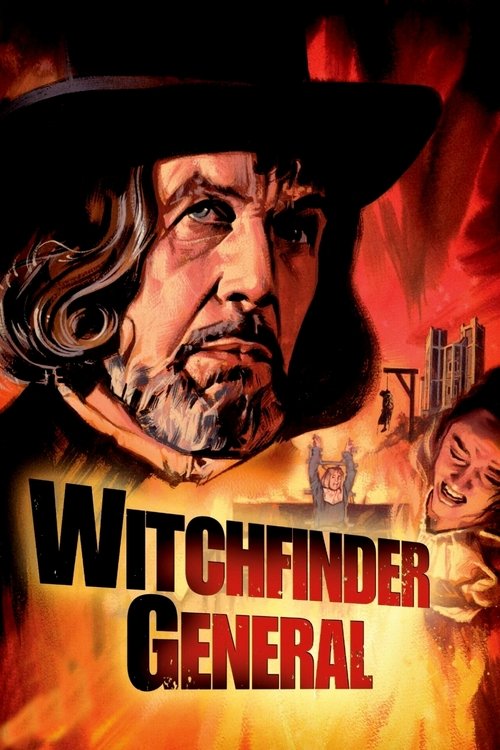
Witchfinder General poster

WITCHFINDER GENERAL

1968 GB HMDB
May 17, 1968

England, 1645. The cruel civil war between Royalists and Parliamentarians that is ravaging the country causes an era of chaos and legal arbitrariness that allows unscrupulous men to profit by exploiting the absurd superstitions of the peasants; like Matthew Hopkins, a monster disguised as a man who wanders from town to town offering his services as a witch hunter.

Cast

👍 👎 🔥 🧻 👑

Comments

Comments (0)

Crew

Production: Philip Waddilove (Producer)Louis M. Heyward (Producer)Arnold L. Miller (Producer)Tony Tenser (Executive Producer)Samuel Z. Arkoff (Executive Producer)James H. Nicholson (Executive Producer)
Screenplay: Michael Reeves (Screenplay)Tom Baker (Screenplay)
Music: Paul Ferris (Original Music Composer)
Cinematography: John Coquillon (Director of Photography)

REVIEWS (1)

Roberto Giacomelli
In 1645, amidst the English Civil War, the inquisitor Matthew Hopkins and his assistant John Sterne travel from village to village in search of witches and papists to kill. The two arrive in Brandstone, summoned by the inhabitants who accuse Reverend Lowes of witchcraft, and hang the man after sexually abusing his niece Sara. Upon hearing of the incident, the soldier Richard, Sara's betrothed, swears vengeance on the inquisitor and takes Sara to a nearby village. Meanwhile, Hopkins, who is aware of the man seeking him, arrives in the very village where Sara has settled and captures her on charges of witchcraft. There are cinematic works that time is hiding from us, films with great substantive power and undeniable emotional and visual impact that today are no longer (or never were) sufficiently remembered and celebrated. "The Conqueror Worm" certainly belongs to this category, a costume drama disguised as a gruesome horror film directed in 1968 by the Englishman Michael Reeves. Taking inspiration from a historical novel/essay by Ronald Bassett ("Matthew Hopkins: Witchfinder General" 1966), American International Pictures entrusted the young Reeves with the direction of this anomalous genre film, already, because at the core of the content and the "high" origin of the theme addressed, "The Conqueror Worm" wants to be a genre film, as was customary for most AIP products. But the limit that this time separates exploitation from "seriousness" is subtle and often invisible, so much so that any categorization is narrow or inappropriate for the film in question. Reeves and his co-screenwriter Tom Baker fundamentally and openly aim to provide a parable of condemnation of power: any mean man provided with a minimum of supremacy, intellectual, political, or economic, is driven to use it meanly to satisfy his basest instincts with greater ease. The inquisitor Hopkins, armed with credibility and authority in the eyes of a superstitious and frightened mass, can give vent to his sadism, quenching his thirst for blood, perverse sex, and money, which arrive punctually and copiously at every location he visits. In his book, Bennett cites very high numbers, 230 people killed for witchcraft in just over a year by the real Matthew Hopkins, demonstrating how the horror of reality is sometimes incredible even for fiction. Reeves thus crafts a work of immense emotional power, incredibly audacious for the period in which it was produced. The '68 was a year – but we can also define it as a true historical period – of great and unparalleled break with previous conventions, and cinema was no exception, seizing these cultural and social upheavals by completely rewriting languages and productive methods. "The Conqueror Worm" is explanatory in this sense, capable of openly addressing "hot" themes such as the denunciation of power and religion, using images of great cruelty. The tortures are never spared from the viewer, and the sadism and sexual perversion of the inquisitor character manage to assume a perverse and unpleasant fascination on the viewer. Just think of the immense power that the final images of the film assume, anticipating a cruelty and existential pessimism typical of the most representative films of the following decade. The cast is composed of good actors such as Ian Ogilvy ("The Devil's Bride"; "The Shuttered Room"), Rupert Davies ("The Five Golden Dragons", "Brides of Dracula"), Hilary Heath ("The Devil's Bride", "The Curse of the Crimson Altar"), but above all stands Vincent Price, in the role of the great inquisitor, who for many here delivers one of his best performances. In reality, Price had a poor working relationship with the director Reeves, who did not want the actor to perform an over-the-top performance as usual and as he ultimately did in this case. Indeed, it is said that Reeves wanted Donald Pleasence in the role, whom he had appreciated as the villain Blofeld in "James Bond – On Her Majesty's Secret Service", but AIP imposed Price as an actor of sure appeal to the public. Price's performance is nevertheless particularly convincing, and the success of the film is certainly attributable to his contribution. Reeves was carving out a highly respectable path in the horror genre, signing some good genre films such as "The She-Beast" and "The Devil's Bride", but his title of greatest interest remains "The Conqueror Worm", unfortunately his last film, since he died by suicide at only 26 years old in 1969. Add half a pumpkin to the final score.
👍 👎 🔥 🧻 👑

Comments

Comments (0)

COMMUNITY REVIEWS (3)

talisencrw

9 /10

An undeniably brilliant swan song for the ill-fated directorial prodigy Reeves, with remarkable vision, and a ghastly sadistic performance by Vincent Price. Hard to like the film because it gets under your skin with its brutality and just stays there, eating you from within. A very fine work that stays with you, hauntingly.

Wuchak

Wuchak

7 /10

Cinema's account of the infamous Matthew Hopkins

The infamous witch-finding exploits of Matthew Hopkins in Eastern England circa 1646 are chronicled based on Ronald Bassett’s 1966 novel. Hopkins (Vincent Price) and his colleague John Stearne travel from village to village brutally torturing "confessions" out of suspected witches and charging the local magistrates for the "work" they carry out.

"Witchfinder General" (1968) is a Tigon production, a minor rival of Hammer Films, retitled "Conqueror Worm" in America with the addition of opening/closing quotes from the Poe poem by Price merely to link the movie to Corman’s Poe-inspired flicks and, theoretically, sell more tickets.

Some call this "the original torture porn" and I suppose the torture scenes were pretty radical in 1968, but the film always struck as a British Western with a simple rape/murder/vengeance plot: A soldier's beautiful fiancé is raped and her uncle tortured & murdered for supposedly being a witch. When the soldier (Ian Ogilvy) finds out, he vows revenge.

In short, it’s like a Western transplanted to 17th century England more so than a torture/horror film, although there is that element. The one death that I found particularly unsettling was where a woman is burned to death by being lowered into a bonfire. It definitely has a lasting impact.

The writer/director was Michael Reeves, a promising young filmmaker. Unfortunately he died of an accidental barbiturate overdose less than nine months after the film was released at the premature age of 25. The dosage was too marginal to suggest suicide; besides, he was already busy working on another film project.

Reeves and star Vincent Price reportedly didn't get along. The director was banking on Donald Pleasence for the title role but, when AIP got involved, they forced Price on him and he had to revise the script accordingly with his cowriter. Reeves mainly objected to Price's somewhat hammy acting style and did everything he could to get Price to play it straight. He would say things like, "Please, Vincent, try to say it without rolling your eyes." At one point Price pointed out to Reeves, "I've made 87 films, what have you done?" The director responded, "Made three good ones.”

After viewing the finished product, Vincent admitted that he saw what Reeves was trying to do and wrote him a 10-page letter praising the movie. After Reeves’ death Price stated: "I (finally) realized what he wanted was a low-key, very laid-back, menacing performance. He did get it, but I was fighting him almost every step of the way. Had I known what he wanted I would have cooperated."

The film is only partially accurate as far as history goes, although the gist is true. The real Matthew Hopkins was in his mid-20s when he committed his atrocities, not almost 60 as was the case with Price. Also, Hopkins & Stearne were reportedly accompanied by female assistants. As far as Hopkins' death goes, tradition tells us that disgruntled villagers caught him and subjected him to his own "swimming test," but there's no actual evidence to support this; most historians believe he died of tuberculosis at home shortly after his torturous escapades in 1647, only 27 years-old.

One of the film's highlights for me is Hilary Dwyer, who plays the soldier's fiancé/wife. She's just a uniquely beautiful woman and a pleasure to behold.

Another strong point is the ending which a man mad with rage hacking someone to death while a just-tortured woman screams and screams. The evil inflicted upon them has brought them to this point of maniacal frenzy. They were venting and it smacks of reality. Despite the downbeat climax I've always viewed it as somehow uplifting for obvious reasons. There's no reason we shouldn't assume that they moved on to live a happy life.

While "Witchfinder General" is not a Hammer film, it is a British movie made at the time when Hammer was in its prime; it therefore has that Hammer vibe, which is why some mistake it for a Hammer picture. Needless to say, if you like Hammer you'll appreciate this. Yet "Witchfinder General" stands apart; it has its own uniqueness, no doubt due to Reeves’ burgeoning genius. As such, the flick is special. Some of the photography is hauntingly beautiful; the protagonists — the noble soldier and winsome Sara — are exceptional; the villains dastardly; and the ending innovative.

So why not a higher rating? Because, as special as this movie is, it's not the most compelling saga, despite lots of action. Artistically, it's gets an 'A' as a low-budget cult flick from that era but, story-wise, there’s room for improvement.

The film runs a short-but-sweet 1 hour, 27 minutes, and was shot in Suffolk & Norfolk, England, both a 1-2 hour drive northeast of London.

GRADE: B+

CinemaSerf

CinemaSerf

7 /10

Vincent Price is superb in this depiction of the tyrannical, evil "Matthew Hopkins", tasked amidst the English Civil War to bring fear and terror to the population. Playing to just about every phobia and superstition, he travels the land seeking out and punishing those who worship or serve the devil... There is a magnificent scene in which he divines that a man dropped into the river with stones tied about him will be a witch if he floats, innocent if he sinks (and drowns!)... Sums up the science, really - and the really quite perturbing attitudes that prevailed, even amongst those deemed educated or sophisticated. Ian Ogilvy is "Richard Marshall", a man determined to stop these atrocities and at risk to himself and his family - and we have now watch a battle royal between the two men as worthy as any fought in the war. It's, at times, quite gruesome to watch - and the whole look of the film adds oodles to the sense of menace evoked by this truly malevolent man. Again, based on the vivid imagination of Edgar Allan Poe, this film is a cracker for late on a winter's night with a glass of red wine and a rogue branch tapping on the window.

Reviews provided by TMDB