
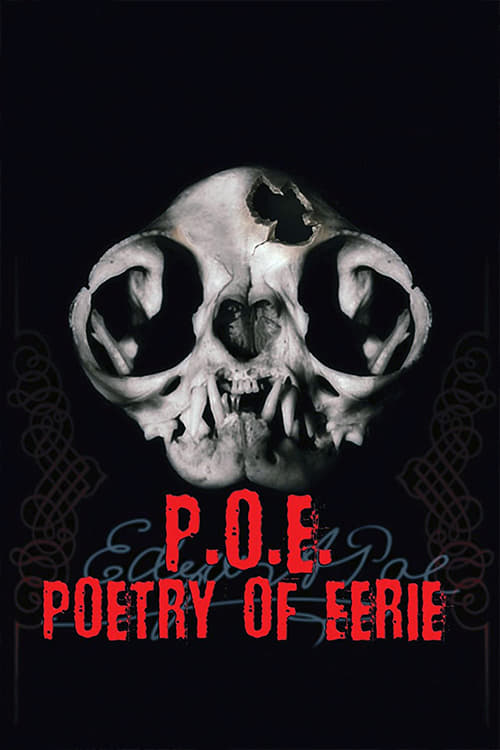





Fifteen Italian authors tackle the free film adaptation of thirteen works by American writer Edgar Allan Poe. The texts used as references are: The Silence, The Sphinx, The Spectacles, The Facts in the Case of M. Valdemar, The Tell-Tale Heart, The Narrative of Arthur Gordon Pym of Nantucket, The Black Cat, Ligeia, The Raven, The Man of the Crowd, Berenice, Maelzel's Chess-Player, and Canto.
How many times has the immortal Edgar Allan Poe been brought to the small and big screen? Many, countless, perhaps too many… even difficult to make a complete philological overview; from the famous «The Fall of the House of Usher» by Epstein to recent Hollywood attempts with the biopic thriller «The Raven», through the masterpieces of Corman in the ¼s60s, yet an operation like «P.O.E. – Poetry of Eerie» was missing. The idea was born to Domiziano Cristopharo together with Giovanni Pianigiani in the summer of 2011, laughing and joking in front of a beer in the Pigneto district of Rome, one of those proposals that smell of unfeasible prank, that are born and die right with that icy beer. Instead, «P.O.E.» really came to life and was completed. The time to put together a team of directors and to draft a real manifesto of intentions that in the most important parts explains:
«P.O.E. Poetry Of Eerie» (Poetry of the Macabre) wants to inaugurate the rebirth of a COLLECTIVE MOVEMENT, where the egocentrism of the individual is annulled in favor of a set of energies, experiences, currents, movements, ideas, languages… a cinema where the subject/object is the film, and not the director or the actors.[…] The only requirement requested: team spirit and freedom! […] What you are about to see is the result of that bet: 14 directors, 13 stories... one author: POE.
The focal point of the project is therefore collaboration, the strength of the group, which in the Italian independent scene is often paradoxically the last requirement requested. If «P.O.E. – Poetry of Eerie» has succeeded in the «social» intent it set itself, it does not matter here, rather we find ourselves analyzing an anomalous and truly unique work in its final composition, a patchwork of ideas, languages, and styles that brings to mind that «DeGenerazione» that marked the directorial debut, among others, of the Manetti Bros., Asia Argento, and Alex Infascelli, but declined in a more elegant and compact formula.
Once the work is complete, «P.O.E. – Poetry of Eerie» presents itself as a certainly successful experiment from a formal and content perspective, an anthology of filmed stories that has the merit of reworking Poe sometimes with a personal style of great impact that makes you forget that it is an operation with an extremely limited budget. Obviously, when dealing with an episodic film, it is normal to find a qualitative discrepancy between short and short that in this case translates into a perhaps exaggerated amount of episodes inserted, which however have the merit of keeping themselves at medium-high levels.
The short film that opens the movie is «The Silence», written and directed by the Capasso brothers, who in the past had already dealt more or less directly with Poe in the short film «The Eye». And it is a stunning start because «The Silence», taken from a «minor» sonnet in the work of the American writer, is the most unsettling and successful episode of the thirteen. The Capasso brothers fundamentally zero out the original work while keeping central the element of silence, as a demon – albeit internalized – of guilt. The short film plays with mixing Poe's imagination with the typical tension of a cinematic ghost story, creating a successful homage – whether intentional or not – to «The Drop of Water», the mythical episode directed by Mario Bava for «Black Sabbath».
The second episode, entrusted to Alessandro Giordani, takes the short story «The Sphinx» and completely subverts it to give life to something substantially different. Poe spoke of visual perception and self-induced fear, Giordani tells instead a story of uncertainties and segregation. The location is suggestive and the actors involved are very good (Mariano Aprea and Laura Gigante), but the pace is too slow, the narration voice at times invasive and in the end one perceives more the perfection of the form than the true essence of the work.
«The Spectacles», taken from the eponymous story of 1844, is signed by Matteo Corazza who cancels out the underlying irony of the original work to focus on the more horrific aspect. The result is very good, one of the visually richest and narratively structured episodes, capable of also riding the wave of contemporary torture porn. Predictable but enjoyable.
Irony is instead the primary objective of «Valdemar», the episode directed by the director of «Bloodline» Edo Tagliavini. In the short film there is everything from the original story, only that the entire affair is declined in favor of a grotesque comedy that in fact transforms this version into a parody of Poe's story. The strange and disruptive result within the unitary corpus of the film makes Tagliavini's episode one of the most pleasant, rich in funny gags and a taste for excess that reminds certain Slavian paradoxes. The same director appears in an ironic cameo.
«The Tell-Tale Heart» is the fifth episode, one of the most famous stories by the writer brought to the stage by the documentarist Manuela Sica with an evident underlying uncertainty. Everything is entrusted to the words, the story known to the viewer is told by a voice-over and by the protagonist of the story who reads the «facts» from a diary found in her new home. It is the basic setting that is wrong because the short film is shot very well, unfortunately however the heaviness of the narrative choice prevails over the overall success.
With the sixth short film we have to deal with «Gordon Pym», namely the only novel written by Poe. An anomalous choice by the directors Giovanni Pianigiani («The Song of the Night») and Bruno Di Marcello («The Terrace»), who start from an almost impossible undertaking – namely to translate into less than ten minutes a complex and structured story spanning hundreds of pages – to instead create an original and successful work precisely in the approach to the source material. The idea seems to derive from Corman's films, namely to take a title notoriously by Poe and use it as a pretext for a product that is instead a set of typical suggestions of the writer. The result is fun and mixes «The Narrative of Arthur Gordon Pym» with the zombies/cannibal imagination in a different way from how it was described in the part of the literary Gordon Pym taken as inspiration. The story is fast, bloody, and represents one of the few truly horror episodes of the anthology.
With the seventh episode there is «The Black Cat», perhaps the most famous story by Poe in cinema, which Paolo Gaudio translates with a stop-motion animation short film. «The Black Cat» is therefore the only real «Intruder» in the film, plasticine characters animated in stop motion that create a macabre and adorable atmosphere with Poe himself as the protagonist. The story is free of substantial changes and the result has evident references to Tim Burton's cinema. Very charming and capable of making a difference.
It remains rather faithful to the story also «Ligeia» by Simone Barbetti, a modern setting gothic melodrama that translates into images the nightmare of the couple of newlyweds haunted by the ghost of his previous wife. The episode is well conducted but anonymous in style and storytelling, it tastes a bit too much of already seen and despite the undeniable artistic quality, in the end it struggles to be remembered.
«The Raven» by Rosso Fiorentino is the simple and unfortunately banal visual adaptation of the famous poem. Fiorentino realizes in black and white what is on paper and that we have seen in all sauces in cinema and television without introducing anything that was not already known. The raven bringer of misfortune is interpreted by the same leading actor and director in a doubling also used elsewhere where there were no means and possibilities to have a domesticated bird or reconstructed with visual effects. The weakest of the thirteen episodes.
The tenth episode is «The Man of the Crowd», directed by Paolo Fazzini («Mad in Italy») who reinterprets the beautiful story by Poe in a completely new key that relies on a successful final twist. The weak point of a certainly original and well-made episode is the repetitiveness of the action, necessary however for the final outcome. Here too the narration voice is at times invasive, the music video style effectively breaks the anthology in its entirety.
«Berenice» by Giuliano Giacomelli («The Progeny of the Devil») succeeds in the attempt to evoke certain Italian gothic cinema by clearly referring to rhythms, colors, and images of Mario Bava's cinema (particularly «What!») and Riccardo Freda. The story excludes the obsession of the protagonist – fundamental in the original story – to focus completely on the night vigil of the corpse, which soon turns into a nightmare with eyes wide open. The effectively macabre atmosphere, the saturated and deliberately unnatural colors, and the acting – equally deliberately – theatrical, make this episode a fascinating and successful exercise in style.
«Maelzel's Chess Player» is the only one of the thirteen episodes not to transpose anything narrative, but rather sets itself the complicated task of being inspired by the eponymous essay that Poe wrote between 1835 and 1836 for the Southern Literary Messenger. A singular short film that reflects ante-litteram the domain of the machine over man and vice versa with a metaphorical chess game in which the mechanical nature of the action clashes with human reasoning. Visually elegant and photographically very careful, «Maelzel's Chess Player» has the limit in the narrative rhythm perhaps excessively diluted. Domiziano Cristopharo directs and the baroque hand of the director of «House of Flesh Mannequins» is noticeable. Fascinating is the look of the chess-playing automaton created (and impersonated) by Leo Capobianco.
The film closes with «Canto», a brief (just 3 minutes) short film that attempts to translate into images the eponymous poem of 1827. I say «attempts» because the author Yumiko Sakura Itou contaminates Poe with her homeland, Japan, seeking a compromise between two distant realities that perhaps does not find. «Canto» describes in a few minutes a harakiri and limits itself obscurely to this. Poe is not perceived and although the short film is visually and directorially of value, the message does not reach the destination.
In conclusion, therefore, «P.O.E. – Poetry of Eerie» can be considered a successful and certainly interesting work for the mammoth undertaking completed. The majority of the episodes included in the anthology are very valid and nevertheless that sense of thematic unity is perceived which would otherwise have been difficult to grasp by putting together so many directors with the most disparate styles. There is the feeling that the duration, which almost reaches two hours, is excessive and the feature film would have benefited in fluidity if it had contained a smaller number of episodes.
A sequel «P.O.E. – Project of Evil» is in preparation.
Add half a pumpkin.
Comments
Comments (0)


Comments