









The Verdict
Special agent Strahm is dead, and everyone now believes he was John Kramer's, the Jigsaw Killer's, accomplice, since Detective Hoffman faked evidence to frame him. But Hoffman's secret identity is in danger, as journalist Pamela Jenkins has discovered crucial clues that could lead to the truth being revealed.
Special agent Strahm is dead, and everyone now believes he was John Kramer's, the Jigsaw Killer's, accomplice, since Detective Hoffman faked evidence to frame him. But Hoffman's secret identity is in danger, as journalist Pamela Jenkins has discovered crucial clues that could lead to the truth being revealed. Meanwhile, insurance agent William Easton is trapped in an obstacle course designed by the Jigsaw Killer to punish him for his arrogance in believing he can calculate the value of others' lives.
Talking about a new chapter in the "Saw" saga is becoming a complicated and challenging task since we are at chapter 6, while writing, chapter 7 is in production, and we are facing the most important — as well as successful — horror saga of the new millennium, perhaps even since the icons of the '80s. There are those who now dismiss every new chapter of this saga as mere trash for gore film onanists or serialization addicts, perhaps without even having watched the film... it's just "Saw" and all chapters are the same, right? Never was a thought or prejudice more wrong. "Saw" is an important saga for rewriting the narrative, visual, and conceptual mechanisms of horror itself, it is a fundamental element in the great web that builds the horror universe on celluloid, and it is destined to influence the future of this genre forever. You may like or dislike what "Saw" and torture porn are doing, but it is ignorance to label it all as useless junk for brainless people.
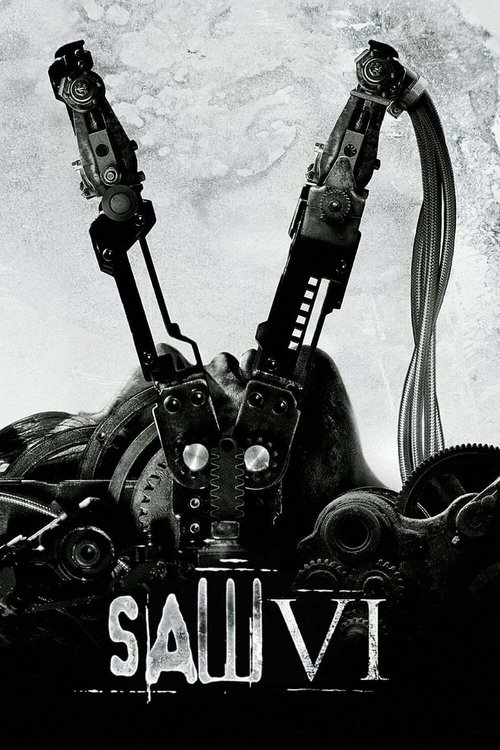
"Saw VI" represents the pinnacle of the second trilogy about the deeds of the Jigsaw Killer John Kramer (whom the Italian distribution has now wanted to identify nomenclature with the same title of the saga, hence calling him Saw), the most successful and best-architected chapter on the actions of the disciple Mark Hoffman. With the fourth chapter, there was a physiological qualitative decline in the saga, mainly due to a lack of ideas that led to a rewriting of some fundamental elements and the addition of others that were definitely uninspired. With "Saw V," they managed to provide a "why" to what was confusingly built in the fourth, thus creating a structurally (and visually) more television-like and flat chapter than the previous ones. With number 6, they return to the right path, combining a certain inspiration in the architecture of the traps/tortures with a notable rhythm and — surprisingly — a content quality that we would not have expected.
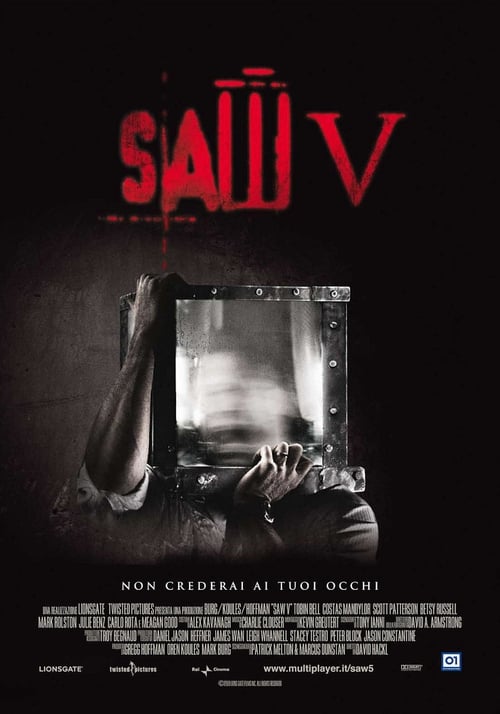
The writer is always convinced that ending at the third film would have been the narratively most accurate choice, but since serialization has paid off and Lionsgate has decided to "go ahead," incredibly, they have managed to remain at medium-good levels even with the further sequels, thus building a second trilogy that has always maintained a solid connection with all the chapters of the saga, making it so that the six films can be seen as one great work.
Marcus Dunstan and Patrick Melton, the screenwriters of chapters 4, 5, and 6, decided to model the first trilogy written by Leigh Whannel and build their second trilogy on the previous model. Therefore, we had a fourth chapter that represented a new beginning, with a new Jigsaw Killer and the structuring of one of the two final twists similar to that of the first film; "Saw V" seemed to follow very closely the model of "Saw II," with the group of people trapped and constantly tested both to save their skin and to find a form of collaboration. Therefore, it seems obvious that chapter 6 will in some way mimic "Saw III," and so it was, since we follow the story of a man, the sleazy insurance agent William Easton, faced with important choices where the lives of some people are entrusted to his decisions.
This time, however, the structure of the 'one man show' is alternated with Hoffman's attempts to cover up the evidence against him and the revelations — often in the form of the inevitable flashbacks — that manage to make those elements scattered during the other films fit together.
"Saw VI" is therefore a complex and complete film, but at the same time fun and rich in rhythm. The variety of traps and tortures that populate it — without ever stealing the scene from the narrative plot, fortunately — is among the most inventive and cruel seen in the entire saga. It starts with an amputation race that, in a crescendo of splatter, even cites "The Merchant of Venice" by Shakespeare and continues with rib-crushing machines, hangings, acid, steam, and an incredible yet cruel human music box.
Unlike the previous chapters, "Saw VI" also decides to launch, in a not too veiled way, a criticism of the American healthcare system strongly linked to the world of insurance, a form of speculation on human life itself that in this case sees John Kramer personally involved. The great plan of the Jigsaw Killer thus takes on increasingly complex aspects, reaching even the great institutional flaws of pre-Obama America. The merit of the film is not to throw in "high" content just to give itself a tone that dusts off the obvious commercial halo of the franchise, but to incorporate such content and make it its own, a fundamental fulcrum of the very narration without ever betraying the splatter serializing vocation of the work.
Here and there, some inconsistencies emerge that inevitably, in the sixth film, surface disguised as "revelations," and the consistent number of people "in play" makes us wonder where Hoffman finds the time and strength to kidnap-transport-chain all those people without anyone noticing. A request for suspension of disbelief that here becomes a bit too pretentious.
"Saw VI" still works. Despite the direction of Kevin Greutert (editor of the previous chapters and already in charge of directing the seventh film) being standardized as usual and the actors — with the exception of the always present and professional Tobin Bell — swimming in the most absolute anonymity, the film in question is the best of the "second trilogy," entertains, and convinces.
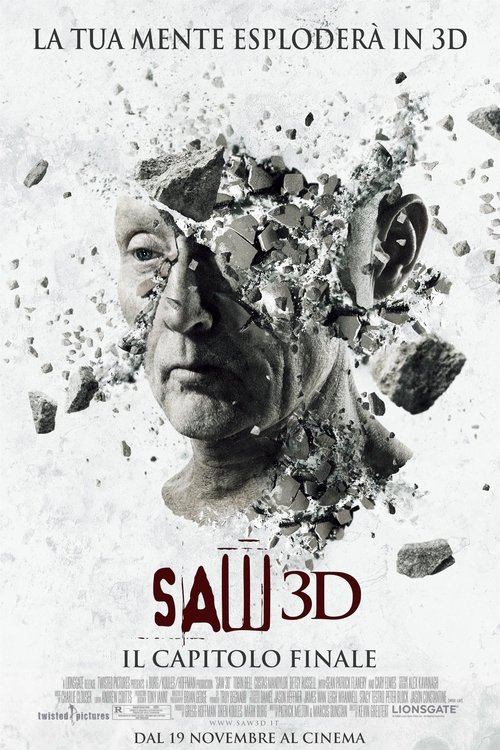
Fans will enjoy it, and everyone else should resign themselves to the fact that in a few months the seventh — and perhaps final — chapter will arrive, moreover in 3D!
Comments
Comments (0)










Comments